
Plinko Explained: Peg Math, Payout Tables & the Animation Lie
The Plinko ball path is fixed by the seed hash before you click. The animation is a replay. Learn the payout math and why near-misses are engineered to fool you.
Plinko: One Ball, Some Pegs, and a Binomial Distribution Wearing a Costume
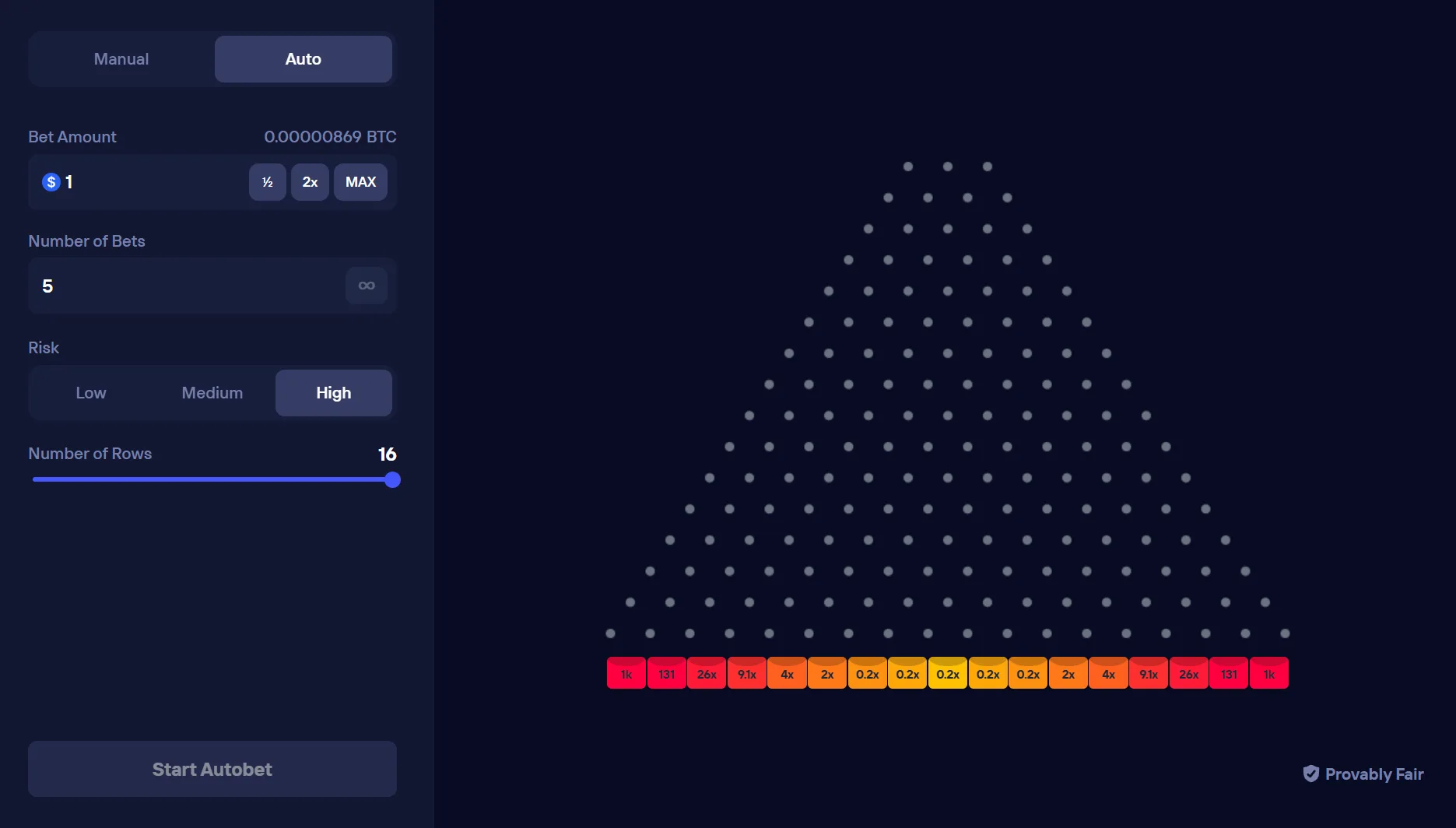
Plinko is a payout table with a physics animation bolted on. A ball drops from the top of a triangular peg board, deflects left or right at each peg row, and settles into one of the multiplier slots at the bottom. That slot sets your payout. Centre slots pay low—often under 1x, which means a net loss. Edge slots pay high, up to 1,000x on certain configurations. That is the whole game.
The deception is that the path looks physical and random. It is neither. On every provably fair Plinko game, the ball’s path is fixed by the hash of the server seed, client seed, and nonce. Each bounce direction—left or right—is pulled from the hash sequence before you click anything. The animation is a wrapper around a number that already exists. You are watching a replay.
How Plinko Actually Works
The Peg Board
The board is a triangle of pegs in rows. The ball starts at one point at the top and meets one peg per row, going left or right at each. After the last row it drops into a bottom slot. Slot count is always row count plus one: a 16-row board has 17 landing slots.
Row Count
Most Plinko games offer a row-count choice, typically 8, 12, or 16. Row count directly reshapes the payout distribution:
- 8 rows (9 slots): Fewer bounces means less separation between outcomes. The ball clusters tightly toward the centre. Edge payouts are smaller because reaching the outside is unlikely. Lower volatility.
- 12 rows (13 slots): A middle ground. The distribution spreads wider, edge multipliers climb, and centre payouts shrink to compensate. Moderate volatility.
- 16 rows (17 slots): Maximum spread. Many possible paths produce a wide outcome range. Centre slots often pay below 0.5x—more than half your bet gone—while edge slots can reach hundreds or 1,000x. High volatility.
Adding rows does not touch the house edge. It reshapes your results: fewer rows means many small wins and small losses; more rows means many small losses punctuated by occasional spikes.
Risk Levels (Low, Medium, High)
Row count is only half the dial. Most Plinko games also offer a risk setting that rewrites the payout table:
- Low risk: The multiplier range is compressed. Centre slots sit near 1x; edge slots pay perhaps 5x-15x on a 16-row board. Most drops return roughly your stake, with occasional modest wins. It feels like grinding, because it is.
- Medium risk: Centre payouts fall below 1x (typically 0.4x-0.7x) while edge payouts climb to the 30x-100x range. You bleed a little on most drops and need edge hits to recover. This is where most players land.
- High risk: Centre slots pay almost nothing—0.2x, sometimes 0x. Edge slots pay 100x-1,000x. The overwhelming majority of drops lose most of the bet; a single edge hit covers hundreds of losing drops. This is volatility maximization, nothing more.
The Math: Binomial Distribution in Disguise
Plinko outcomes follow the binomial distribution—the same math that governs coin flips. Every peg bounce is a binary event (left or right), and the final slot is just the tally of lefts versus rights across all rows.
On a 16-row board, the ball makes 16 binary decisions. Landing dead centre means 8 lefts and 8 rights—the most common outcome by a wide margin, exactly like flipping 8 heads and 8 tails in 16 flips.
Landing on the far-left edge means 16 lefts. The probability is (1/2)^16 = 1 in 65,536 drops. That is why the far-edge multiplier is so large: it almost never happens.
Centre slots are cheap because many paths lead to them. Edge slots are expensive because only one or two paths reach them. Each slot’s payout is (roughly) the inverse of its probability, minus the house edge.
Because the distribution is binomial, results form a bell curve. Most drops land in the centre third of the board, and probability falls off exponentially toward the edges. This is why high-risk Plinko feels like slow bleeding with the occasional explosion: most drops hit the low-paying centre, and the edge multipliers are statistically rare by construction.
House Edge in Plinko
The house edge lives in the payout table. If a 16-row board’s far edge has a true probability of 1 in 65,536, the mathematically fair payout would be 65,536x. The site offers perhaps 1,000x. That gap is the house’s cut. The same shortfall applies to every slot: each payout sits slightly below its fair value, and the shortfalls sum to the total house edge.
Most Plinko games run a 1% to 3% house edge overall, but the edge is not spread evenly. Edge slots typically carry a slightly higher house edge percentage than centre slots. This is deliberate: edge slots are the jackpot outcomes that draw attention, so the casino takes a bigger cut exactly where players are most excited.
Check the game’s info page for the exact RTP (Return to Player). RTP of 99% means a 1% house edge; 97% means 3%. That single number tells you more about the game than any copy on the casino’s homepage.
The Animation Deception
This deserves its own section because it is the most widespread misunderstanding about Plinko. The animation is cosmetic. On provably fair platforms, the outcome—which slot the ball lands in—is derived from the seed hash before the drop. The animation then renders a path consistent with that predetermined result.
In other words: when you watch the ball rattle through the pegs, you are watching footage, not a live event. The ball was never “almost” landing in the 100x slot. The near-miss where it slides past the edge and drops into a 0.3x centre pocket was not bad luck—it was the only possible outcome for that round.
This matters because near-miss presentations are a documented engagement tool in gambling. Watching the ball come “so close” to a big payout triggers the frustration-then-hope cycle that keeps people playing. If the result were displayed as a raw number, as in Dice, the emotional pull would be minimal. The animation exists to make you feel something about a result that was already decided.
Plinko Strategies (Spoiler: It’s Still Gambling)
Low Risk, High Volume
Set risk to Low, rows to 8, and fire drops quickly. Most balls land near the centre at 1.0x-1.2x, with occasional 2x-5x edge hits. Your balance drifts slowly in both directions. This minimizes variance and is sometimes used for VIP wager grinding, similar to Dice—though Dice is more efficient for that, since its house edge is typically lower and bet speed is faster.
High Risk, Single Drops
Set risk to High, rows to 16, and drop one ball at a time with a larger bet. Most rounds lose (centre hits often return only 20-30% of your bet). When an edge slot finally hits, the payout is enormous. This is the Plinko version of high-multiplier hunting on Crash. The expected loss per dollar wagered is identical to the low-risk approach. You are only choosing bigger swings.
Multi-Ball Spam
Some sites let you drop several balls at once or in rapid succession. Players fire 10-20 balls simultaneously hoping one finds an edge slot. Pure volume play. The house edge applies to each ball individually: 20 balls at $1 each is mathematically identical to one $1 ball dropped twenty times. The cascade looks impressive; it changes nothing about the math. What it does change is wagering speed, which benefits the house.
Pattern Betting
“Ten balls in a row landed centre, so an edge is due.” No. Each drop comes from an independent seed+nonce combination. Prior results have zero influence on the next drop. The gambler’s fallacy is unusually convincing in Plinko because the visible clustering of balls in the centre looks like a pattern that should “correct” toward the edges. It will not. The distribution resets on every drop.
The Psychology of Plinko
- Hypnotic visuals. Tracking a bouncing ball taps the same visual-following instinct you use for a tennis ball or a bird in flight. That passive engagement holds your attention longer than a static number would, which means more drops per session and more money wagered.
- The near-miss animation. Covered above, but it bears repeating: it is the dominant psychological mechanic in the game. The ball visually passing near a high-payout slot creates a feeling of being “almost” there. You were not. Proximity to a near-win is among the strongest documented drivers of continued play.
- Speed and ease. Click, watch, result. There is no mid-round decision (unlike Mines, where you choose when to cash out). The simplicity removes friction from starting another round, and fifty balls can disappear in ten minutes without a single deliberate thought.
- Risk level as perceived control. Switching between Low, Medium, and High creates the sensation of strategic choice. The house edge does not change between risk levels—only volatility does. But choosing a setting feels like controlling the outcome, a well-documented engagement pattern in gambling design.
Common Plinko Mistakes
- Playing High Risk on a small bankroll. High-risk Plinko on 16 rows returns under 0.5x on most drops. A $100 bankroll at $1 per drop can lose $50-70 before a meaningful edge hit arrives. If it does not arrive in that window, you are bust. High-risk settings demand a bankroll that can absorb dozens of losing drops, because the distribution guarantees most results will be losers.
- Chasing edge hits. “No edge slot in 200 drops, so one must be coming.” It need not come at all. Each drop is independent, and the far edge of a 16-row board lands roughly 1 in 65,000 drops. You could play 100,000 drops and never see it. Expecting a rare outcome on a schedule is the gambler’s fallacy with a Plinko skin on it.
- Multi-ball spam without tracking total wager. Ten balls at once feels like $10 in action. Thirty such volleys is $300 wagered. The feature obscures your volume because each individual bet feels small. Track your total session wager manually—the number will probably surprise you.
- Ignoring RTP differences between risk levels on some sites. A few platforms quietly adjust RTP per setting: Low risk might run 99% RTP while High risk runs 97%. If you play High risk, check whether the published RTP applies across all settings or whether you are paying a higher house edge for the privilege of bigger swings.
- Treating Plinko like a slot machine. Slots carry bonus features, free spins, and progressive mechanics that create genuine variance spikes. Plinko has none of that. It is one static payout table applied to a binomial distribution. No bonus round. No hot-streak mechanic. Every drop has the same expected value as every other. If you want slot-style dopamine spikes, Plinko is the wrong game. If you want clean, predictable math with a visual wrapper, it is the right one.
Provably Fair Verification for Plinko
Verifying Plinko follows the same process as other provably fair games, except the output is a sequence of binary values—one per row—rather than a single number. The server seed, client seed, and nonce are hashed together, and the resulting hex string is read in chunks. Each chunk sets one bounce direction (left or right), and the full sequence maps to a landing slot.
To verify: rotate your server seed, take a past round’s nonce, combine the inputs using the published formula, and confirm the computed bounce sequence produces the slot you actually got. Ball landed in slot 7 and the formula says slot 7 for those inputs? The round checks out. If they disagree, the site altered the result. Full walkthrough in our provably fair guide.
Where We Stand on Plinko
Plinko is among the most visually satisfying original games on crypto casinos and one of the easiest to model. Ball goes down, multiplier comes out. The math is clean, the house edge is reasonable, and provably fair verification is straightforward. Nothing about the game’s mechanics is hidden.
The danger is pace and presentation. Near-miss visuals manufacture a false sense of proximity to big payouts. One-click drops stretch sessions well past what you planned. Multi-ball mode can burn a bankroll quickly once you lose count of total wagered. Treat every drop as a distinct bet with real money attached. Count total wagered, not total drops. And keep in mind that the path you watched was decided before you clicked—the animation is entertainment, not information.