
Crash Gambling: How the Multiplier Works and Why Strategies Fail
Every Crash strategy loses long-term because the edge is baked into the multiplier distribution. Learn the math before your next round.
Crash: A Multiplier, a Button, and a Decision
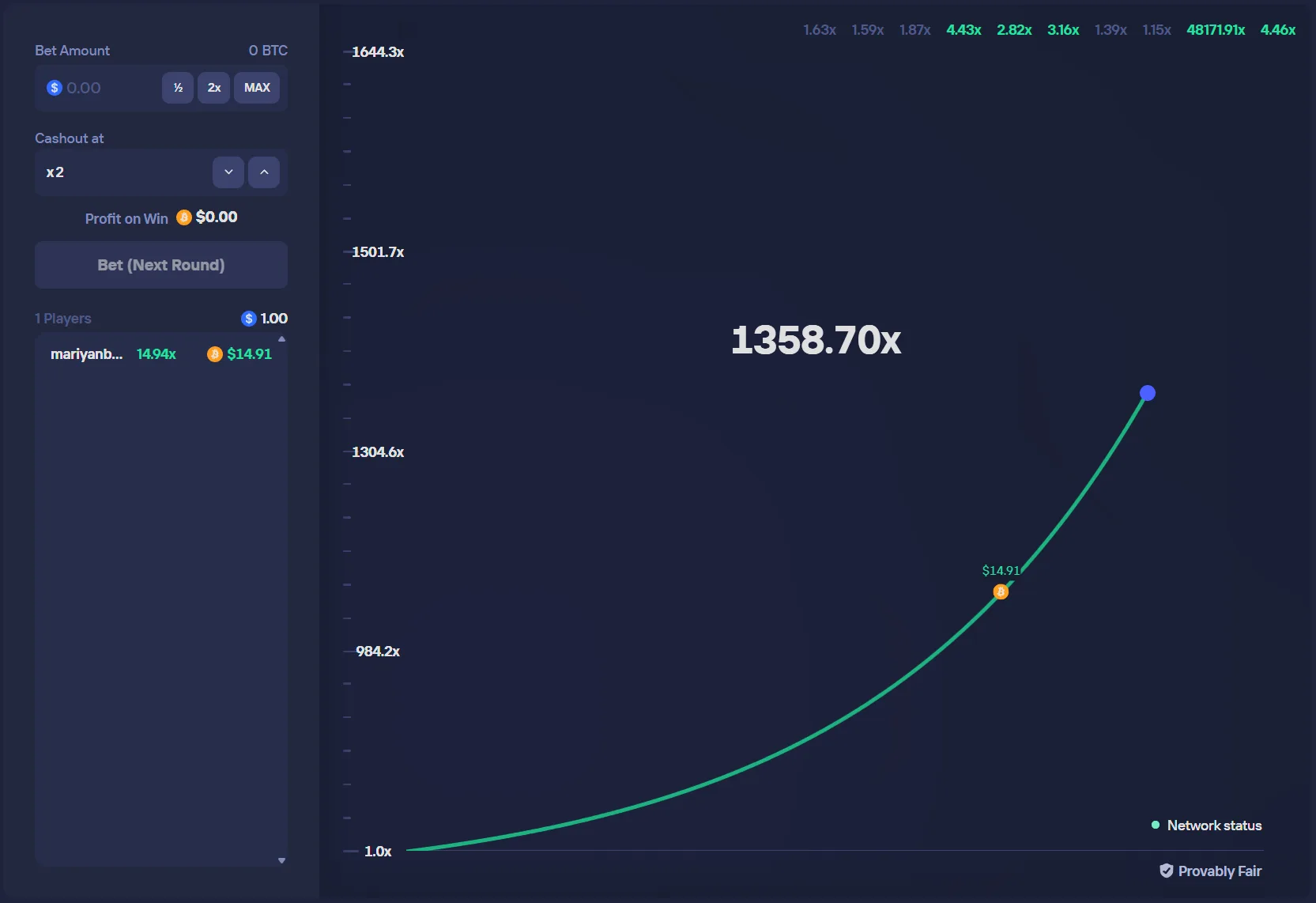
Crash is the game that made crypto casinos feel unlike anything on the Las Vegas strip. No reels, no dealer, no cards. A multiplier climbs from 1.00x upward and can collapse at any moment. You bet, you watch the number rise, you choose when to cash out. Cash out before the crash and you win your stake multiplied by the value on screen. Crash first, and the bet is gone.
That’s the whole game. Five seconds to learn; considerably longer to stop playing it at 3 a.m. Crash is the most psychologically intense game on any crypto platform because it reduces gambling to a single tension — greed versus self-control — broadcast live on a curve the entire lobby watches together.
How Crash Actually Works (The Mechanics)
A round starts. The multiplier sits at 1.00x and climbs — sometimes crawling, sometimes rocketing. At a predetermined point, the round ends and the multiplier crashes. Everyone who cashed out before that point wins. Everyone still holding loses the full bet. No partial outcomes exist here.
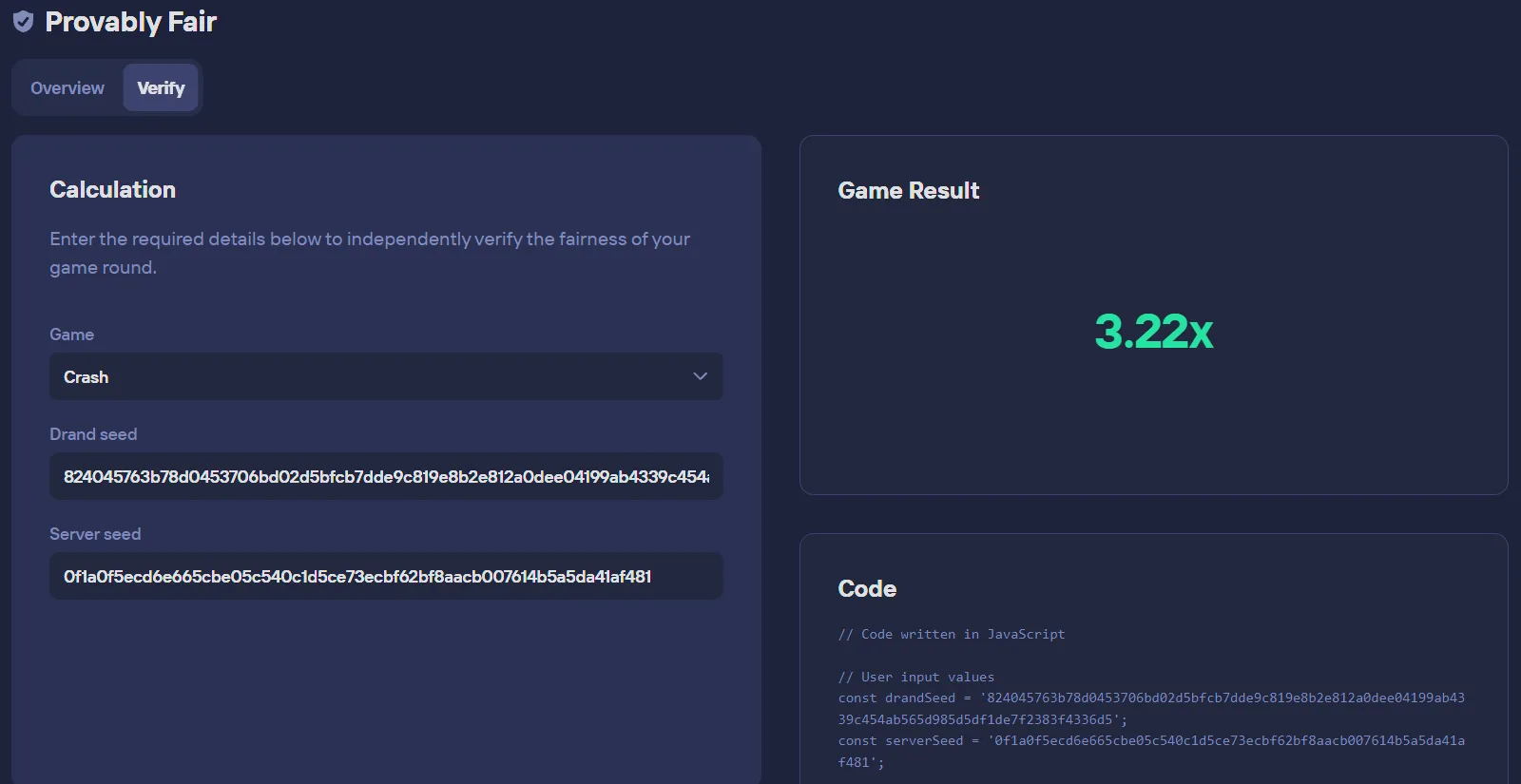
Crucially, the crash point is determined before anyone bets. On provably fair sites, the multiplier is generated from a server seed hash chain, so the casino can’t see your wager and then crash the round early. The outcome is cryptographically locked in before the round begins. Our provably fair guide covers the full verification process.
The Crash Point Distribution
Most guides skip this part. Crash points are not evenly spread — they follow a specific mathematical curve built to give the house an edge. In practice:
- Roughly 1 in every 33 rounds crashes instantly at 1.00x (you lose no matter what).
- About 50% of rounds crash below 2.00x.
- Around 33% of rounds reach 3.00x or higher.
- About 10% of rounds reach 10.00x or higher.
- Rounds hitting 100.00x+ occur roughly 1% of the time.
The exact figures shift depending on the house edge a site bakes into its formula, but the shape never changes. Low multipliers are common; high ones are rare. Over infinite rounds, the casino keeps its edge regardless of what you do.
House Edge in Crash
Most crash games run a house edge between 3% and 4%. Some sites publish the number on the game page. Others bury it in the terms of service or omit it entirely — a transparency test in itself.
What does 3% mean in dollars? For every $100 wagered over a long enough period, you lose about $3 on average. Manageable, until you remember that “long enough” includes the violent swings Crash is famous for. You might be up $500 after an hour and down $700 thirty minutes later. The 3% average only emerges across thousands of bets. Short term, anything happens.
And the edge lives inside the distribution itself. Those 1.00x instant crashes are the casino’s guaranteed profit rounds — nobody can cash out at 1.00x because the round ends before the button activates. Every bet in an instant-crash round is pure house revenue.
Crash Strategies (And Why None of Them Beat the Math)
Every crash player eventually builds a “system.” None survive long-term. But knowing why people use them — and why they fail — lets you play with open eyes instead of a fantasy.
Low Multiplier Grinding (The “Safe” Approach)
The idea: set an auto-cashout at 1.10x or 1.20x and collect frequent small wins, since most rounds clear 1.10x.
The reality: it works beautifully until it doesn’t. A 1.10x auto-cashout wins roughly 88% of rounds. But each losing round wipes the full bet, while each win adds only 10% of your stake. Run it over 1,000 rounds and you’re losing at the house edge rate regardless. The frequent wins just make the loss feel slower — which is the design. The casino wants you to feel like you’re winning.
There’s a nastier trap too: the instant 1.00x crashes. Even a 1.01x auto-cashout loses on those rounds. No target is low enough to dodge them.
High Multiplier Hunting
The idea: bet small, set an auto-cashout at 10x, 20x, or 50x, and wait for a big one to cover all the misses.
The reality: the math is symmetric. Reduced win frequency exactly offsets the larger payout. A 10x cashout hits roughly 9.5% of the time (slightly below the “fair” 10% because of the edge). Over thousands of rounds, expected loss is identical to the low-multiplier grind — it just feels more dramatic. Long losing streaks punctuated by dopamine-spiking wins. The casino’s edge hasn’t moved a cent.
Martingale (Doubling After Losses)
The idea: bet $1 at 2.00x. Lose? Bet $2. Then $4, then $8. One eventual win covers all prior losses plus $1 profit. Reset and repeat.
The reality: Martingale works until it destroys you. Seven consecutive sub-2.00x crashes means your next bet must be $128 to chase a $1 profit. Ten means $1,024. And streaks of 10+ sub-2.00x rounds happen more often than your gut suggests — remember, roughly half of all rounds crash below 2.00x. Martingale is only mathematically guaranteed with an infinite bankroll. Yours isn’t. Neither is the table maximum. One bad streak and you’ve blown your balance chasing a dollar.
Anti-Martingale (Increasing After Wins)
The idea: raise your bet after wins, lower it after losses, and ride “hot streaks.”
The reality: hot streaks don’t exist. Each round is generated independently from the hash chain. Round #4,001 has zero relationship to rounds #3,998 through #4,000. Your brain sees patterns because human brains are pattern-detection machines. The generator has no memory.
The Only Honest Strategy
Set a session budget you can afford to lose in full. Pick a cashout multiplier that suits you — no mathematically superior target exists. Play until the budget is spent or you hit a number you’re happy with. Withdraw and leave. The house edge is fixed; no strategy changes it. What you control is session length and stake size, and both should be decided before you open the game, not mid-round.
The Psychology of Crash (Why This Game Hooks People)
Crash — by design or by accident — exploits several psychological quirks that make it more addictive than almost any other casino game:
- The near-miss effect. Cashing out at 2.50x and watching the multiplier climb to 15.00x before crashing feels like a loss, even though you won. Your brain registers “I could have had 15x,” not “I gained 2.5x.” That pushes you to hold longer next round, increasing your exposure to crashes.
- Social proof in the lobby. Crash is multiplayer. You see other players’ bets and cashouts in real time. When someone hits 47x and their name lights up the chat, your brain files it as attainable. You don’t see the fifty players in that same round who rode it to zero.
- Variable ratio reinforcement. The same mechanic that makes slot machines addictive. The reward — a high multiplier — arrives at unpredictable intervals. Dopamine isn’t released when you win; it’s released while you anticipate winning, which is every second the multiplier climbs.
- The speed of rounds. A typical round lasts 5-30 seconds. You can clear 100+ rounds in an hour without trying. That speed denies you time to think. By the time your rational brain catches up, twenty more bets are placed.
None of this means don’t play. It means know exactly what the game is doing to your head while you play. Awareness doesn’t switch the effect off, but it makes chasing easier to spot — and harder to lie to yourself about.
Crash Variants You’ll See on Different Sites
The core mechanic is identical everywhere, but platforms add their own packaging:
- Classic Crash: The standard version — a curve climbs, you cash out manually or via auto-cashout. Roughly 90% of sites run this.
- Trenball / Slide: A visual reskin showing the multiplier as a ball rolling along a track or a character sliding up a slope. The math underneath is the same as classic Crash. The visuals are engagement bait.
- Manual vs. Auto-Cashout: Most sites offer both. Manual means clicking in real time; auto-cashout sets a target in advance and executes automatically. Auto removes the emotional decision — a benefit or a liability depending on your self-control.
- Crash with Bonuses: Some sites inject “bonus rounds” with boosted multipliers or guaranteed minimum crash points. These are promotional tools built to increase round volume. Bonus multipliers are marketing, not free money — the house edge over time still holds, and any wagering conditions still apply.
Provably Fair Verification for Crash
Crash was among the first casino games to implement provably fair verification, back in the early Bitcoin gambling days. Here’s how it works specifically:
The site generates a chain of hashes before any player bets. Each hash determines one round’s crash point. The chain runs backwards — hash #10,000 generates the first round played, hash #9,999 the second, and so on. Because each hash derives from the next in the chain, the casino can’t insert a rigged round without breaking the entire chain, which would be immediately detectable.
After a server seed rotation, you can verify any past round: take the revealed server seed, your client seed, and the round nonce, run them through the published formula, and check that the calculated crash point matches what you saw. Note what this does and doesn’t prove — verification confirms the outcome wasn’t manipulated, not that you’ll win. If you’ve never done it, our provably fair page walks through the full process.
Bankroll Management for Crash
Crash burns bankrolls faster than almost any game, thanks to round speed and emotional swings. If you’re going to play regularly, a few ground rules help:
- Set a session budget, not a “stop-loss.” A session budget is money you’ve mentally written off before round one. A stop-loss is a number you promise to respect and then ignore when tilted. Be honest about which one you actually use.
- Never bet more than 1-2% of your total bankroll on a single round. A $500 bankroll means $5-$10 bets. Tiny and slow-feeling, but it gives you the statistical runway to absorb inevitable losing streaks without going bust.
- Don’t increase bets after losses. You already know why. Martingale kills bankrolls. Flat betting keeps you alive.
- Cash out of the site after winning sessions. Up 30% on your session budget? Withdraw it. Balance money isn’t real money until it’s in your wallet. The simplest way to protect winnings is to remove them from the platform.
Where We Stand on Crash
Crash is the most transparent casino game on crypto platforms. Simple rules, a house edge lower than most slots, provably fair rounds, no hidden mechanics or confusing bonus features. A multiplier, a button, a decision — that’s the whole product.
It’s also one of the most psychologically dangerous games precisely because of that simplicity. The speed, the social lobby, the near-misses, the variable reinforcement — a loop that’s very easy to get stuck in. If you play, set hard limits on time and money before you start, and enforce them. The game will still be there tomorrow. Your bankroll might not be.