
Provably Fair, Verified: How Casino Crypto Checking Works
Provably fair lets you verify casino outcomes with cryptography—but it never removes the house edge. Here is exactly how server seeds, client seeds and hashing fit together.
Provably Fair: What It Verifies (and What It Leaves Open)
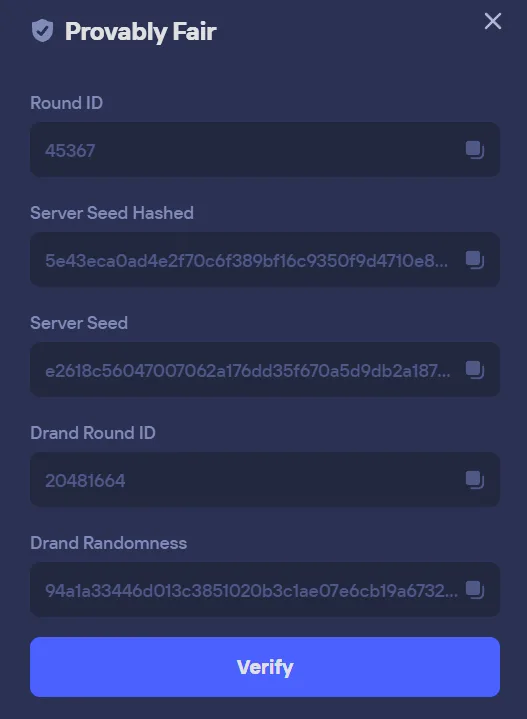
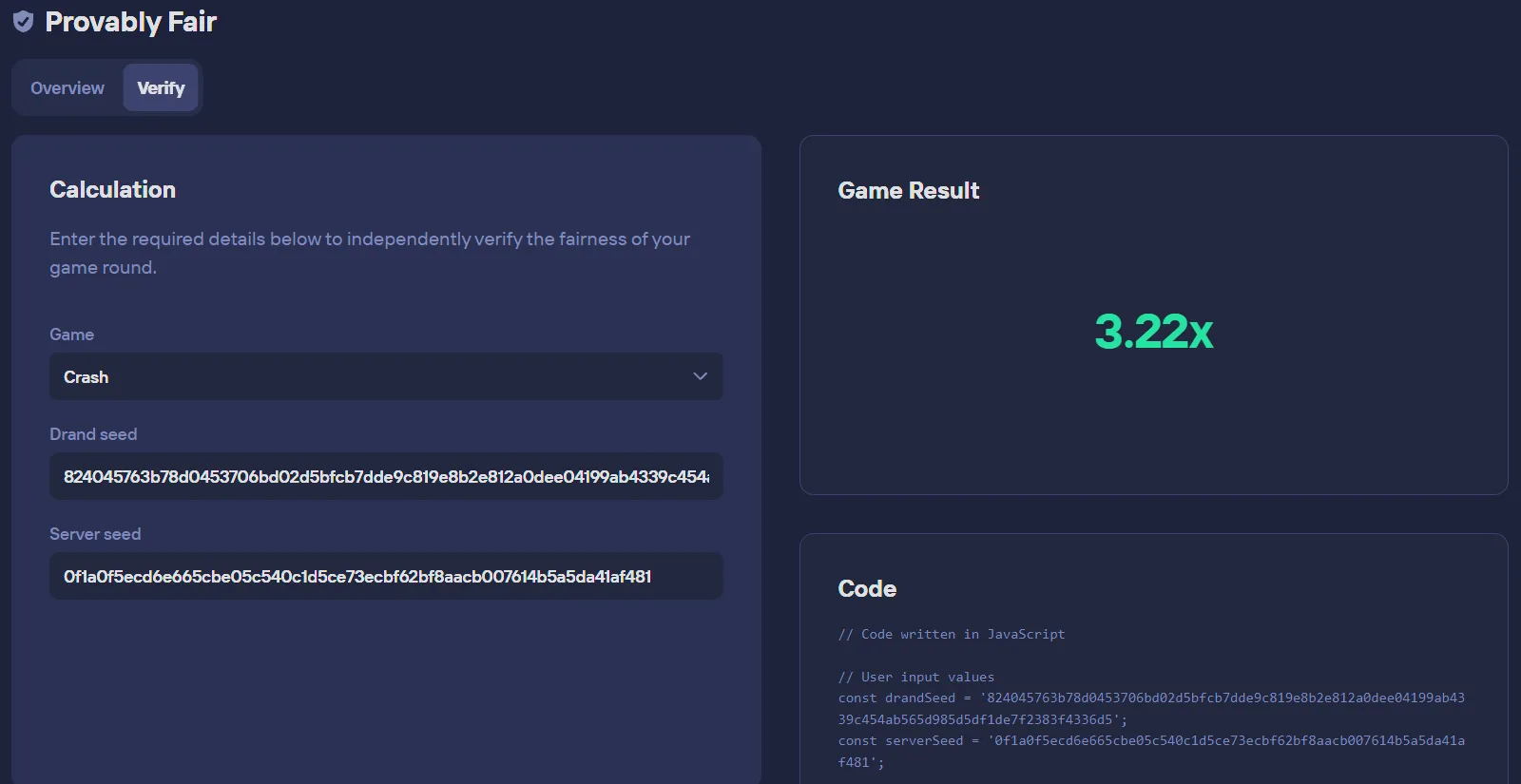
Crypto casinos treat “Provably Fair” as marketing copy. Most players read it as “not rigged” and stop asking questions. Half right. The label means something narrow and specific, and the narrowness is exactly the part the marketing tends to skip.
Provably fair is a cryptographic mechanism that lets you confirm a game’s outcome was fixed before your bet and untouched afterward. It does not make the game “fair” in the colloquial sense. The house edge remains. Over time, the math wins. What the system actually proves is that the operator did not manipulate that particular round. That is a narrower promise than most players assume, and it is the entire point of this page.
The Cryptography, Explained Without Jargon
The whole thing rests on hash functions: one-way operations that convert any input into a fixed-length string. You cannot derive the input from the output. Verification only works one way, by feeding the same input through the same function and comparing results.
The process, step by step:
Step 1: The Server Seed
Before you bet, the casino’s server generates a random string, the server seed, which partly determines the outcome. Showing it to you beforehand would let you compute winning bets in advance, so instead the server publishes the hashed version, typically SHA-256. That hash is a receipt: it proves the seed existed before the round without revealing what it is.
Step 2: The Client Seed
Your part of the equation. The casino assigns a client seed you can view and change whenever you like. Because your randomness enters the formula, the casino cannot predetermine outcomes alone. Even a fixed server seed produces different results once your client seed shifts them.
Plenty of players never touch it. That is a mistake. Changing it regularly is the cheapest test that the system actually uses your input. If you change the client seed and the outcome pattern stays identical, something is broken.
Step 3: The Nonce
The nonce is a counter that increments by 1 on every bet. It stops the same seed pair from producing the same result twice in a row. Without it, every round with identical seeds would resolve identically, which would make the entire setup pointless.
Step 4: The Outcome Calculation
The result comes from combining all three inputs: server seed + client seed + nonce, fed into an HMAC-SHA256 (or similar) function that outputs a long hexadecimal string. The game converts part of that string into the result—a crash multiplier, a dice roll, a mine position, a plinko ball’s path, whatever the game needs.
The conversion method varies per game. The principle never does: one deterministic function, three inputs, one output. Same inputs, same output, every time.
Step 5: Verification
After the round ends, or when you rotate your server seed, the casino reveals the unhashed server seed. With all three pieces in hand, you can run them through a third-party verifier (or a terminal, if that is your thing) and check whether the formula reproduces your result. Match: legitimate round. Mismatch: the casino altered the outcome.
1. Open the site’s provably fair settings. Copy your current hashed server seed.
2. Play a few rounds. Record outcomes and nonces.
3. Rotate your server seed. The site reveals the previous unhashed server seed.
4. Hash the revealed seed yourself with any SHA-256 tool. It must match the hash you copied in step 1, exactly.
5. Feed the unhashed server seed, your client seed, and the nonce into the site’s verifier or an independent tool. The calculated outcome should match what you saw in-game.
Which Games Support Provably Fair Verification?
Verification works best where the outcome reduces to a single deterministic calculation. That covers most of the “originals” on crypto casinos:
- Crash: The server seed fixes the crash multiplier before anyone bets, and its hash is visible before the round. Every player in a round faces the same multiplier; only cashout timing differs.
- Dice: One roll between 0.00 and 99.99. The easiest game to verify, because the outcome is literally one number.
- Mines: Mine positions are locked before you click a single tile. Server seed plus your inputs determine every mine’s location, and you can confirm after the game that nothing moved in response to your clicks.
- Plinko: The ball’s path is predetermined. Each bounce direction, left or right, is derived sequentially from the hash output. The animation is decoration; the landing slot was decided before the drop.
- Coinflip / Roulette: Single-outcome games. The hash decides heads or tails, or the winning colour and number.
- Case Opening: The item is calculated from the hash before you open. The spin is theater. Your knife was either in the pool or it wasn’t, locked in before you clicked “Open.”
What Provably Fair Does Not Protect You From
Most guides skip this section. The limits are real, and ignoring them means extending the casino more trust than the cryptography earns.
It Does Not Remove the House Edge
A provably fair crash game with a 4% edge drains your balance at the same rate as a traditional RNG crash game with a 4% edge. Verification proves the casino is not cheating beyond its stated edge. It does nothing about the edge itself. You are still playing negative EV.
It Does Not Cover Third-Party Games
Slots from Pragmatic Play, live dealer tables from Evolution Gaming, and every other licensed provider game on a crypto casino are not provably fair. Those run on the provider’s own RNG servers, outside the casino’s control and visibility. They are audited by third-party agencies such as eCOGRA or iTechLabs, but you cannot verify individual results the way you can with originals.
So if a site claims “all games are provably fair” while hosting 3,000 third-party slots, that claim is false. Only the in-house games use the system.
It Does Not Stop Pre-Commitment Manipulation
The entire construction depends on the casino committing to a server seed hash before your bet. If a site generates the seed after seeing the bet, or rotates seeds mid-round without telling you, provably fair is worthless. You are trusting that the hash appeared at the right moment, and timing cannot be verified cryptographically.
Serious operators mitigate this with chain hashing: each server seed is the hash of the next, forming a verifiable chain that runs backwards. A broken chain means tampering. Not every site implements it, and most players never check.
It Does Not Prove the Advertised House Edge
A casino can claim a 3% edge on crash while the real edge hides inside the outcome formula. Unless you audit the formula and gather a statistically meaningful sample, you are taking the documentation on faith. Some sites publish source code or exact formulas. Others publish the words “provably fair” and nothing else.
Provably Fair vs. Licensed RNG
A genuine debate, without a clean winner.
Provably fair gives you per-bet cryptographic verification. No regulator, auditor, or reputation required; you check the math yourself. The trade-off: most provably fair sites hold no gambling license, so if the operator freezes your account or refuses a withdrawal, there is nobody to appeal to. Sound cryptography, unregulated business practices.
Licensed RNG casinos (Curaçao, Malta, Isle of Man, etc.) use random number generators tested by independent labs. You cannot verify individual bets, but the RNG is audited statistically across millions of results. The upside is regulatory recourse, at least in theory. The downside is that some licenses, Curaçao especially, are weak and rarely enforce player complaints.
The honest answer: the better sites do both. Provably fair originals in-house, plus a license covering the third-party library. Neither system alone is airtight.
How to Judge a Site’s Provably Fair Implementation
- The hashed server seed is shown before every round or rotation. No visible hash in the interface means no real system.
- You can change your client seed at any time. A locked or hidden client seed removes your randomness from the equation, defeating the purpose.
- A built-in verifier exists AND the formula is public. Their verifier alone is circular; you need the published algorithm to verify externally. A secret formula means you are just trusting them to grade their own homework.
- Seed rotation reveals the previous unhashed server seed. Without the raw seed from your last session, nothing is verifiable. This is the most common red flag on shady operations.
- Independent tools reproduce the results. Run your seeds and nonces through an external provably fair calculator. Matching output means the system works. Mismatch means leave.
Common Misconceptions, Corrected
- “Provably fair means I can’t lose.” No. It means you cannot be cheated on individual outcomes. You will still lose over time because the house edge is mathematically baked in. The guarantee is that the casino follows its own rules.
- “If the site says provably fair, every game is verified.” Almost never true. Third-party slots, live dealer, and licensed provider games are excluded. Only the site’s own originals—crash, dice, mines and the rest—use the system.
- “The system is automatic, so I don’t need to check.” The entire design exists so you can check. A system nobody audits produces zero accountability. Its strength comes from players actually using it. Skip verification and you are trusting a logo.
- “Provably fair is experimental.” The concept dates to at least 2012 and the Bitcoin gambling scene, starting with SatoshiDice. The underlying cryptography—SHA-256, HMAC—is standard, battle-tested, and load-bearing across modern internet security. The math is not in question. The implementation is.
- “One verified bet means all bets are fair.” Every bet needs its own verification. An operator could run a clean system for 99% of bets and manipulate the remaining 1% by swapping seeds. Chain hashing makes that detectable, but only if someone audits the chain.
ProvablySmart’s Position
We verify manually: seeds rotated, hashes checked, outcomes run through independent calculators across multiple game types. Where an implementation fails verification or hides the pieces needed to verify—no published formula, no client seed control, no seed reveal on rotation—we say so in the review, and it hits the trust score directly.
Provably fair is a tool, not a guarantee. A good one, when implemented honestly. It does not replace due diligence: check withdrawal complaints, check operating history, and never deposit more than you can afford to lose. Cryptographic verification protects you from rigged outcomes. It does nothing about an operator who vanishes with the deposits overnight.