
Games pillar: Dice Strategy
Interactive Tool: Test Stake Dice Betting Systems
Model auto-betting progressions and calculate exact payout multipliers using our Stake Dice Strategy & Calculator with built-in HMAC-SHA256 roll verification.
Provably Fair Dice Strategy: The Only “Edge” You Get Is Discipline (Odds, Variance, and Bankroll Runway)
Strip away the theme skins and Dice is pure probability with a UI on top. No reels, no bonus rounds, no story elements. You set a win chance, the payout multiplier adjusts to match it, and the house edge quietly applies to every roll you make.
Simplicity cuts both ways here. Rounds come fast, the loop repeats endlessly, and sliders create an illusion of control — as if the right configuration could bend a negative-expectation game positive. It can’t. What you control is how you lose: chasing losses, oversized bets, impulsive multiplier changes mid-session, and progression systems that assume infinite money all rank among the fastest ways to empty an account.
This guide lays out what a realistic approach to Dice looks like: settle on a risk profile before the first bet, impose fixed rules that hold up under tilt, and learn enough of the math that ordinary losing streaks stop feeling like betrayals.

There’s nothing to solve in Dice. Treat it as a volatility dial: set your position once, and leave it alone once emotion enters the room.
How provably fair Dice works (in plain English)
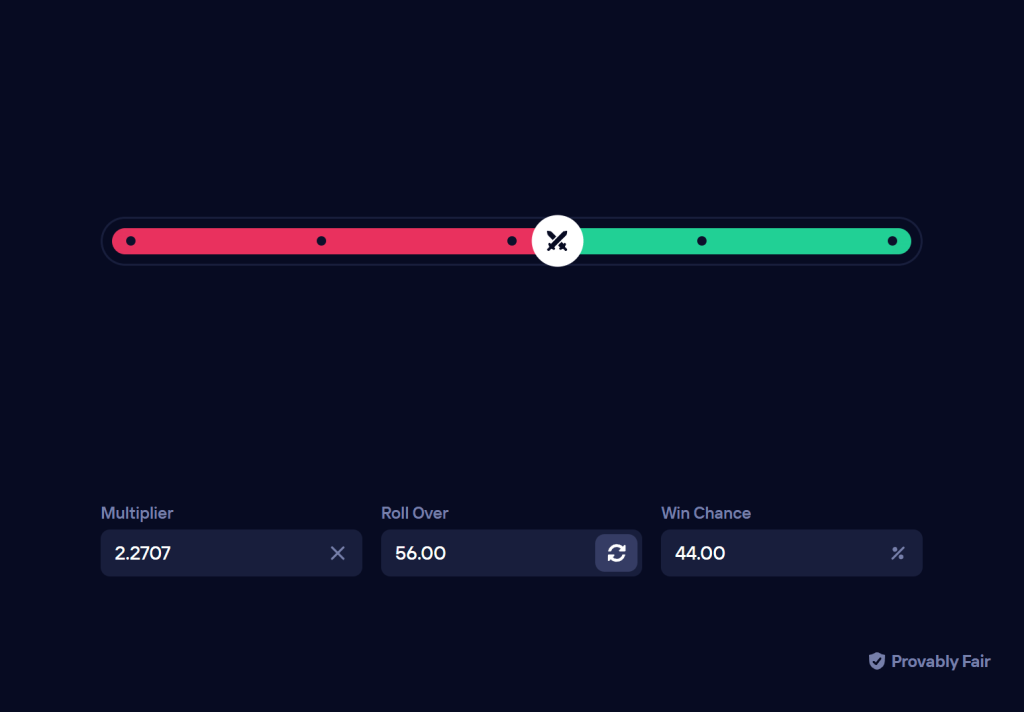
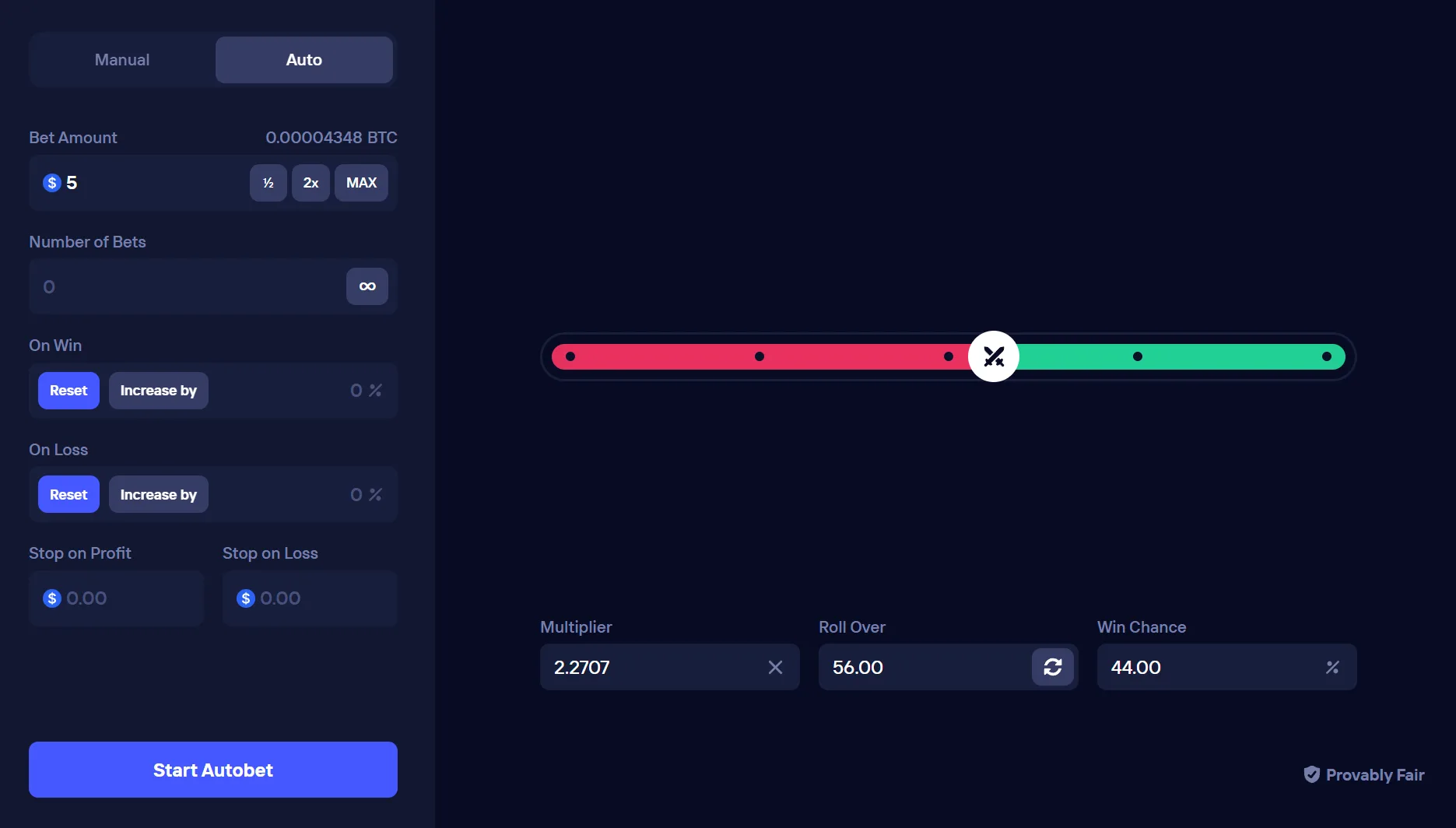
Most Dice implementations generate a number between 0.00 and 99.99. You bet on whether the roll lands over or under a target you select. The interface then shows two numbers: your win chance (the actual probability) and the payout multiplier tied to it.
Aim for a low win chance and the multiplier gets large — wins become rare but heavy. Aim high on the win chance and multipliers shrink while hits arrive constantly. That inverse relationship is the entire design space of the game.
When a casino is provably fair, each result can be reconstructed from published inputs — server seed, client seed, nonce — so you can confirm the roll wasn’t tampered with after your wager. Verification gives you trust. It does not give you profit.
Provably Fair Explained
How to Verify a Provably Fair Bet
Server Seed, Client Seed & Nonce
Dice math you actually need (two ideas, no headache)
The whole intellectual toolkit fits in two concepts:
1) Expected value stays negative (house edge doesn’t vanish)
Moving the win chance around alters volatility alone. The house edge is baked into the payout table at every setting, so negative EV remains negative EV whether you play tight or aggressive. Your slider choice decides only what shape the cost takes.
If you want the clean foundation: RTP vs House Edge.
2) Variance is the real boss in short sessions
Over small samples, results wander far from expectation — that’s normal behavior, not malfunction. High win chance smooths the ride; low win chance serves up dry spells punctuated by occasional spikes. Neither pattern means the game is “rigged.”
With those two facts accepted, the slider stops looking like a lever for profit and starts looking like what it is: a way to match volatility to your bankroll limits and to however emotionally steady you are today.
The Dice Risk Dial (choose a profile before you bet)
Bet number one rarely does much damage. Bet thirty usually hurts, because most players start conservative, take a few hits, then raise targets or multipliers trying to “get even.” That reflex is where sessions die.
Our countermeasure is simple: the Dice Risk Dial. Pick one profile now, run the entire session on it.
Low-volatility Dice (high win chance)
What it is: A high win chance produces frequent, modest payouts. Swings are gentler and session outcomes are more predictable.
What it’s good for: building staking discipline, practicing bankroll routines, steering clear of tilt spirals.
Hidden danger: constant winning feels like permission to keep going, so total volume creeps up. This profile punishes anyone who refuses to timebox.
Medium-volatility Dice (balanced)
What it is: A middling win chance, which means streaks can run hot or cold and both are expected.
What it’s good for: entertainment without chaos — provided your unit size respects the bankroll.
Hidden danger: players treat the balanced middle as a tuning exercise and start “optimizing” settings mid-session. Slow-motion chasing by another name.
High-volatility Dice (low win chance)
What it is: Rare, larger-multiplier hits. Extended losing runs are part of the spec here, not a defect.
What it’s good for: brief sessions with hard caps — you’re paying for adrenaline, and you should know the price going in.
Hidden danger: a long drought triggers panic, panic triggers progressions, progressions trigger empty accounts.
Session rule: One dial position per session, chosen before betting starts. Feeling the itch to adjust? That’s tilt at the door. Close the tab.
The only sustainable staking approach for Dice: flat staking
Because Dice moves fast and computes easily, every progression “system” eventually arrives here. Resist them. Speed plus edge plus exponential bet sizing compounds into destruction quicker than almost any other combination in gambling.
Flat staking means every round carries the same small unit — or a fixed percentage of your session bankroll. Yes, it’s dull. Dullness is the feature: no bet size ever becomes large enough to force a desperate decision.
Bankroll Runway Score: smaller units equal more rounds survived without changing behavior. Runway buys calm; calm buys better decisions.
Foundations for doing this properly:
Why Martingale (and friends) fail hardest on Dice
Martingale doubles after every loss so one eventual win recovers everything plus a small profit. Clean arithmetic — and fatally incomplete, because the formula silently requires unlimited funds and unbounded bet ceilings. Neither exists.
Dice is uniquely hostile territory for Martingale precisely because rounds resolve in seconds. An eight-loss streak — entirely ordinary at common win chances — can materialize inside a couple of minutes, and by loss six your required stake has often outgrown either your wallet or the site maximum.
The collapse always follows the same script: a streak pushes the next required bet past your affordability line or past the platform limit. Once doubling becomes impossible, the “guaranteed” recovery evaporates and everything staked stays lost.
If you want the full breakdown and the math story behind it:
Dice and “bonus wagering” (a careful, realistic note)
Casualties of promotional thinking often pick Dice to grind wagering requirements because rounds are quick and outcomes feel manageable. The unavoidable truth: wagering is volume, and volume converts directly into expected loss through the house edge.
Facing a promotion, don’t ask whether you can dodge the edge — you can’t. Ask instead: what does completing this required volume cost me in expectation, and does the bonus value still clear that bar?
Promo reality check: Bonus EV ≈ Bonus Value − (Required Wagering × House Edge)
Use these pages if promos are part of your play:
Cashback EV
Wagering Requirements Explained
Excluded Games & Contribution
Max Cashout Traps
And read terms before acting on them. Chasing loopholes you half-understand isn’t cleverness; it’s a dispute you’ve already lost in the fine print.
The “Expected Loss” lens: why Dice feels harmless until it isn’t
Dice presents as low-drama entertainment, and that presentation is expensive. Calm hands generate high volume, volume feeds the edge thousands of times, and the tiny percentage applied repeatedly turns into real money leaving real accounts.
Expected Loss ≈ Total Wagered × House Edge
Hence the insistence on timers and session caps even for careful play. Your cost is determined by turnover, not by mood.
Deep dive (worth reading once): How to Calculate Expected Loss
The Dice Session Blueprint (simple, friendly, effective)
Here’s a routine built to reduce emotional errors rather than to pretend any setup beats a negative-EV game. Run these five steps in order, every time.
Step 1: Set a session bankroll
Decide on a sum whose total loss would change nothing about tomorrow. That figure is the session bankroll, exhausted means finished, and there are no exceptions granted after three losses in a row.
Step 2: Choose a risk dial setting
Low, medium, or high volatility — one choice, locked until the session ends. The moment you start adjusting under stress, Dice works against you.
Step 3: Pick a unit size and keep it flat
For fast games like this, disciplined players commonly stake 1–2% of session bankroll per round. Going smaller costs little and buys runway. Flat means flat.
Step 4: Add stop-loss, stop-win, and a timer
A stop-loss blocks chasing. A stop-win blocks the invincibility delusion. A timer blocks cheap-feeling volume from becoming expensive volume.
Step 5: If you feel tilt, end the session
The game drains bankrolls fine on its own; tilt just accelerates it. Urgency, irritation, or the sensation of being “owed” a win are all exit signals.
Want a printable version you can reuse for every game?
Provably fair Dice: what it proves (and what it doesn’t)
Verification establishes outcome integrity — the seed-and-nonce machinery rules out one specific fear, namely that your roll was rewritten post-bet.
It certifies nothing about operator reliability, licensing quality, payout speed, or expected value. Losing streaks remain fully verifiable losing streaks. Fairness and operator conduct are separate audit tracks:
If you want a quick red flag filter for fake transparency:
Dice sanity checklist (before you click “Roll”)
- I chose a risk profile (low/medium/high volatility) and will not change it mid-session.
- I’m using flat staking with a small unit size.
- I set stop-loss and stop-win rules.
- I set a timer to limit volume.
- I understand that streaks happen and do not imply “rigging” by themselves.
- If I feel tilt or chasing thoughts, I end the session immediately.
Printable rules: Session Rules Template
FAQ
Is there a “best” win chance setting for Dice?
No universal best exists. Push win chance higher and volatility drops, though sessions tend to stretch and volume grows. Push it lower and losing runs lengthen dramatically. Match the profile to what your bankroll and temperament can absorb, then freeze it.
Can Dice be beaten with a betting system?
No system touches expected value. What progressions change is the distribution of outcomes across time — smoother stretches followed by sudden catastrophic ones. Finite bankrolls and finite table limits finish the job.
Does provably fair mean Dice is profitable?
Not at all. Provably fair confirms the outcome was generated from verifiable inputs and untouched afterward. Whether the game profits you depends on expected value and house edge — matters entirely independent of verification.
Why do I get long losing streaks even with a high win chance?
Random sequences produce streaks naturally, and fast play compresses many trials into minutes. Higher win chance softens average streak severity but cannot remove streaks from random data.
Where should I go next?
For other speed-first games, see Plinko Strategy or Crash Strategy. Prefer a slower classic? Start with Roulette Odds & House Edge.