
Games pillar: Mines Strategy
Interactive Tool: Calculate Stake Mines Multipliers & Odds
Want to see exact survival probabilities for your specific mine count and cashout goal? Use our free Stake Mines Calculator & Predictor to compute combinatorial board odds, payout matrices, and audit seed hashes.
Mines Strategy: Risk Profiles, Cashout Discipline, and Quitting Before Variance Does
Mines wears a disguise. The 5×5 grid whispers “logic puzzle,” your clicks feel like decisions, and every successful reveal feeds the sense that you’re reading the board. Then a mine detonates under your third pick and the puzzle reverts to what it always was: a probability engine in costume.
Set the target honestly: no pattern-reading method beats Mines on a consistent basis. A useful strategy instead means three things — a risk profile sized to your bankroll, cashout rules that cut the near-miss spiral short, and unit sizing that keeps variance from pushing you into chase mode.
The skill in Mines isn’t locating a safe tile. It’s deciding when your clicking stops.
How Mines works (the version most casinos use)
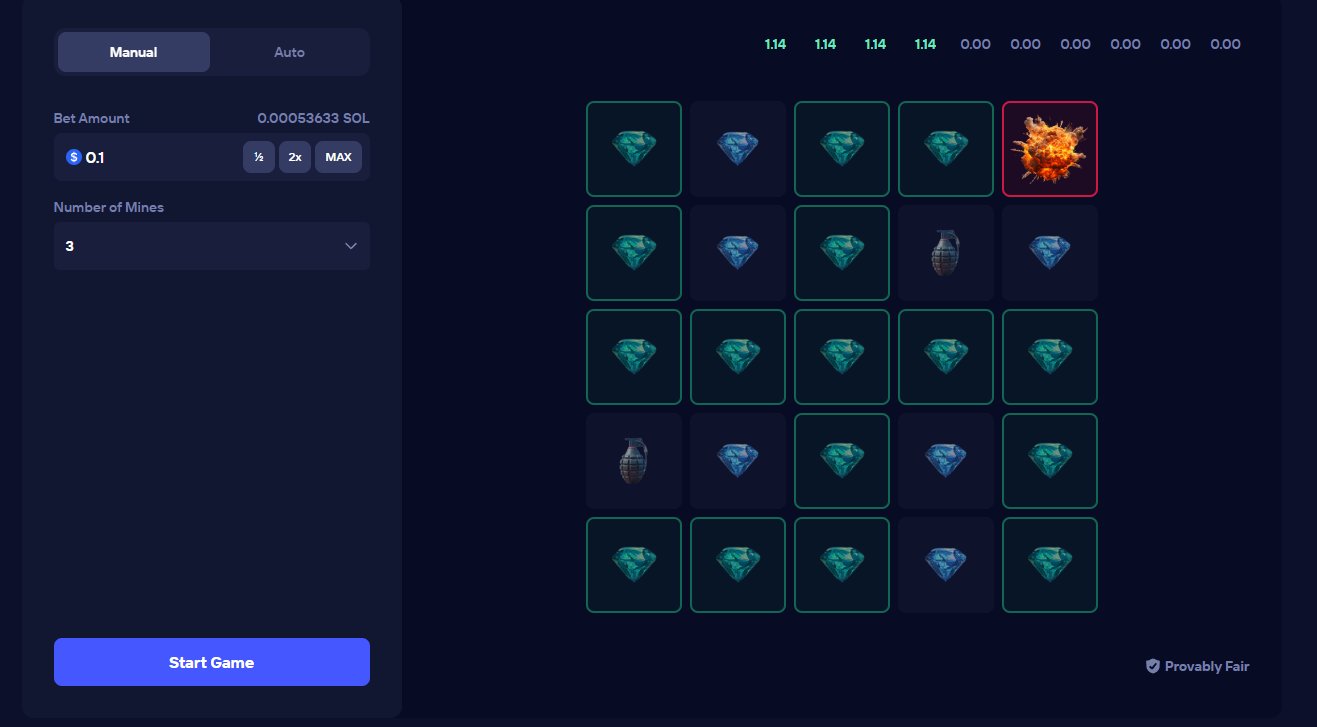

The standard layout is a 5×5 grid (25 tiles). You pick the mine count before the round — commonly anywhere from 1 to 24 — then start revealing tiles:
Every safe tile pushes your multiplier up, and you can bank the round whenever you like. Land on a mine, and that round’s stake is gone.
Venues vary the dressing: grid dimensions, payout curves, interface touches, “auto pick” options. The engine underneath doesn’t change — each click is a probability decision, and the odds shift as tiles flip.
On a provably fair casino, you can confirm the mine layout was generated honestly (that’s trust, not profit):
How to Verify a Provably Fair Bet
Server Seed, Client Seed & Nonce
The real enemy: the Illusion of Control
Few games manufacture “I’m getting sharp at this” as efficiently as Mines. Because you choose the tiles, wins register as skill and losses register as near-misses. That’s the hook, and it’s psychological, not mathematical.
In a correctly implemented game, tile positions are effectively random from your seat. Corners aren’t safer. Mines don’t “follow a pattern.” There is probability, and there is nothing else.
Illusion of Control Meter: The moment you think “I knew that corner was safe,” the meter climbs. A high meter correlates directly with clicking one tile too many instead of cashing out.
Which is why strategy pages peddling Mines “patterns” mostly teach people to lose money faster while feeling smart about it.
Mines math in one minute (simple, useful, and not scary)
Heavy formulas aren’t required. One thing matters: how the odds move as the round unfolds.
Take the 25-tile board with M mines. Safe tiles number 25 − M.
Probability your first click is safe:
(25 − M) / 25
Once k safe tiles are revealed, 25 − k tiles remain, of which 25 − M − k are safe.
Probability the next click is safe:
(25 − M − k) / (25 − k)
In plain words: each additional click tightens your survival odds. The multiplier climbs for exactly that reason — rising reward tracks rising risk. That exchange is the entire game.
Your strategy therefore reduces to three decisions:
- how many mines you’ll face (risk profile)
- how many clicks you’ll permit yourself (cashout discipline)
- how large each unit is (bankroll survival)
The Minefield Risk Dial (your strategy starts here)
Most Mines losses trace back to one habit: setting the mine count by mood instead of by math. A fixed risk dial fixes that. Here’s a classification you can realistically hold to.
Low-risk profile (1–3 mines)
The bankroll-longevity zone. Early clicks carry decent odds, multipliers build slowly, and the emotional whiplash of constant busts mostly disappears.
Best for: disciplined sessions, practice, and anyone who prefers smooth over spectacular.
Medium-risk profile (4–8 mines)
Here the heat rises. Busts arrive more often, and the urge to “win it back with one more click” grows teeth. A workable middle ground, provided your unit size is sane.
Best for: players who want some thrill and still honor stop rules.
High-risk profile (9+ mines)
Adrenaline territory. Survival odds collapse quickly, losing streaks turn ugly, and the game becomes a tilt amplifier for anyone drifting off plan.
Best for: short sessions under hard caps. Not for “grinding back to even” fantasies.
Rule that saves money: One risk profile per session. Never change it mid-session. Switching mine counts is usually tilt wearing a lab coat.
Cashout discipline: the only lever that consistently reduces damage
Once the game clicks, an uncomfortable truth surfaces: you don’t lose because you picked a bad tile. You lose because you kept clicking after you’d already won enough.
The fix is a simple device: Click Budget.
Click Budget (set it before you start)
A click budget caps how many safe tiles you’ll reveal before cashing out. “Two safe clicks, then bank it” for a low-risk grind; “three or four” for medium play.
It doesn’t make the game +EV. It makes you predictable — and predictability is what blocks emotional over-clicking.
A companion habit that transfers to every fast game:
Auto features: helpful when they lock you, harmful when they tempt you
Auto-pick, auto-cashout, “repeat bet” — Mines variants ship with several of these. The same feature protects one player and bankrupts another, depending entirely on usage.
Good use
Auto-cashout / auto-stop that enforces your click budget and closes the round without giving you a vote. That defuses the classic “one more tile” spiral.
Bad use
Auto-repeat paired with rising stakes, shifting mine counts, or no timebox. That converts Mines into a high-speed bankroll shredder, and you get a front-row seat.
If your finger has ever hovered over the board like it had its own agenda, read this pair:
Bankroll rules for Mines (because variance is fast here)
Mines runs fast, so variance arrives in bulk. The trick isn’t smarter tile picks — it’s surviving the streaks without altering your behavior mid-storm.
Stack these three rules:
1) Unit sizing
Keep the unit small relative to your session bankroll (disciplined players often run 1–2% on fast games). Small units buy runway, and runway buys calm decisions.
Base guide: Bankroll Management
2) Stop-loss & stop-win
Stop-loss shuts down “recovery mode.” Stop-win shuts down “I’m invincible” mode. Both stop volume creep — the quiet mechanism by which the house edge collects rent.
3) Timeboxing
Long sessions punish Mines players, since expected loss scales with volume. A timer isn’t a vibe tool. It’s a math tool.
For the arithmetic behind that “volume tax”:
“Can I use Martingale in Mines?” (Please don’t.)
Mines is already streaky. Martingale — doubling after every loss — takes that streakiness and adds gasoline.
The real-world sequence: a losing streak (routine), an exponentially swelling stake (dangerous), then collision with either a table limit or your bankroll limit. The system doesn’t break because the casino cheats. It breaks because reality contains finite money.
Full breakdown here:
A practical Mines session plan (friendly, formal, repeatable)
Here’s a clean routine that holds up. It isn’t thrilling. That’s the feature.
Step 1: Choose your session bankroll
Decide what you can lose today without it denting tomorrow’s mood. That number is your session bankroll.
Step 2: Lock a unit size
Pick a small unit and freeze it. Any mid-session size change is a tilt warning — end the session on the spot.
Step 3: Pick a mine count (risk profile) and keep it
Low, medium, or high. Decide before the first round. No switching on feelings.
Step 4: Set a click budget
Example: cash out after 2 safe tiles (low-risk), or 3 (medium). Write it down. Mid-session, your future self is unreliable.
Step 5: Set stop-loss, stop-win, and a timer
Those three convert Mines from a spiral machine into a controlled experience.
Want a printable template that matches this structure?
Provably fair Mines: what it changes and what it doesn’t
On a provably fair venue, you can verify the randomness wasn’t edited after your bet settled. That matters. It eliminates one specific fear: “they’re tweaking outcomes live.”
It does not remove the actual reason people lose: variance plus human behavior. You can cryptographically confirm a fair mine hit and still feel robbed. That’s the emotional tax on high-frequency risk.
For the “fair vs safe” reset (critical at crypto casinos):
Mines sanity checklist (before you click)
- I picked a mine count that matches my bankroll and mood (not my ego).
- I set a click budget and will cash out when I hit it.
- I’m using a fixed unit size (no mid-session increases).
- I have stop-loss and stop-win rules.
- I set a timer so volume doesn’t silently explode.
- If I feel “one more tile” pressure, I end the round or the session.
The printable rules template removes every ounce of guesswork:
FAQ
Is there a “best” number of mines to choose?
No universal answer. Fewer mines lower volatility and stretch your bankroll runway; more mines do the opposite. Match the count to your risk tolerance, then keep it fixed for the whole session.
Do “patterns” exist in Mines?
In a properly implemented game, the patterns you spot are manufactured by your own brain. Provably fair verification confirms the outcomes were generated consistently — it still can’t tell you where a safe tile sits.
How do I stop the “one more tile” impulse?
A click budget, enforced without exceptions. Auto features help when they close rounds for you. Timebox the session and run stop-loss rules so you’re never clicking from a desperate place.
Is Mines better than slots because it’s interactive?
Interactivity changes the feel, not the expected value. Mines can be provably fair (a genuine trust win) while remaining negative EV and violently swingy. Your bankroll rules outrank the game type.
Where should I go next?
For other fast games, see Dice Strategy or Plinko Strategy. If Mines has you clicking emotionally, go directly to Tilt Triggers.