
A hot streak is not a system. This Hands to Certainty Calculator tells you exactly how many rounds or spins it takes before your net results stop being a story about luck and start being a measurement of your true edge — the variance behind that distinction is covered in Variance and Volatility Explained.
Hands to Certainty
The illusion of short-term success
How Does This Compare to 0% House Edge Protocols?
Audited 100% RTP
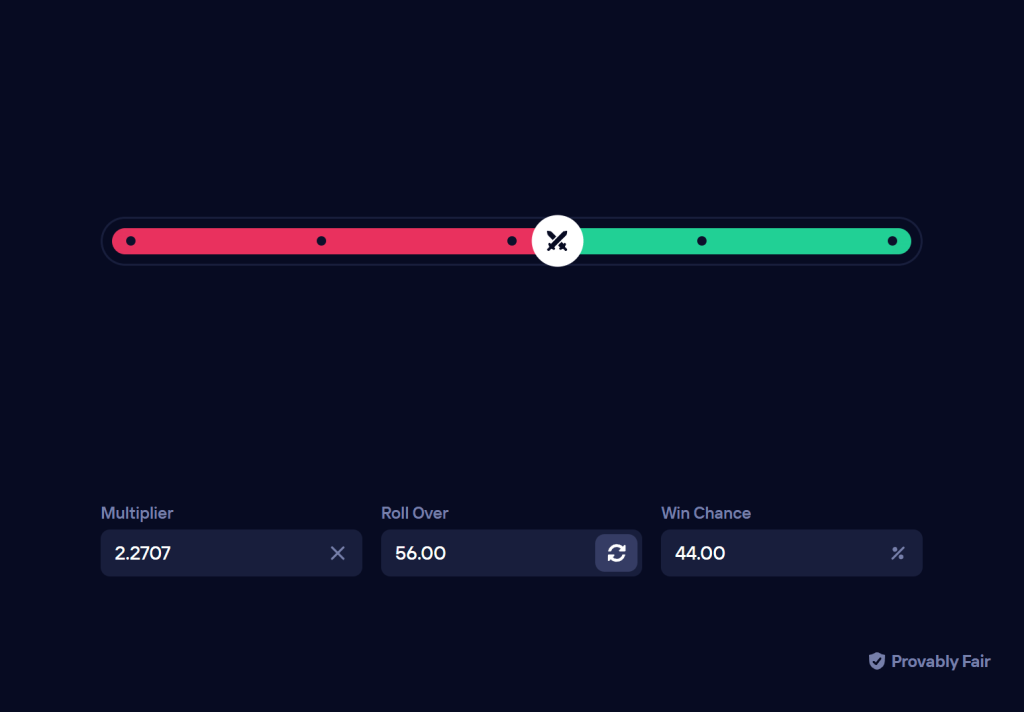
Instead of standard 1.00% to 4.00% casino house margins, compare with mathematically verified 100% RTP Originals (0.00% House Edge) on Duel Casino:
A card counter grinds through 5,000 blackjack hands and finishes ahead. Skill, or a run of favorable shoes? A player wins session after session across 1,000 spins on one slot. Faulty machine, or ordinary volatility doing what volatility does? Neither question can be answered by staring at the balance.
What answers it is sample size calculation. Pick a confidence level — usually 95% or 99% — and the tool computes the number of plays ($N$) needed before your accumulated expected value ($EV$) reliably overpowers the game’s standard deviation ($sigma$).
The math: Solving for sample size
To push the probability of a lucky outlier down to your chosen tolerance, solve for the trial count ($N$):
N = (z * σ / EV)²
Where:
- $N$: The number of hands, spins, or rounds required.
- $z$: The $z$-score tied to your confidence level (
1.96for 95% certainty,2.576for 99% certainty). - $sigma$: The standard deviation of a single round’s outcome.
- $EV$: Your expected value per round, as a fraction of your bet — 0.01 equals a 1% edge.
Practical audit: A card counter’s edge
Run the numbers for a Hi-Lo counter and the scale of the problem becomes obvious fast.
Assume a theoretical edge of 1.00% ($EV = 0.01$) against the house and blackjack’s standard deviation of roughly 1.15 ($sigma = 1.15$). At a 95% confidence target ($z = 1.96$), here is the hand count:
N = (1.96 * 1.15 / 0.01)²
N = (2.254 / 0.01)²
N = 225.4²
N = 50,805 hands
Read that twice. Even playing flawless Hi-Lo strategy, a counter needs more than 50,000 hands before there is a 95% chance the scoreboard shows profit. At 5,000 hands, finishing in the red despite perfect play remains a real possibility.
Frequently asked questions
Why does a smaller edge require so many more hands?
Sample size grows with the square of the inverse edge. Halve your edge — say from 2% down to 1% — and you don’t double the workload. You quadruple it ($2^2 = 4$).
Can I use this to audit slot machine RTP claims? (This is ideal for setting your confidence intervals)
You can. Take a slot advertising 96% RTP (a 4% house edge) with a high standard deviation around 4.0, and you’re facing a sample in the hundreds of thousands of spins before statistics can demonstrate the actual payout trails the advertised figure.
What is the difference between 95% and 99% certainty?
At 95%, one result in twenty can still be pure luck. Raising the bar to 99% cuts that residue to one in a hundred — but demands close to double the sample size, since the $z$-score climbs from 1.96 to 2.576.