
PROVABLY FAIR PROTOCOL
GAMBLING
DECODED.
Guessing is expensive. We break down the exact math casinos build their margin on: verify each round yourself, run the EV numbers on any promo, and set bankroll rules before variance makes them for you.
Verification-first
RTP & Edge Clarity
provably_smart_user
a1b2…f9e0
MATCH CONFIRMED
48.6% (example)
So… what exactly happens on this site?
ProvablySmart exists for one narrow reason: provably fair games and the people who play them without understanding them. We cover Dice, Crash, Mines, Plinko, Keno, and similar instant formats — the games where a round lasts seconds and a bad decision costs more than it should.
The site is organized around three working parts: verification, so outcomes can be checked instead of trusted; risk control, so variance can’t end your session for you; and expected value, so a promotion gets judged by its terms rather than its banner.
If you keep just one sentence from this page: your biggest edge is usually discipline, not settings. Settings move variance around. Discipline decides what happens over months.
Any term that sounds fuzzy lives in the glossary: Glossary.
Provably fair: the one thing you can actually check
Standard casino messaging asks for faith — audited RNGs, reassurances, fine print you’ll never read. Provably fair games work differently. They expose the raw inputs behind every result, usually a server seed, a client seed, and a nonce. With those three pieces, you can reproduce a completed round and compare it against the cryptographic commitment published before betting started.
Put simply: trust isn’t required when confirmation is available. In fast-paced games, where suspicion turns into tilt fast, having proof in your own hands changes how you react to losses.
Two entry points, depending on depth. Full theory first: Provably Fair Explained. Straight to practice (copy, paste, verify): How to Verify a Provably Fair Bet.
A quick mindset reset
Verification isn’t magic. Variance will still hand you losing streaks, and impatience still burns bankrolls. What checking seeds actually removes is a specific poison: the helplessness that fuels tilt. When you can confirm the math yourself, a bad streak is just a bad streak — not evidence of fraud.
Casino math without the headache
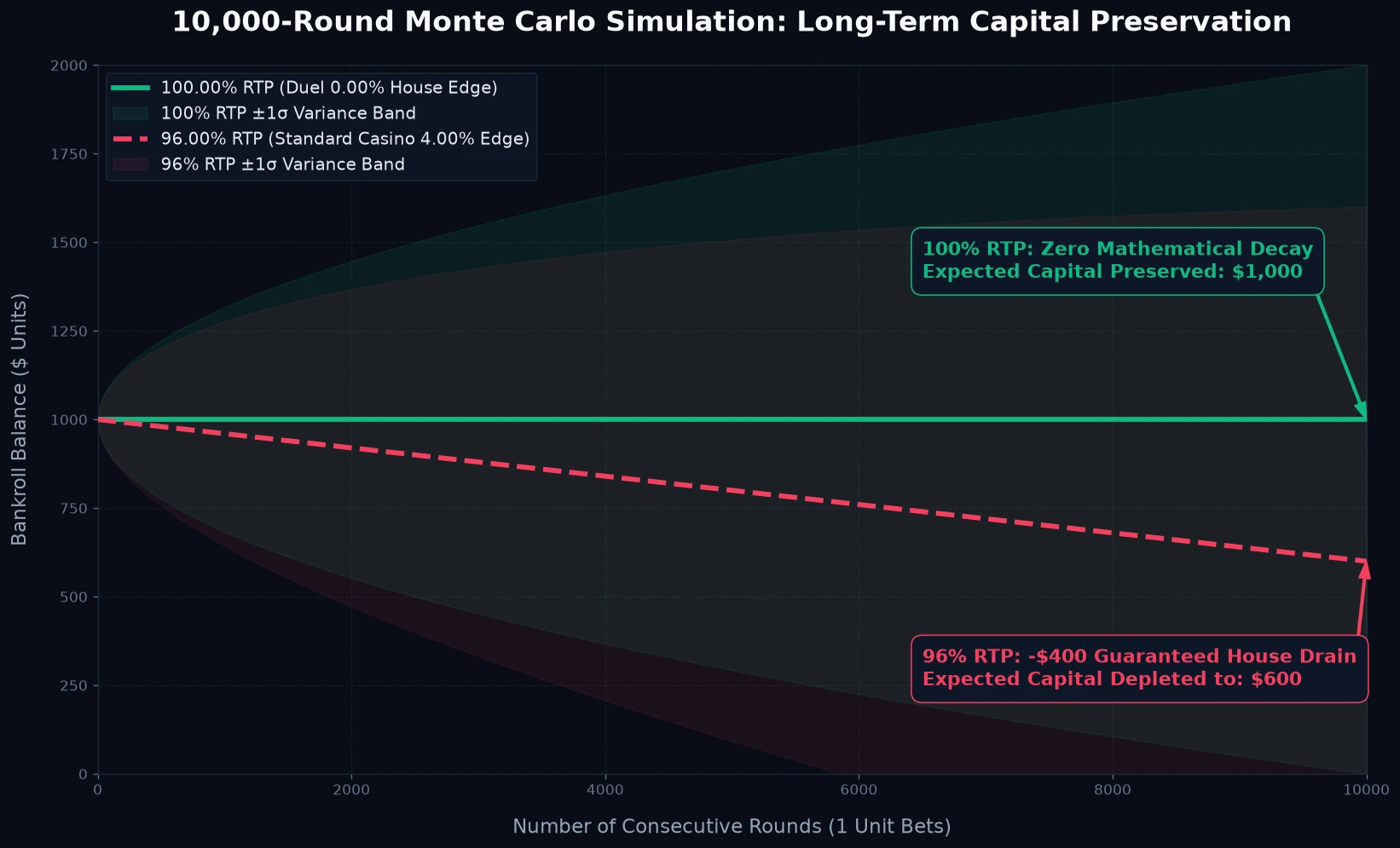
Two terms get confused constantly: RTP and variance. RTP (Return to Player) describes a long-run average across enormous sample sizes. It tells you nothing reliable about your next 200 rounds. The label only starts resembling reality after millions of bets.
Variance is what you actually feel at 2am. It’s why two players running the same game at the same RTP can walk away with opposite results. It also explains why “ten losses in a row” feels rigged but usually isn’t. Sometimes the math is just being the math.
For explanations with examples worth remembering, start with RTP vs House Edge, then continue to Variance Explained.
Need numbers while reading? Open House Edge Table or Expected Loss.
Three pillars (and why the order matters)
The whole site follows one sequence of operations. Following it won’t make you unbeatable — nothing does — but it closes the handful of avoidable holes most money leaks through.
1) Verify fairness first
Wherever a platform publishes provably fair data, use it. Check one completed bet per session or per day at minimum. Not because audits hide under every rock, but because verifying routinely trains you to treat gambling as a system rather than a mood.
Run through the checklist: Provably Fair Checklist.
2) Lock bankroll rules before emotions show up
Pick a session bankroll, fix a unit size, and write down your stop-loss and stop-win points before the first bet. These rules matter precisely at the moment logical thinking checks out — and that moment arrives on schedule. Plan for it in advance.
Begin with: Bankroll Unit Calculator and Session Rules Template.
3) Only chase promotions when EV is favorable
Bonus amounts are marketing; wagering requirements are reality. EV calculation reveals true value once rollover, max-bet caps, game exclusions, and expiry windows are priced in.
Work with: Bonus EV Template and Wagering Requirements Explained.
“How do I not lose?” starts with “What do I keep doing wrong?”
Losing rarely comes from picking the wrong title. It comes from running identical behavioral loops no matter which game is loaded. New platform, same pattern.
Chasing is the obvious culprit. Right behind it sit progression systems such as Martingale, which manufacture a comfortable stream of small wins right up until an ordinary losing streak demands a stake your bankroll — or the table limit — cannot fund.
Then the quiet one: time dilution. Every individual bet looks harmless, yet hundreds accumulate. The damage shows up later, like water finding a slow leak.
Detailed breakdowns here: Chasing Losses, Martingale: Why It Fails, and Timeboxing Sessions.
Common traps we cover (and how we neutralize them)
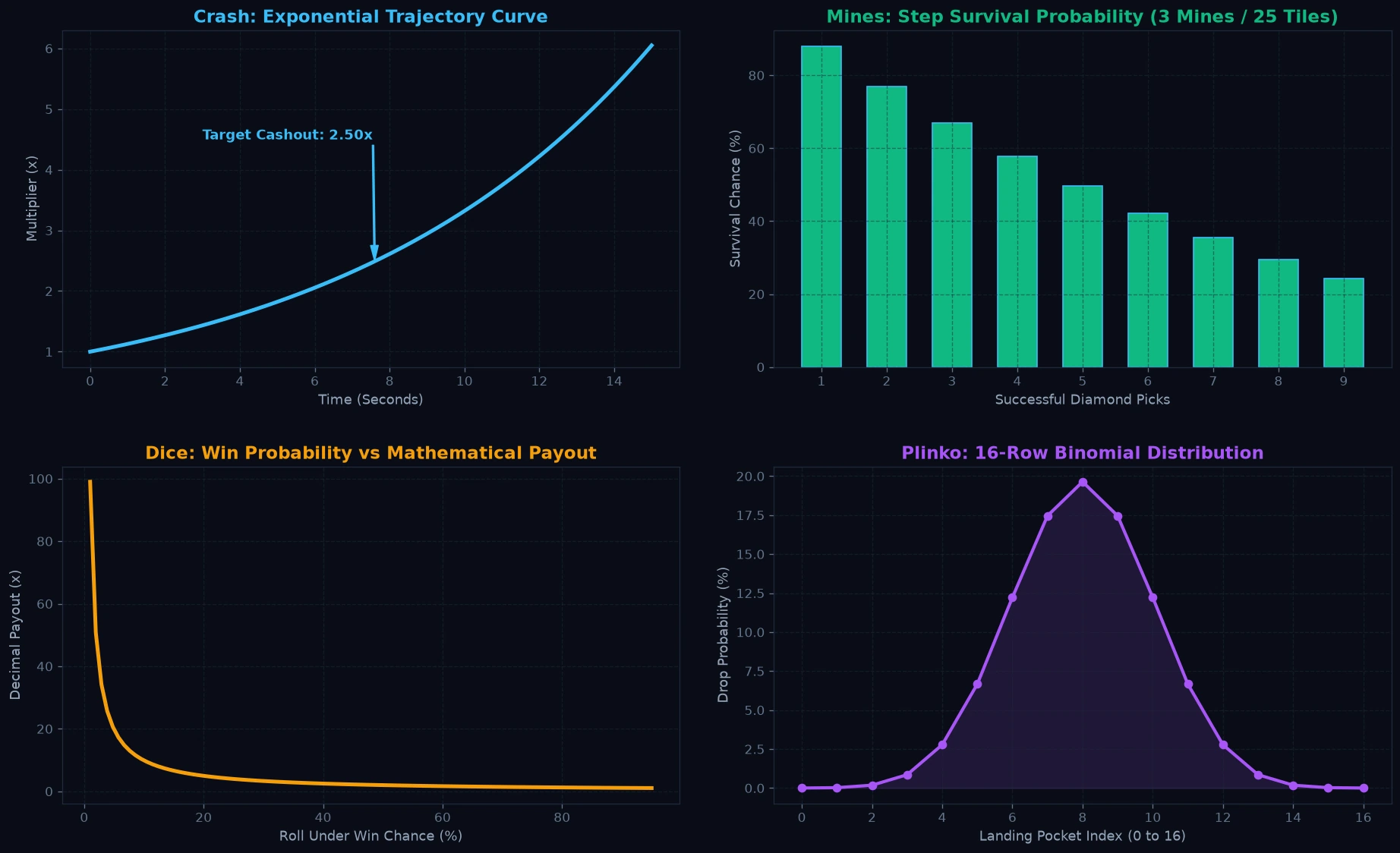
The same traps recur in Crash, Mines, Dice, and Plinko. Knowing the list means spotting them live, mid-round, before they cost anything.
- Multiplier chasing: increasing risk because the “big one is due.”
- Progressions: doubling after losses and rebranding it as strategy.
- Illusion of control: assuming click timing meaningfully shapes randomness.
- Near-miss addiction: “I was so close” mutating into “one more round.”
- Session drift: stake sizes creeping upward without a decision ever being made.
The counters are dull, effective habits:
- Flat staking: hold unit size fixed; adjust only by written plan.
- Timeboxing: timer on, session over when it rings.
- Stop rules: loss boundaries written before the first wager.
- One risk profile per session: never escalate risk mid-tilt.
- Verification habit: audit fairness inputs on a schedule.
Game guides written like real sessions, not sales pages
People don’t play these games calmly and optimally — they play fast, emotionally, often late. Every guide is structured accordingly, pairing a list of common mistakes with concrete replacements for each.
Short on time? Read these three first:
Crash
A multiplier hiding a psychology experiment. Our coverage treats auto-cashout as a variance-control tool, not a profit engine. Start here: Crash Strategy.
Mines
Mines is where illusion of control goes to thrive. Fixed risk profiles, early cashouts, short sessions — that’s the framework. Start here: Mines Strategy.
Dice
Dice is transparent and merciless. It’s also ground zero for progression-system folklore. Start here: Dice Strategy.
Additional guides (Plinko, Keno, Blackjack basics) follow the same template: fewer fantasies, more survivability.
Bonus EV: the only place “advantage” sometimes exists
In the long run nearly every game carries negative player EV — that’s the house’s revenue model funding infrastructure and ads alike. Promotions occasionally bend this curve for a limited window; cashback structures do it most often.
An EV calculation converts promotional legalese into one number, letting you decide calmly instead of hopefully.
Example: a cashback offer returns $50 after losses, but requires rolling that $50 over ten times on a game holding a 4% house edge. Rollover totals $500. Expected cost sits near $20 (4% of $500). Rough EV: $50 – $20 = +$30. That’s a favorable model, not guaranteed profit.
More worked examples here: Cashback EV Guide.
Promo EV rule of thumb
Terms buried three clicks deep, phrased confusingly, or impossible to model weren’t designed that way by accident. Promotions built for players tend to be the simplest ones to calculate.
Labs: case studies, not hype
Labs put our framework to work on live platforms. No “Top 10 Casinos Ever” filler. Instead: structured case studies measuring how easily results get verified, whether parameters are disclosed clearly, and whether terms stay readable when you’re tired and annoyed.
Standards and disclosure documents: Affiliate Disclosure and Methodology.
The current Lab hub: Duel Lab.
Duel Lab
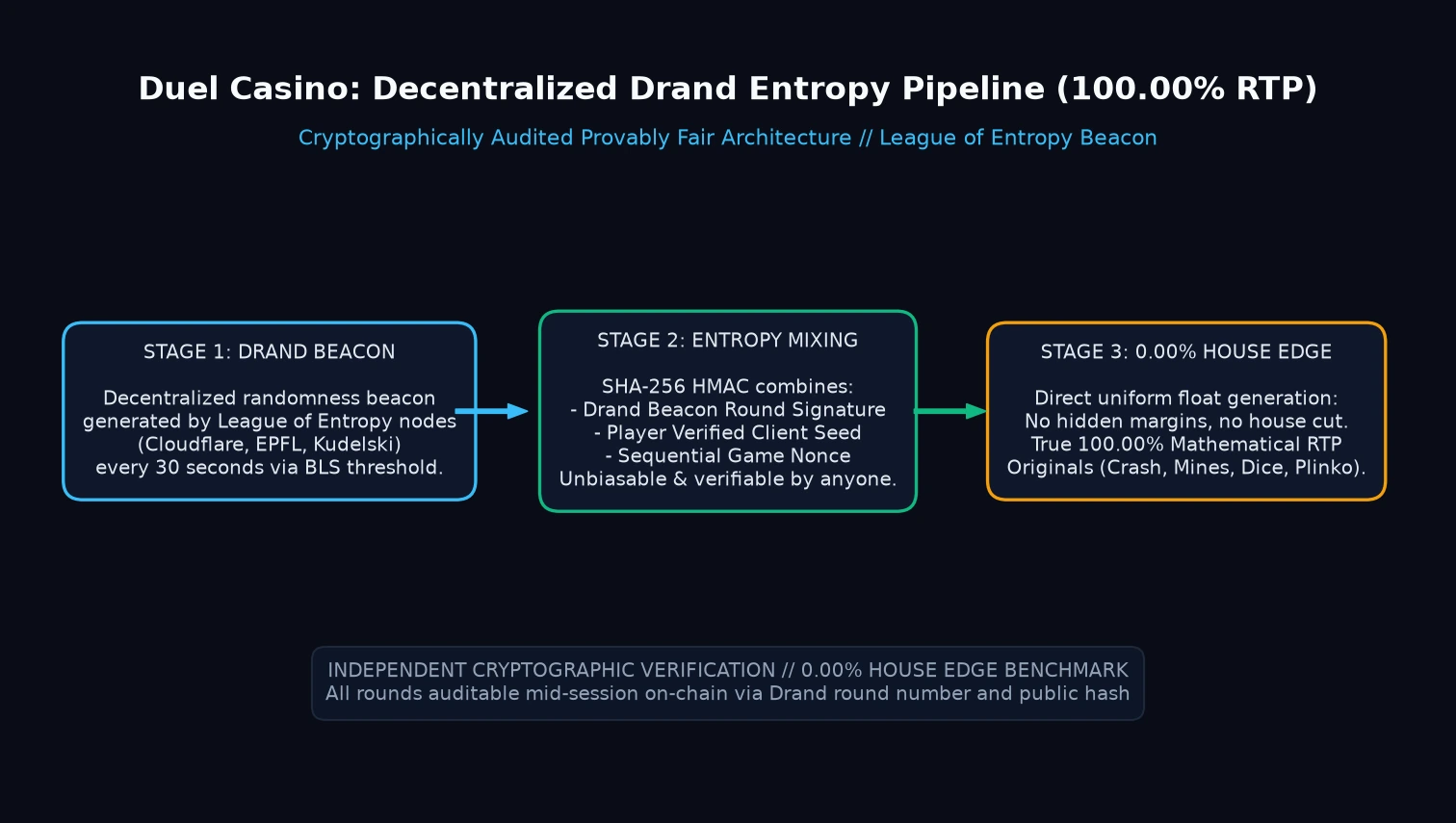
Built for practical use: what to inspect, which bets to verify, and how to protect your pre-written session rules when the interface pushes you to bet faster. Think operating manual rather than review.
Disclosure: certain Lab links may be affiliate links. Using them supports the site at no extra cost. Our methodology stays the same.
More Labs (as comparisons)
Additional platforms join as comparative case studies over time. The goal isn’t another leaderboard — it’s surfacing real differences in verification UX, term clarity, and how hard each platform makes consistent risk management.
Free tools built for use mid-session
Tools exist because theory collapses the moment fatigue sets in. Ours stay deliberately minimal. Complexity is where good habits go to die.
Provably Fair Checklist
Shows exactly which fields to copy from bet history — server seed, client seed, nonce, result — and a repeatable method for checking them.
Session Rules Template
A copy/paste sheet covering unit sizing, stop-loss, stop-win, timeboxing, and tilt triggers. As close to a dependable edge as anything gets.
Bankroll Unit Calculator
Sizes a sensible base bet against your session bankroll, then takes improvisation out of stressful moments entirely.
Bonus EV Template
Turns promo terms into a modelable number. Remember: promotions are contracts with conditions, not gifts.
Responsible play (the smartest move is sometimes “stop”)
Gambling is not an income plan. If play has become recovery of losses, distraction from a rough day, or self-medication for anxiety, step back now.
When that pull arrives, take a break and read: Responsible Gambling Resources. Your bankroll matters. Your mind matters more.
FAQ
Does provably fair mean a casino is “safe”?
No. It certifies that outcomes in provably fair games weren’t manipulated — verifiable via seeds, not by vibes. Withdrawal reliability, contract fairness, and business conduct sit outside that guarantee entirely. Verification is one layer among several.
Does 100% RTP mean I can’t lose money?
Definitely not. RTP is a long-run statistical model, and sessions live entirely inside variance territory. Overbetting or chasing drains a bankroll quickly even on high-RTP titles — which is exactly why bankroll rules come before game selection.
What’s the most realistic way to “increase odds”?
Cut repeated mistakes, hold one risk profile per session, and accept promotions only when EV stays positive after full terms. None of that guarantees wins; all of it removes the standard ways players demolish their own bankroll.
Where should I start if I’m new?
Read RTP vs House Edge, follow with Variance Explained, then learn verification hands-on with one provably fair bet: How to Verify.
Casino reviews backed by our own tracking data
Every review below is built on what we measure, not on what the casino claims: RTP builds sampled from live game clients, on-chain reserves and payout flows, and public bet feeds. Numbers first, opinions second.
- 500 Casino Review: We Tracked $14.4M in Withdrawals
- BC.Game Review: We Tracked 218 Games' RTP Builds
- Duelbits Review: 272 Games Tracked, 96.33% Avg RTP
- Gamba Review: $564M Withdrawals, 73.5% Payout Ratio
- Gamdom Review: 205 RTP Builds Tracked, 98.5% Payout Ratio
- Rainbet Review: 315 Games Tracked, 96.32% Avg RTP
- Rollbit Review: We Tracked 46,068 Withdrawals in 30 Days
- Roobet Review: $546M Withdrawals, 59K Cashouts Tracked
- Shuffle Review: We Tracked 286 Games' RTP & Payouts
- Stake Review: 329 RTP Builds & Payout Ratio Tracked
- Winna Review: $9.3M Reserves, 91% Payout Ratio Tracked