
A 1.00x instant bust is exactly when you want receipts. This verifier rebuilds any Crash round from the operator’s own seeds, so the casino’s word is optional rather than required.
Crash Verifier
Verify a Crash round in 30 seconds: the three inputs you need
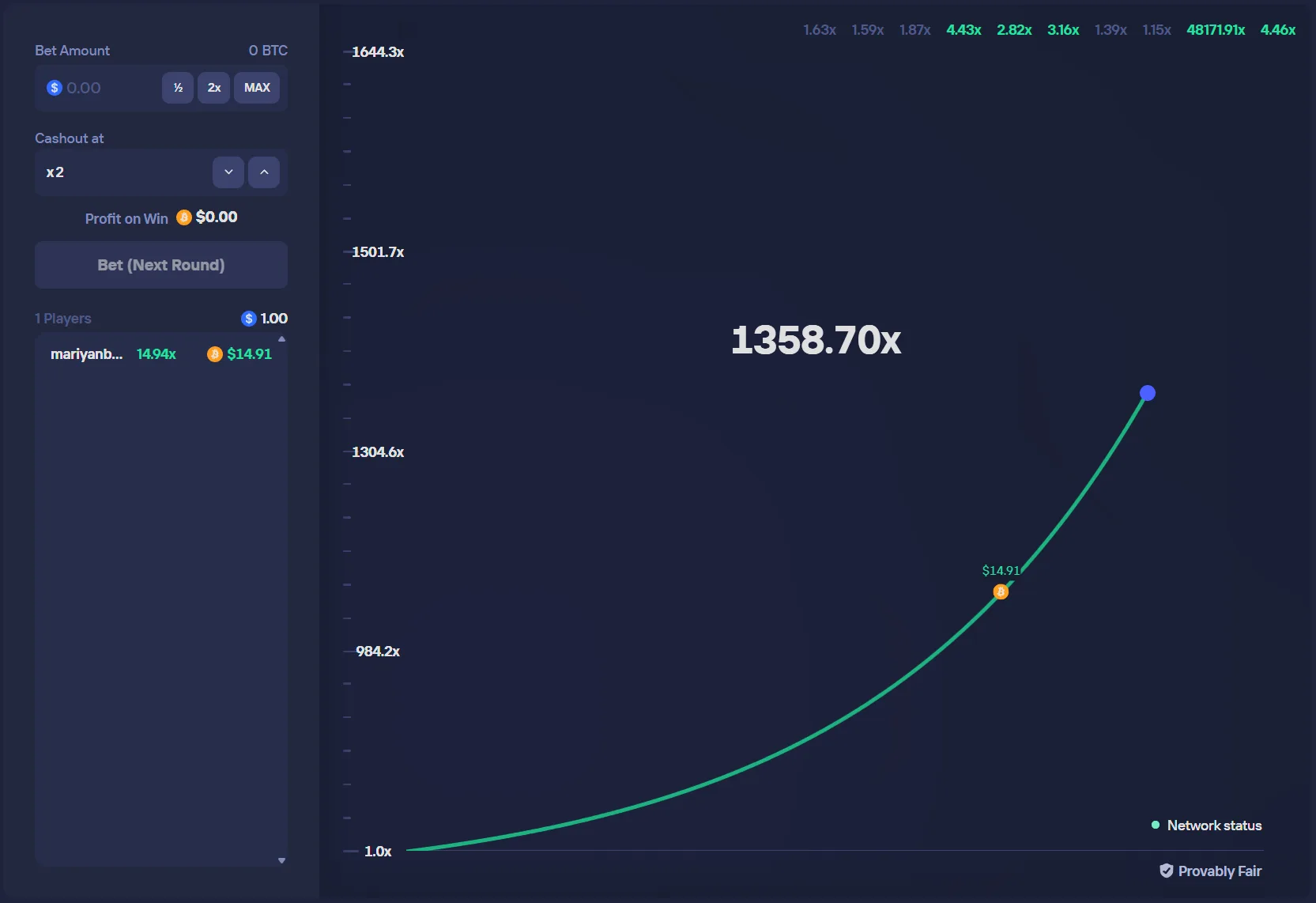
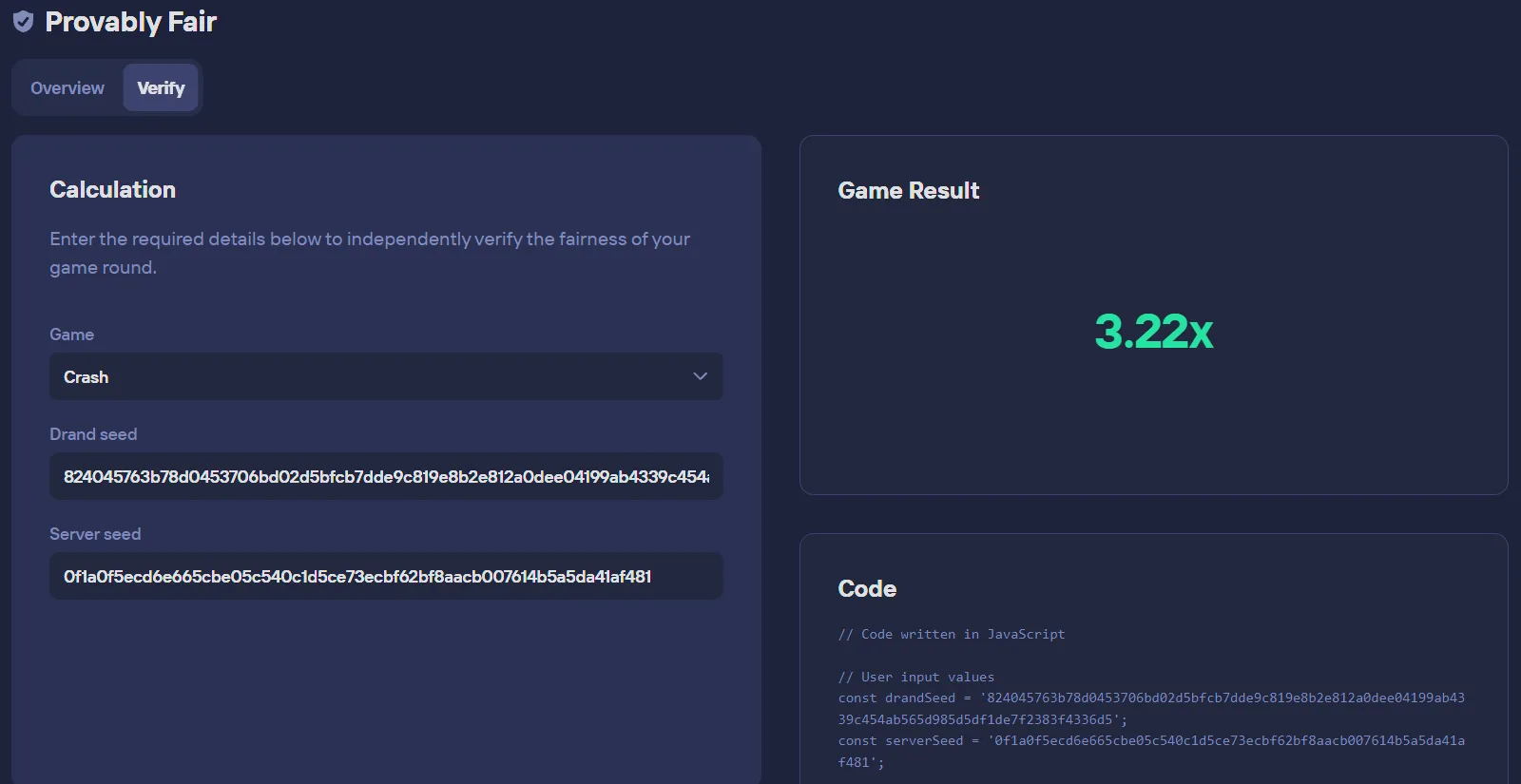
Stake, BC.Game, Roobet and most other crypto casinos label their system “Provably Fair” — a hash-based scheme where outcomes are fixed before your bet lands. Auditing one round takes three values pulled straight from your bet history panel:
- Server Seed (Revealed): While a seed pair is active, the casino only publishes the server seed’s hash. The full hex string becomes visible once you rotate to a new pair — that revealed value is what the verifier needs.
- Client Seed: A string generated by you or your browser at seed creation time. It mixes into every result as a client-side modifier.
- Nonce: A running counter of bets placed on the current pair. Depending on the site it starts at 0 or 1 and increments by exactly one per bet.
The math behind the Crash multiplier
My first assumption was that “provably fair” was branding, not cryptography. Then I ran actual revealed seeds through my own scripts and found the reproduction matched the client to the last decimal. Here is the full pipeline from raw strings to crash point:
1. Generating the hash
Your client seed and nonce are joined with a colon and fed into HMAC-SHA256 using the revealed server seed as the key:
Hash = HMAC-SHA256(Server_Seed, "Client_Seed:Nonce")
2. The instant bust check (Modulo trick)
Most crash games run a 3% house edge. Compare that with blackjack’s 0.5% and you see why session length matters so much in this genre.
That edge is enforced arithmetically: take the first 13 hex characters of the hash (52 bits), convert them to an integer h, and test divisibility by 33:
If (h mod 33 == 0) -> Game busts instantly at 1.00x
Five 1.00x busts in an hour feels rigged. It rarely is. Run each through this check — if h mod 33 == 0, that bust was mathematically baked in before the round began. If the modulo never matches what the site shows, you have grounds for a complaint.
3. Scaling the multiplier
Rounds that survive step 2 get scaled with a limit formula:
Multiplier = floor((100 * e - h) / (e - h)) / 100
Where e = 2^52, i.e. 4,503,599,627,370,496 — the largest 52-bit integer. Under this model big multipliers like 1,000x and 10,000x can occur, but their probability decays strictly per the formula; nothing is adjusted mid-session.
Audit routine: use the verifier without wasting your evening
Trust in game integrity comes before any betting system — including the progression models in our Crash game strategy guide. Pair this page with our Crash Cashout Explorer to model realistic cashout targets once fairness is settled.
- Audit randomly, not exhaustively: Verifying all 400 bets from a session is overkill. Rotate your seed pair at logout, copy 5–10 nonces from anywhere in the session, and check them here or in our Universal Verifier. Multipliers should match exactly.
- Spot-check suspicious streaks: Ten consecutive crashes under 1.2x is a legitimate reason to run the seeds. One mismatched decimal digit means the operator’s output no longer matches its published commitment.
Frequently asked questions
Can the casino change the crash point after I place my bet?
No. The server seed’s hash is published before betting starts, which locks in every outcome derived from it. Swapping the seed to force a bust would fail the reveal at rotation time — the disclosed seed wouldn’t match the pre-published hash, and the manipulation would be provable.
Why did my round verify with a different multiplier than what I saw on screen?
Check the house edge setting first. Stake’s default uses 3% (mod 33), but some newer casinos run 1% (mod 101) or 2% (mod 50). A wrong modulo setting produces a valid-looking yet incorrect multiplier.
Is there a cheat or predictor for the Crash game?
No. The crash point comes from HMAC-SHA256 applied to a server seed that stays encrypted until you rotate it, so advance prediction is cryptographically out of reach. Every “crash predictor” app on sale is extracting payment details or deposits, not odds.