
Stop playing blind. We explain the math casinos rely on. Verify outcomes, calculate EV, and protect your bankroll with practical tools.
ProvablySmart is a practical guide to provably fair and the kinds of games that show up there most often: Dice, Crash, Mines, Plinko, Keno, and other “instant” formats. These games move fast, feel personal, and they’re very good at turning small emotional decisions into big financial damage.
Our job is to slow the experience down. We focus on three things that are actually useful in the real world: verification (so you’re not blindly trusting outcomes), risk control (so variance doesn’t wipe you out), and expected value (so promotions are judged by math, not marketing).
If you only remember one line from this page, make it this: your biggest edge is usually discipline, not settings. Settings change variance. Discipline changes outcomes over time.
If a term ever feels fuzzy, use the glossary: Glossary.
Most casino games ask for trust. “The RNG is audited.” “The system is fair.” “Don’t worry.” Provably fair games are different because they can expose the inputs used to generate each result (commonly via a server seed, a client seed, and a nonce), letting you verify that a finished round matches the cryptographic commitment shown before it happened.
In plain English: you’re not being asked to believe. You’re being given a way to confirm. That’s powerful, especially in fast games where suspicion and tilt can spiral quickly.
We explain this properly and gently. If you want the full breakdown, start here: Provably Fair Explained. If you want the practical version (copy, paste, verify), go here: How to Verify a Provably Fair Bet.
Verification is not a spell. It does not protect you from variance, impatience, or “one more round.” What it does protect you from is the worst kind of uncertainty: the kind that makes you tilt because you feel powerless. When you can verify, you can breathe again.
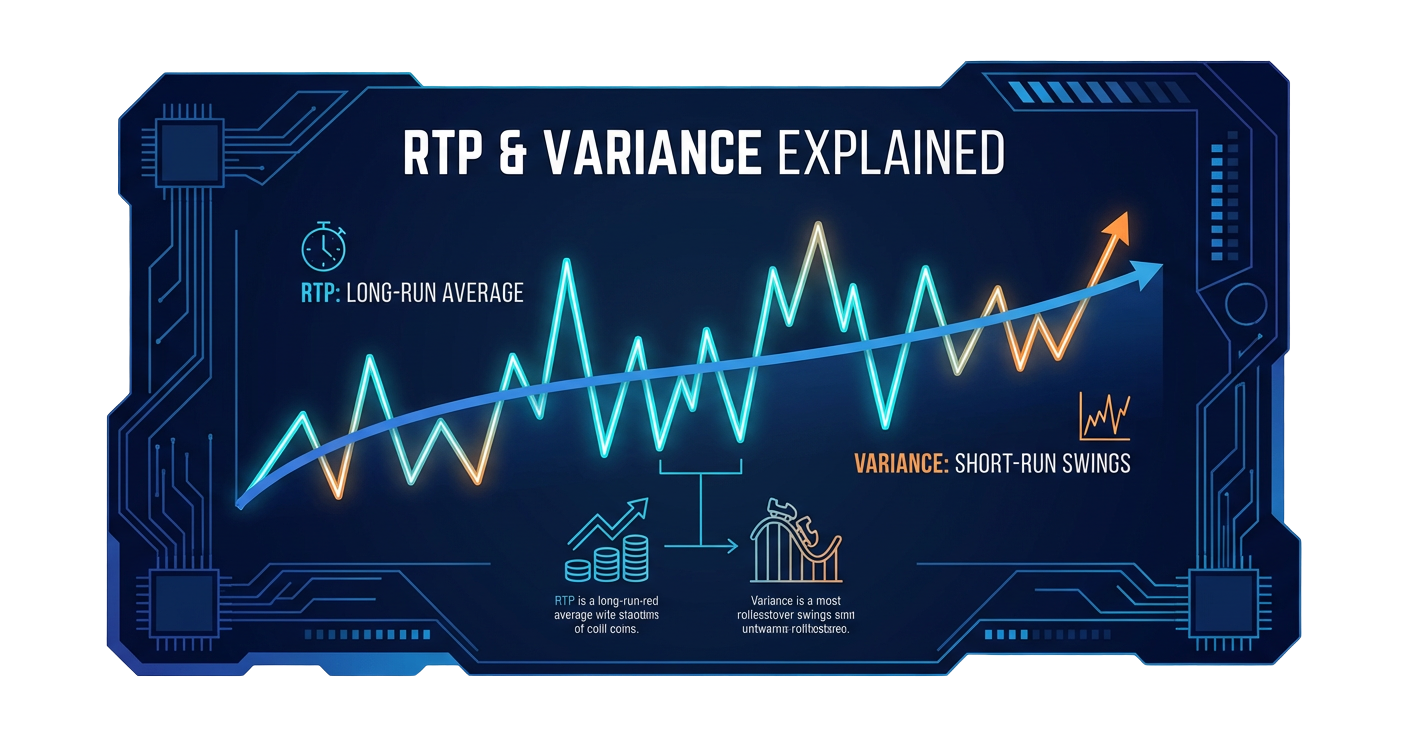
Let’s talk about the two numbers people confuse the most: RTP and variance. RTP (Return to Player) is a long-run average. It’s not a promise for your next 200 rounds. It’s a model that starts to behave like the label only after a very large sample.
Variance is the lived experience. It’s the reason two people can play the same game with the same RTP and have totally different nights. Variance is also why “I lost ten times in a row” feels like a conspiracy. It’s not always a conspiracy. Sometimes it’s just the math doing math.
If you want the basic explanation with examples you can actually remember, read RTP vs House Edge and then Variance Explained.
For quick numbers mid-reading, these tools help: House Edge Table and Expected Loss.
Everything on ProvablySmart is built around a simple order of operations. If you follow it, you won’t become invincible, but you will stop leaking money through the same avoidable holes.
If a platform offers provably fair tools, use them. Verify at least one finished round per session (or per day). Not because you’ll catch something constantly, but because it trains you to approach gambling like a system, not a mood.
Use the checklist: Provably Fair Checklist.
Set a session bankroll, choose a unit size, and define stop-loss and stop-win boundaries. These rules exist for the moment your brain stops being logical. That moment is predictable. Plan for it.
Start here: Bankroll Unit Calculator and Session Rules Template.
Bonuses look big. Terms quietly shrink them. EV is how you see the true value after wagering requirements, caps, excluded games, and time limits.
Most players don’t lose because they picked the “wrong” game. They lose because they repeat the same behavioral patterns across every game. The platform changes; the pattern stays.
Chasing is the classic one. Another is progression systems like Martingale, which feel safe because they offer frequent small wins until one normal losing streak forces an exponentially larger bet that your bankroll (or table limits) can’t sustain.
Then there’s the subtle one: time dilution. Each bet is “small,” but you place hundreds of them. The loss arrives quietly like a slow leak.
If you want the clean breakdowns: Chasing Losses, Martingale: Why It Fails, and Timeboxing Sessions.
Here are the traps you’ll see repeatedly across Crash, Mines, Dice, and Plinko. We list them so you can recognize them in the moment.
And the counter-moves (the boring stuff that saves money):
Our guides are written for the way people actually play: quickly, emotionally, sometimes late at night. That’s why every guide includes “common mistakes” and “do this instead.”
If you only want three starting guides, make them these:
Crash is basically a psychology test wrapped in a multiplier. We treat auto-cashout as a variance-control tool, not a money machine. Start here: Crash Strategy.
Mines is where illusion of control lives. We focus on fixed risk profiles, early cashouts, and short sessions. Start here: Mines Strategy.
Dice is honest and brutal. It’s also where progression systems spread like a rumor. Start here: Dice Strategy.
Other guides (Plinko, Keno, Blackjack basics) are built the same way: less fantasy, more survivability.

Most games are negative EV for players in the long run. That’s how casinos pay for servers, marketing, and profit. But promotions can change the math temporarily, especially cashback and certain structured offers.
EV calculation is how you translate terms into a real number and make a calm decision instead of a hopeful one.
Example: imagine a cashback promo gives you $50 back after losses, but you must wager that $50 ten times on a game with a 4% house edge. Required wagering is $500. Expected cost is about $20 (4% of $500). Rough EV: $50 – $20 = +$30. Not guaranteed profit, just a favorable model.
We expand these examples here: Cashback EV Guide.
If the terms are hard to find, hard to understand, or impossible to model, that’s not accidental. The most player-friendly promotions are usually the easiest to calculate.
Labs are where we apply the framework to real platforms. We don’t do “Top 10 Best Casinos” fluff. We do structured case studies: how easy it is to verify results, how transparent the parameters are, and how readable the terms feel when you’re not in a perfect mood.
For disclosure and standards, see: Affiliate Disclosure and Methodology.
Right now, the main Lab entry point is here: Duel Lab.
This Lab is designed to be practical: what to look at, what to verify, and how to keep your session rules intact when the game tries to speed you up. It’s less “review” and more “how to use a platform responsibly.”
Disclosure: some Lab links may be affiliate links. Using them supports the site at no extra cost. Our methodology stays the same.
As the site grows, we’ll add other platforms as comparisons. Not to flood you confirms lists, but to show meaningful differences: verification UX, clarity of terms, and how easy it is to keep risk consistent.
Tools are where theory becomes something you can lean on when your brain is tired. We keep them simple on purpose. Complexity is how people abandon good habits.
This checklist shows what to copy from bet history (server seed, client seed, nonce, and result) and how to verify in a repeatable way.
A copy/paste template for unit sizing, stop-loss, stop-win, timeboxing, and tilt triggers. It’s the closest thing to an “edge” that doesn’t rely on luck.
Pick a base bet that makes sense for your session bankroll, then stop improvising under stress.
Turn promo terms into a model you can reason about. Promos are contracts, not gifts.
Gambling should never be your financial plan. If you’re playing to recover losses, to numb a bad day, or to quiet anxiety, it’s time to pause.
If you ever feel that urgent pull, please step away and read: Responsible Gambling Resources. Your bankroll matters. Your mind matters more.
It means outcomes for specific provably fair games can be verified as not manipulated. It does not automatically guarantee withdrawals, terms clarity, or overall business conduct. Verification is one layer. Safety is several layers.
No. RTP is a long-run model. In real sessions, variance can swing hard. You can lose quickly if you overbet or chase. That’s why bankroll rules matter even when RTP is high.
Reduce mistakes, keep your risk profile consistent, and only take promotions when EV is favorable after terms. That won’t guarantee wins, but it reduces common ways people torch a bankroll.
Start with RTP vs House Edge, then Variance Explained. After that, learn how to verify one provably fair bet: How to Verify.