
Mines Explained: Multipliers, House Edge & Provably Fair Verification
Mines is Minesweeper with money on every click. Safe tiles raise your multiplier, mines erase the bet. Here is the payout math, the 1% house edge, and how to verify the outcome yourself.
Mines: Minesweeper With Real Money and No Second Chances
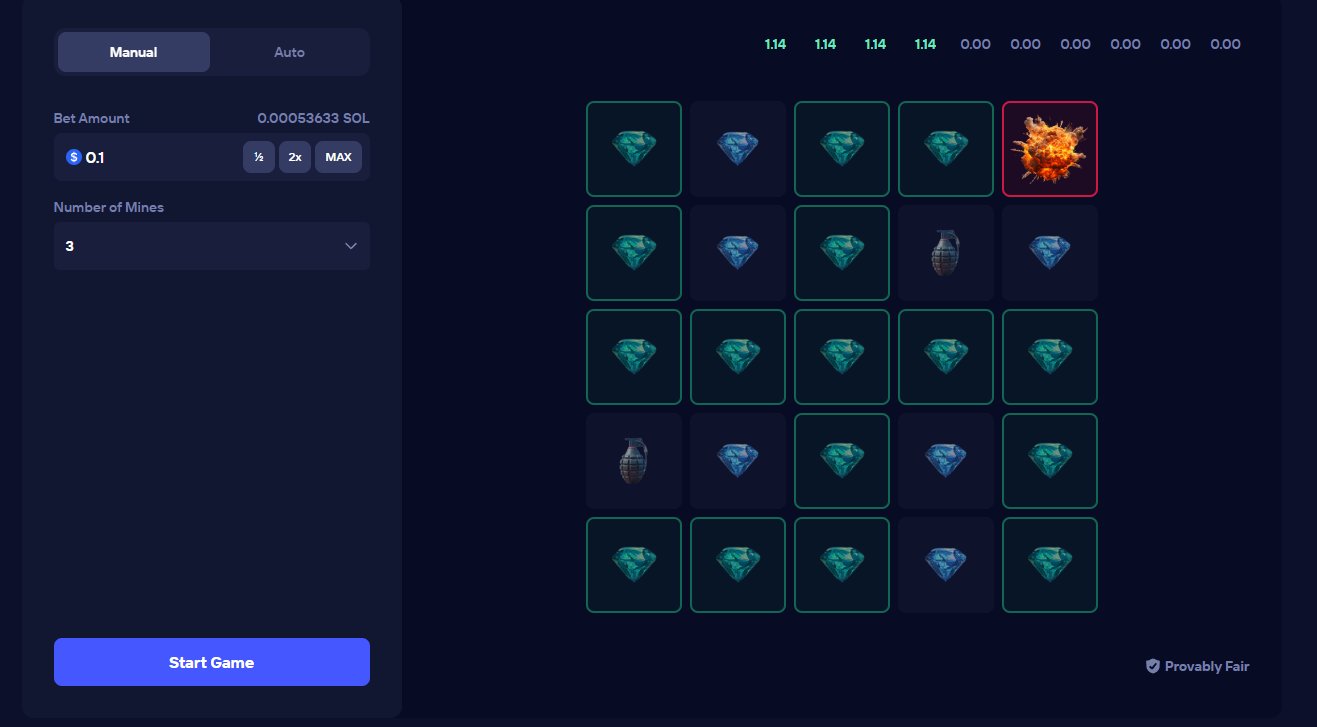

The Windows Minesweeper instinct transfers directly: a grid of hidden tiles, some safe, some lethal. Here the stakes are money. Reveal a safe tile and your payout multiplier climbs. Reveal a mine and the bet is gone on the spot. The critical difference from the desktop original: there is no deduction possible. You receive zero information about which tiles are safe before clicking. Every click is pure chance, and the only genuine decision is when to stop and cash out.
That simplicity is why Mines became a fixture on crypto gambling platforms. Each reveal raises the stakes while your odds of survival on the next click deteriorate. You sit in front of the grid weighing whether one more click justifies risking everything accumulated so far. The entire game is a repeated stop-or-go decision compressed into single clicks.
How Mines Works
The Grid
The standard layout is a 5×5 grid of 25 tiles. Before each round you choose the mine count—any value from 1 to 24. Every other tile is safe (gems, stars, diamonds—the cosmetic label varies by platform, the arithmetic never does). On provably fair sites, mine positions are committed cryptographically before your bet is accepted. The operator cannot move a mine after seeing your clicks. The layout is fixed from the moment the round begins.
Choosing Your Mine Count
This is your only pre-round input, and it determines the entire character of the game:
- 1 mine (low risk): 24 of 25 tiles are safe on the first click—a 96% survival rate. The per-tile payout is marginal, roughly 1.04x after one reveal. You need many reveals to build a multiplier worth taking, but danger grows slowly.
- 3 mines (moderate): 22 safe tiles out of 25 on click one (88%). The multiplier accelerates faster. Five or six safe tiles put you in the 2x–3x range with a real chance of a mine on the next click.
- 5 mines (standard): 20 safe tiles out of 25 (80% survival). This is where most players settle. The curve rewards without being immediately punishing. After 8–10 reveals, payouts sit in the 5x–10x range and remaining-tile mine density starts to bite.
- 10+ mines (aggressive): Half the grid or more is mined. First-click survival is 60% or lower. A single safe tile may already pay 1.5x–2x, two tiles around 4x, three tiles 10x+. Rounds are short, brutal, and resemble roulette with extra steps.
- 24 mines (degenerate): One safe tile in the whole grid. A correct click pays roughly 24x (after house edge) at a 4% hit rate. Functionally a single-number roulette bet wearing a grid costume. Anyone playing this setting is either stress-testing the provably fair verifier or has a gambling problem. Possibly both.
The Click-by-Click Multiplier Escalation
The multiplier grows because each surviving click reduces the conditional probability that the next tile is safe. After one click in a 5-mine game, the grid holds 20 safe tiles among 25. Survive, and it is 19 of 24, then 18 of 23, then 17 of 22. Each safe reveal removes one good tile from the pool, so the mine-to-remaining-tile ratio worsens with every click.
The multiplier at any point approximates the inverse of the cumulative survival probability, discounted by the house edge. Early tiles move slowly: the first three reveals in a 5-mine game might carry you from 1.0x to 1.5x. Tiles 8 through 12 can jump from 4x to 25x. The curve is exponential, not linear—which is precisely why the pull of “one more click” strengthens the deeper you go.
The Math (Combinatorics Under the Hood)
Mines payouts come from combinatorics—the mathematics of counting arrangements. For a grid of n tiles, m mines, and k safe reveals, the multiplier follows:
Your fair payout after k safe clicks = 1 / P(surviving k clicks)
P(surviving click 1) = (n – m) / n
P(surviving click 2 | survived click 1) = (n – m – 1) / (n – 1)
P(surviving all k clicks) = product of each step’s survival probability
The casino multiplies this fair payout by (1 – house edge) to get your actual payout. On a 1% edge site, your real multiplier is 99% of the mathematically fair value.
You never need to compute this manually—the interface shows your live multiplier. But the formula reveals something important: the payout is mathematically consistent with the risk at every tile depth. There is no generous sweet spot. The house edge is constant across all click depths. Cashing out at 3 tiles or at 15 tiles produces the identical expected loss per dollar wagered.
The House Edge in Mines
Most reputable platforms run Mines at a 1% house edge, matching Dice. Some push it to 2% or 3%. That gap sounds trivial until you multiply it by hundreds of rounds.
At 1% edge, $100 of total wagers costs $1 on average. At 3%, it costs $3. Over a month of regular play the difference routinely reaches hundreds of dollars. Check the game info page for the stated edge. If a site won’t disclose it, treat that as a red flag, not a detail.
One subtlety: the edge applies to your initial bet, not the accumulated multiplier. Bet $10, cash out at 5x for $50, and the house took its cut from your $10 stake. No additional edge is charged on the winnings themselves.
Provably Fair Verification for Mines
Mines is the strongest case for provably fair verification in the original-games genre, because the suspicion is so natural: every player has wondered whether the casino dropped a mine onto the tile they were about to leave at 20x. On a properly implemented provably fair site, that question has a verifiable answer—and it isn’t the operator’s word.
Here is the mechanism as it applies to Mines:
- Before the round starts, the server seed, your client seed, and the nonce are combined to generate a sequence of numbers.
- These numbers determine the exact positions of every mine on the grid. All mine positions are fixed before your first click.
- After you rotate your server seed, you can reveal the previous seed and verify that the mine positions were consistent with the formula. If you hit a mine on tile 14, you can confirm that tile 14 was a mine before the round started, not placed there reactively.
The full verification process is documented on our provably fair page. For Mines specifically, the decisive check is whether the mine layout derived from the seeds matches the layout you played through. If it matches, the round was fair. If it doesn’t, you hold cryptographic evidence of manipulation. Verification proves the outcome was honest—it does not make the game profitable. The house edge still applies to every verified round.
Mines Strategies (The Honest Assessment)
Early Cashout (Conservative)
Pick 3–5 mines, click 2–3 tiles, cash out around 1.3x–1.8x, repeat. You win often because each round carries only a few clicks of risk. Payouts are small and the house edge grinds your bankroll slowly but continuously. Structurally this is Dice with extra clicks—and it is slower than Dice, since each round demands multiple reveals instead of one button press.
The flaw: one mine on click 2 or 3 erases 100% of the bet, wiping out several sessions of marginal wins. Variance feels low until it spikes, and the spike always feels undeserved.
Deep Grid Runs (Aggressive)
Pick 3–5 mines and keep clicking toward 10x, 20x, or beyond. Most rounds lose; occasional deep runs cover a stretch of failures. Emotionally intense, mathematically unremarkable. Expected loss per dollar wagered does not change with cashout depth. You are only repositioning variance—bigger swings both ways.
The “Reveal Pattern” Myth
Some players click the same sequence every round: top-left corner, diagonal, bottom row. Others avoid edges or start at the centre. None of it matters. Mine positions come from the provably fair algorithm’s random distribution. There is no spatial pattern to exploit and no carryover between rounds—each game is an independent layout. A “lucky pattern” is superstition wearing a strategy costume.
High Mine Count, Single Click
Set 20+ mines and click exactly once. Safe tile means a large multiplier (roughly 5x with 20 mines); mine means a loss. This is a single high-variance bet, equivalent to a low-win-chance Dice roll: same math, same house edge, different visuals. Some players prefer it because it removes the recurring “one more tile?” decision—one click, done.
The Psychology of Mines (Why Every Click Gets Harder)
Mines differs psychologically from Crash and Dice through one mechanic: the cashout decision repeats within a single round. Crash offers one decision per round; Dice resolves instantly. Mines asks “continue or cash out?” again and again while the stakes compound.
- Sunk cost of revealed tiles. Six safe tiles and a 3x multiplier later, cashing out feels like quitting early. The brain frames those reveals as “progress” that a cashout would “waste.” In reality each click is independent: the multiplier on screen is claimable money now, and the next click is a fresh gamble unrelated to everything before it.
- Escalation of commitment. “Ten tiles survived—why not one more?” Because each surviving click made the next one more dangerous, not less. The grid shrinks and mine density rises, but the sensation of momentum insists otherwise.
- The visual tension. Sequential reveals—safe, safe, safe—produce physical arousal: elevated heart rate, sweating palms. This is measurable, not metaphorical; research on gambling arousal shows sequential-reveal formats generate stronger physiological responses than instant-result formats. More engagement means longer sessions, which means more money wagered.
- Catastrophic loss impact. Hitting a mine at 15x with $20 staked destroys a $300 potential cashout—a far stronger emotional hit than losing $20 on a single Dice roll. The perceived loss is anchored to the payout you were “about to collect,” though you never held it. That spike fuels revenge play: an immediate higher-bet round chasing phantom winnings.
Common Mines Mistakes
- Never cashing out. Some treat Mines like a puzzle to clear. It isn’t. The objective is extracting a payout. Chase the maximum multiplier and a mine will intercept you nearly every time. Set a target multiplier before the round and take it when reached.
- Increasing bet size after hitting a mine. Tilt in Mines is vicious because the loss sits “one tile away” from a big win. Doubling the next bet is textbook Martingale and ends the same way: a blown bankroll.
- Playing too many mines for the thrill. A 15-mine setup on a 5×5 grid gives a 40% first-click survival rate—worse than a coinflip before you touch anything. Multipliers look attractive on paper; the instant-loss frequency is punishing. Losing over 60% of rounds on the first click means you’re paying for adrenaline, not playing a game.
- Ignoring the displayed multiplier in favour of tile count. “I always click 8 tiles and cash out.” Tile count is not the meaningful number—the multiplier is. With 3 mines, 8 tiles might pay 2.5x. With 10 mines, 8 tiles is 100x+ (if you get there). Think in multipliers, not tiles.
- Assuming safe tile positions carry over between rounds. Every round generates a new layout from new seed inputs. Tile (3,2) being safe three games running predicts nothing about the fourth. Treat each grid as unseen—mathematically, it is.
Where We Stand on Mines
Mines pairs a modest, disclosed house edge with some of the strongest provably fair implementations in the genre. It is also among the most psychologically punishing originals on any platform: the repeated cashout decision and the sting of a late-run mine exploit sunk cost bias more aggressively than any comparable game.
If you play, fix your mine count and target multiplier before the round begins. When the multiplier hits the target, cash out—no mid-round renegotiation. The next tile is always more dangerous than the last, your own judgment will always argue otherwise, and the house edge is indifferent to your survival streak. Take the payout and click “New Game.”