
If a casino generated a fresh seed after every single round, you would have no way to catch a rigged result. This Hash-Chain Auditor solves that: it verifies an entire chain of pre-committed round hashes in one pass, confirming that every game outcome was fixed before play began — a foundational element of Provably Fair systems — and that nothing was swapped or edited along the way.
Hash-Chain Auditor
| Label | Computed | Published | Status |
|---|
What is a cryptographic hash chain?
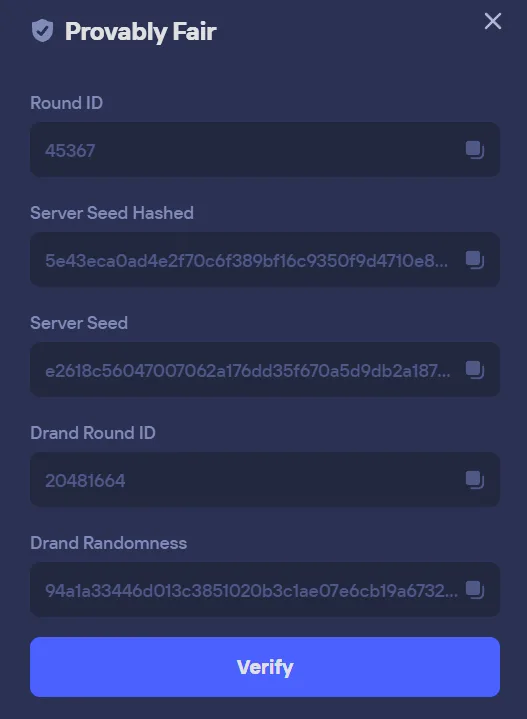
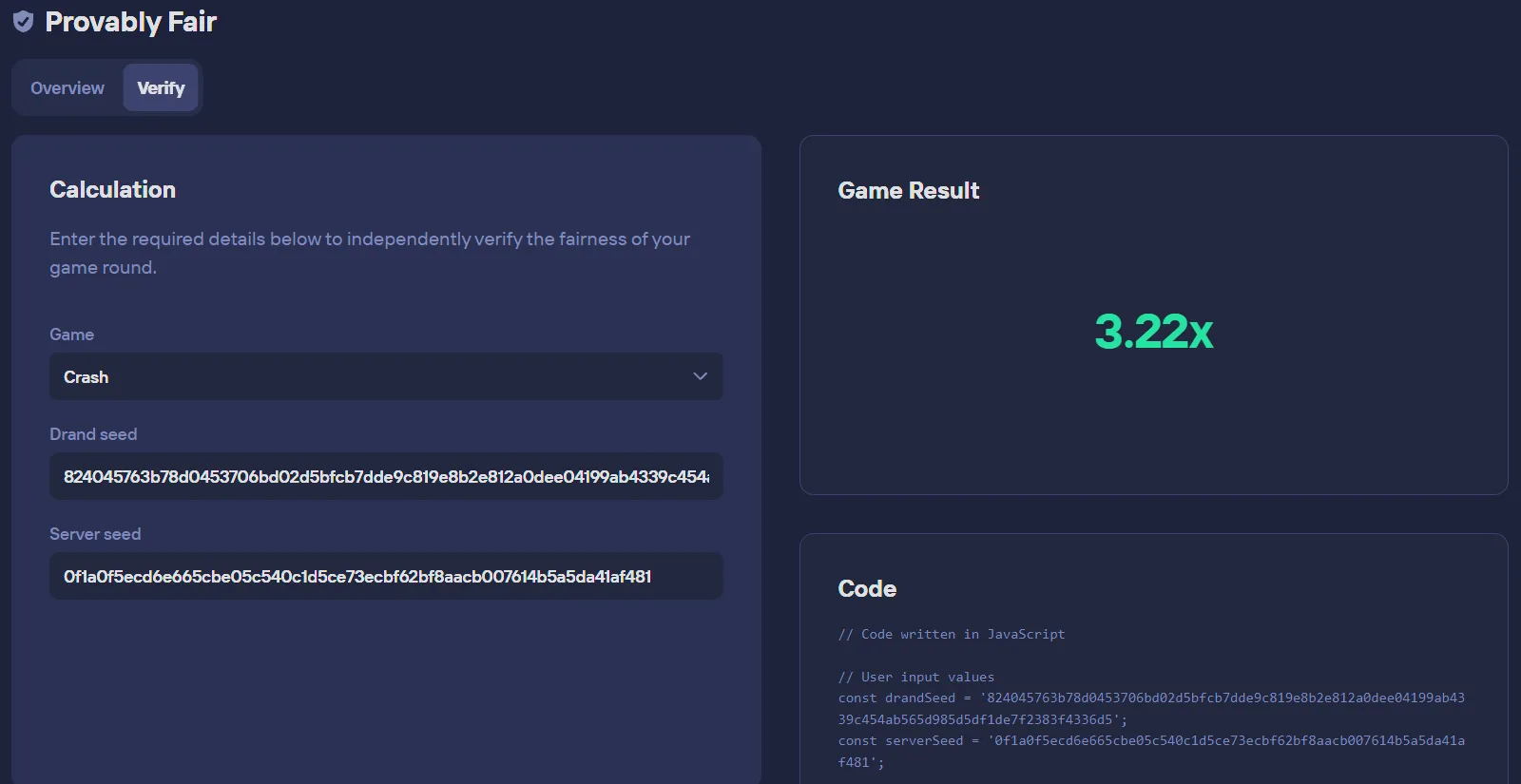
Bustabit popularized the technique in the early crypto casino era. The idea: commit to millions of results before the first bet lands. The operator takes one random seed and runs it through SHA-256 over and over — sometimes as many as 10 million iterations — instead of rolling random numbers as each round happens.
Before any betting opens, the house publishes the final link in that chain (the “genesis” hash). SHA-256 only works one way, so nobody can reverse it to peek at upcoming seeds. But once rounds unfold in reverse order — last chain position played first — anyone can check that each revealed hash is the true SHA-256 parent of the one published for the prior round.
The math: Recursive SHA-256 hashing
Generation runs forward at setup; play and auditing run backward through the chain:
1. Forward generation (Casino setup)
Starting from a secret base seed ($S_0$), the operator applies the hash function $N$ times:
S₁ = SHA-256(S₀)
S₂ = SHA-256(S₁)
...
S_N = SHA-256(S_{N-1})  (This is the Genesis Hash, made public first)
2. Reverse verification (Player audit)
Play proceeds from round $N$ down to round 1. At any point $k$, take the current round’s hash ($S_k$) and confirm that hashing it reproduces the neighboring value ($S_{k+1}$):
SHA-256(S_k) = S_{k+1}Step-by-step audit: Verifying a session log
Say you’ve finished a block of 100 crash rounds and want to check them. Most provably fair casinos export history logs as CSV files listing round numbers alongside their hashes:
- Grab the CSV from your casino’s game history page.
- Select the column holding the hex hashes.
- Paste those hashes into the auditor box above.
- Hit “Verify.” The tool hashes each row recursively and compares it against the next entry.
- A fully green result means every round resolved correctly: none skipped, none inserted, none rewritten.
Frequently asked questions
What does a “broken chain” mean?
Round $k$ fails to hash into round $k+1$’s value. That’s mathematical proof of interference: the operator either rewrote a mid-session outcome, omitted a round entirely, or slipped in an unrecorded one to dodge a hot streak.
How can I be sure the casino didn’t pick a favorable chain?
Operators could grind out millions of candidate chains and keep the luckiest one. Reputable sites close that loophole by folding a public “client seed” — a recent Bitcoin block hash, for instance — into the final round outcomes. Since the future block was unknowable when the chain was built, cherry-picking becomes impossible.
Why is SHA-256 used for hash chains? (Read our step-by-step tutorial on How to Verify outcomes)
SHA-256 is the industry-standard cryptographic hash: collision-resistant and effectively pseudo-random. A one-character tweak in the input seed scrambles the entire output, so predicting patterns or engineering a specific hash is not feasible. For a hands-on walkthrough, see our verification tutorial linked above.