
The Monte Carlo Fallacy: 26 Blacks in a Row and the Death of Gambler’s Intuition
On the sultry summer evening of August 18, 1913, inside the gilded halls of the Casino de Monte-Carlo in Monaco, an event occurred that would enter the annals of probability theory and cost wealthy gamblers millions of francs: a roulette wheel landed on black twenty-six consecutive times.
The Monte Carlo fallacy (commonly known as the gambler’s fallacy) is the cognitive error of believing that because a random outcome has repeated frequently in recent trials, the opposing outcome is “due” to restore statistical balance. In truth, independent probabilistic trials possess no memory: on a European roulette wheel, even after 25 consecutive black spins, the probability of the next spin landing on red remains exactly 18/37 (48.65%), with an immutable 2.70% house edge.
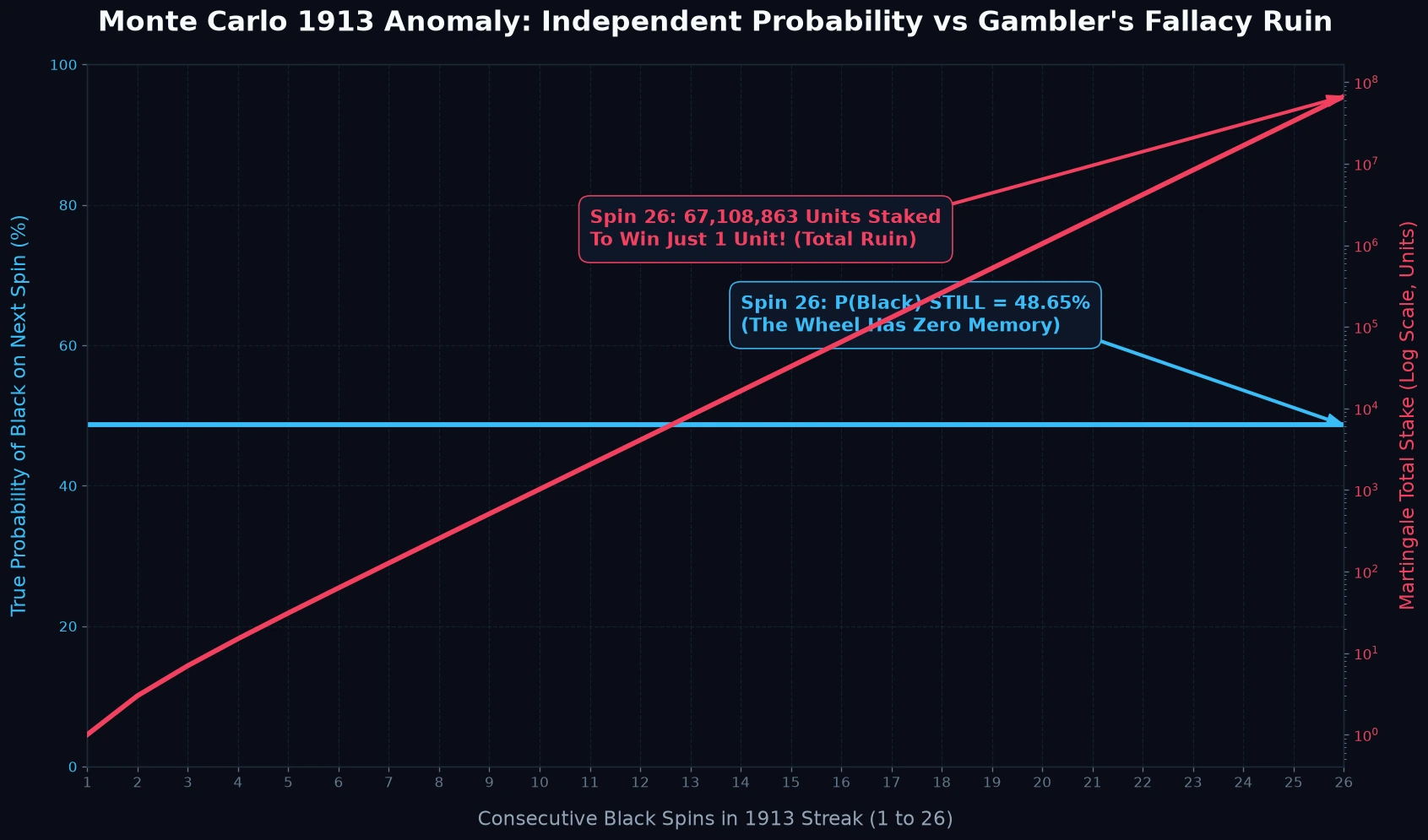
The Anatomy of the 1913 Catastrophe
When the ivory ball settled into a black pocket for the tenth consecutive spin, whispers spread across the gaming salon. By the fifteenth spin, play across surrounding tables halted as a dense crowd gathered around the table. Bettors pulled stacks of gold francs from their pockets, desperate to wager on Red.
The logic felt intuitive and irresistible: what were the chances of another black? Surely, nature demanded an immediate correction. When spin 16 landed black, the betting frenzy intensified. By spin 20, players were placing maximum house limit bets on Red, convinced that the laws of nature could not allow black to continue.
The wheel spun black on spin 21. Then 22. Then 23. Then 24. Then 25.
Men broke into cold sweats; women gasped. Fortunes accumulated over generations vanished in minutes. Only on the 27th spin did the ball finally drop into Red 36. By that point, the casino’s coffers were overflowing with millions of surrendered francs, and the term “Monte Carlo Fallacy” was permanently stamped into mathematical history.
The Probability Mathematics: A Priori vs Conditional Reality
To understand why the crowd went broke, we must separate a priori probability (looking forward before any spins occur) from conditional probability (evaluating the next spin given that previous spins have already occurred).
Before the first spin took place, the probability of 26 consecutive blacks on a standard single-zero European roulette wheel was:
P(26 Blacks) = (18 / 37)^26 = 0.0000000073088… ≈ 1 in 136,823,107
Indeed, a 1-in-137-million anomaly! But here lies the fatal trap: once the wheel has already landed on black 25 times in a row, those 25 events are in the past. Their probability is now exactly 1.0 (they have already occurred).
Because each spin is an independent event with no physical connection to past spins, the probability of spin 26 being Red is strictly:
P(Red_26 | 25 Blacks) = 18 / 37 = 48.65%
The roulette wheel has no memory. It has no brain, no conscience, and no obligation to the universe to “even things out.” The ball does not know it landed on black five seconds ago.
Streak Probability Matrix: The Illusion of “Due” Outcomes
| Consecutive Blacks | A Priori Probability | Odds Against Occurrence | Next Spin Probability (Red) | House Edge on Next Spin |
|---|---|---|---|---|
| 5 in a row | 2.73% | 1 in 36.6 | 48.65% | 2.70% |
| 10 in a row | 0.074% | 1 in 1,343 | 48.65% | 2.70% |
| 15 in a row | 0.0020% | 1 in 49,271 | 48.65% | 2.70% |
| 20 in a row | 0.000055% | 1 in 1,807,249 | 48.65% | 2.70% |
| 26 in a row (1913) | 0.0000000073% | 1 in 136,823,107 | 48.65% | 2.70% |
How the Fallacy Manifests in Modern Crypto Casinos
More than a century later, crypto gamblers fall victim to the exact same cognitive illusion every single day. Whether playing Crash, Dice, or Limbo:
- Crash “Train” Illusion: A player sees Crash bust under 1.20x four times in a row and wagers their entire balance on a 10x multiplier, assuming a “moon spike is due.”
- Dice “Roll Under” Churn: A player rolling under 50.00 hits 8 consecutive “Roll Overs” and doubles their bet repeatedly (Martingale), expecting a win to balance the streak.
- Provably Fair Seed Verification: In provably fair gaming, the entire outcome is cryptographically generated by HMAC-SHA256 from the seed pair before the bet is even placed. Past rounds cannot dynamically adjust future cryptographic hashes.
The Only Way to Beat the Bleed: Eliminating House Edge
In 1913, what guaranteed the casino’s victory was not merely the streak—it was the compounding 2.70% house edge on every chip tossed onto the felt. Over millions of francs in turnover, the green zero pocket ensured an inescapable mathematical leak.
If you want to protect your capital against streak anomalies, progressive betting systems cannot help you. The only mathematical defense is eliminating the operator’s margin entirely. Duel Casino operates audited 100% RTP Originals (0.00% House Edge), where fair mathematical payouts ensure you never pay an operator tax on your bets. Register using code VIP to unlock instant VIP Fast-Track benefits and instant crypto cashouts.