
Provably Fair pillar: How to Verify
How to Verify a Provably Fair Bet (Step-by-Step, No Guessing)
A provably fair label means nothing until someone actually runs the check. An unverified badge is a gym membership paid for and never used.
This guide walks you through verifying a provably fair result in a way that’s repeatable, dull, and correct. First we cover the quick route using the casino’s own verifier, then a cross-check against an independent one, then the reasoning behind each step so no tool gets your blind faith.
Verification isn’t about winning. It confirms the randomness wasn’t edited after you placed your bet.
Before you start: what you need for any verification
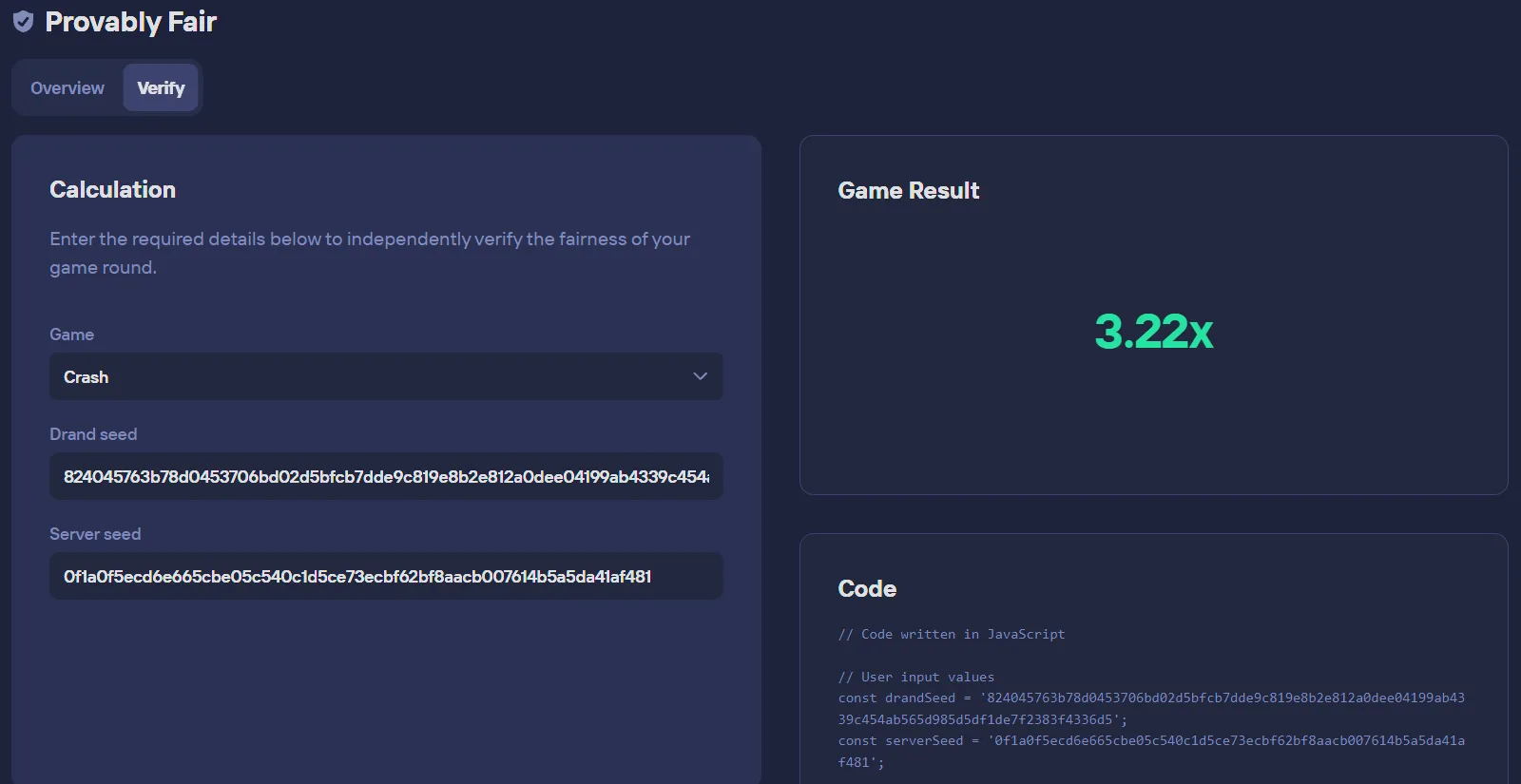
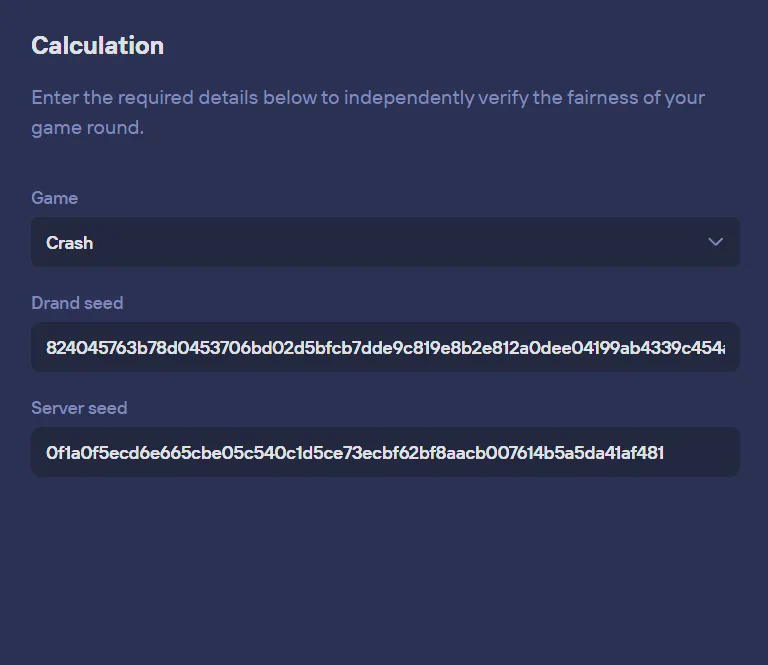
The input set barely changes across game types. Whether you’re checking Dice, Crash, Mines, or Plinko, verification needs three values:
- Server Seed (revealed after the round or after a seed cycle)
- Client Seed (your seed, often editable in settings)
- Nonce (the round counter for that bet)
The commitment check needs a fourth item:
- Server Seed Hash (shown before results are generated)
Goal: confirm the revealed Server Seed matches the previously shown hash, and that Server Seed + Client Seed + Nonce reproduce the exact outcome you received.
If those terms still feel fuzzy, pause and read:
Server Seed, Client Seed & Nonce.
Where to find the data (the most common places)
Sites bury these values in different spots, but three locations cover almost everything:
1) Your game history / bet history
Open an individual bet and look for “Fairness”, “Provably Fair”, “Verify”, “Seeds”, or “Bet Details”. That panel usually shows the nonce and outcome parameters for that specific round.
2) Provably Fair settings page
Many casinos keep a dedicated fairness page listing your current server seed hash, client seed, nonce counter, plus controls to reveal or rotate seeds.
3) The in-game “fairness” button
Certain games hide a small “i” icon, shield symbol, or “Fairness” label inside the interface. Clicking it opens a panel containing the seeds and often a verifier.
If none of these exist anywhere, treat that as a warning sign. A fairness claim without accessible verification data is a lock shipped without keys.
Use this page if you want a dedicated warning list:
Provably Fair Common Red Flags.
The 60-second verification method (use the casino verifier)
This is the quickest legitimate workflow, and it’s usually enough for routine spot checks.
Step 1: Open the bet you want to verify
Pull up bet history, open the round’s details, and copy the Server Seed, Client Seed, and Nonce. Note the game type too (Dice, Crash, etc.).
Step 2: Find the built-in verifier
Most casinos ship a “Verify” tool that takes these values, or auto-fills them from history. With an integrated tool this may be a single click.
Step 3: Confirm the result matches your outcome
The verifier produces a number, such as a dice roll, or a derived value like a crash multiplier. Only an exact match counts as a pass.
Step 4: Confirm the server seed hash commitment
This step matters most: compare the revealed server seed against the hash shown before the bet (or before the seed cycle). A mismatch means seeds could be swapped after bets are seen.
Pass condition: The hash matches AND the verifier reproduces the exact result.
That’s quick verification done. The next method raises confidence further.
The stronger method (cross-check with an independent verifier)
To reduce reliance on the casino’s own tooling, run the same inputs through an independent verifier.
Why bother? A casino-hosted verifier can be implemented wrongly, or presented selectively. Rare, sure — but you’re reading this because blind trust isn’t your style.
Step 1: Collect the exact same inputs
Server Seed, Client Seed, Nonce, and where available the Server Seed Hash.
Step 2: Use a known external verifier
Pick a tool that states its algorithm openly and reproduces outcomes deterministically. We maintain a curated list here:
Step 3: Match the output exactly
Precision counts. On a mismatch, don’t leap straight to accusations of cheating — first check you used the right game algorithm and the right nonce for that round.
Important: Different casinos, and even different games at the same casino, map raw hash output onto outcomes in their own ways. Always verify using the algorithm documented for that specific game.
What’s happening under the hood (so verification isn’t “magic”)
Beneath the surface, most provably fair systems run a deterministic cryptographic function: its output looks random, yet reproduces perfectly whenever the inputs are known.
The usual chain looks like this:
- Combine inputs (Server Seed, Client Seed, Nonce)
- Apply HMAC or hashing
- Convert part of the output into a number
- Map that number to a game result (roll, multiplier, board layout, etc.)
Key property: Deterministic + unpredictable-before-reveal = verifiable fairness.
Deterministic simply means identical inputs always yield an identical result. That property is what makes checking possible at all.
Unpredictable-before-reveal covers the other side: future outcomes stay unknown because the server seed stays secret until revealed.
The “Hash Commitment” check (this is non-negotiable)
A large share of players verify the outcome math and quietly skip the commitment step. Don’t join them.
Displaying a server seed hash before play serves exactly one purpose:
The casino locks in a secret value ahead of your bet; swapping it afterwards would expose the switch.
So your checks should include all of these:
- Find the server seed hash shown before the bet (or seed cycle)
- Once the seed is revealed, hash it yourself using the stated method
- Confirm both hashes match character for character
No pre-commit hash displayed, or hashes shifting in untrackable ways? Classify it as a serious transparency failure and move on.
More red flags here:
Provably Fair Common Red Flags.
Common verification mistakes (the ones that create false alarms)
When someone shouts “it didn’t verify!”, the culprit is usually a mismatched input rather than rigged software. Five classic slip-ups:
- Wrong nonce: using the current nonce instead of the historical nonce attached to that bet.
- Wrong client seed: rotating the seed later and forgetting what was active during the round.
- Wrong game algorithm: Dice and Crash map outputs differently even when the hash function matches.
- Seed cycle confusion: server seeds may only be revealed once a rotation cycle ends, not per bet.
- Copy/paste whitespace: stray spaces or invisible characters silently break the whole calculation.
If you want the “don’t fool yourself” math mindset page (it helps with verification too):
Common Gambling Math Mistakes.
How often should you verify?
Nobody expects per-round auditing on the scale of a nuclear inspection. A saner rhythm looks like this:
Verification habits that actually work
Sample-check on arrival. New casino or new game? Verify 5–10 rounds calmly before settling in.
Check when something feels off. Odd streaks are usually plain variance, but running a verification costs nothing and settles nerves.
Check before recommending. Nobody wants their bad advice to cost a friend money.
One boundary to respect: provable fairness proves result integrity, not operator safety. Judging “safe” requires a broader checklist:
Provably Fair does not cancel variance (verify a loss, still a loss)
Here’s the emotional trap: some players who learn about provable fairness stop blaming the house and start blaming themselves instead. “If it’s fair, why am I losing?”
Fair randomness still hands out brutal streaks. Fast games compress those streaks into minutes instead of weeks.
For a clean explanation of why “fair” can still feel cruel:
Variance & Volatility Explained
Why High RTP Still Loses Short-Term
Timeboxing Sessions
A simple “verification checklist” you can reuse
Keep this exact checklist in your notes. It catches sloppy work and filters out fake alarms before they reach Twitter.
- I have the bet’s Server Seed (revealed) and its pre-commit hash.
- I have the Client Seed that was active during that bet.
- I have the exact Nonce for that round.
- I used the verifier built for the correct game (Dice vs Crash vs Mines mapping).
- The verifier output matches my observed result exactly.
- The revealed server seed hashes to the pre-commit hash exactly.
- If unsure, I cross-checked with an external verifier.
Tool version (downloadable / reusable):
Provably Fair Checklist.
FAQ
What do I do if verification fails?
Suspect your own inputs first: wrong nonce, wrong client seed, wrong game verifier, stray whitespace. Then run the same values through an external verifier. Still failing? Record every input and output, and treat the case as a serious red flag.
Can changing my client seed help me win?
No. It reshuffles the sequence of outcomes but grants zero predictive power, since the server seed stays hidden from you. Seed controls exist for transparency and hygiene, not for “hacks.”
Do provably fair games have better RTP?
No guarantee there. Provably fair concerns verifiability; RTP and house edge are separate properties. A fully verifiable game can still carry negative expected value.
Is using the casino’s verifier enough?
For casual spot checks, yes. Deeper trust comes from cross-checking externally and completing the hash commitment step properly.
What’s the single most important thing to verify?
Both halves together: reproduce the outcome correctly AND confirm the revealed server seed matches the previously shown hash. The commitment is the anti-tamper lock; skipping it defeats the purpose.