
Stake sizing is a trade-off, not a guess. Wager pennies and your edge compounds nowhere; wager too much and variance eats the bankroll. This Bet Sizing Optimizer sweeps sizing fractions (built on the same math as our Kelly Criterion calculator) to find the point where growth peaks while your ruin probability stays under a cap you set.
Bet Sizing Optimizer
How the optimizer finds the right stake
How Does This Compare to 0% House Edge Protocols?
Audited 100% RTP
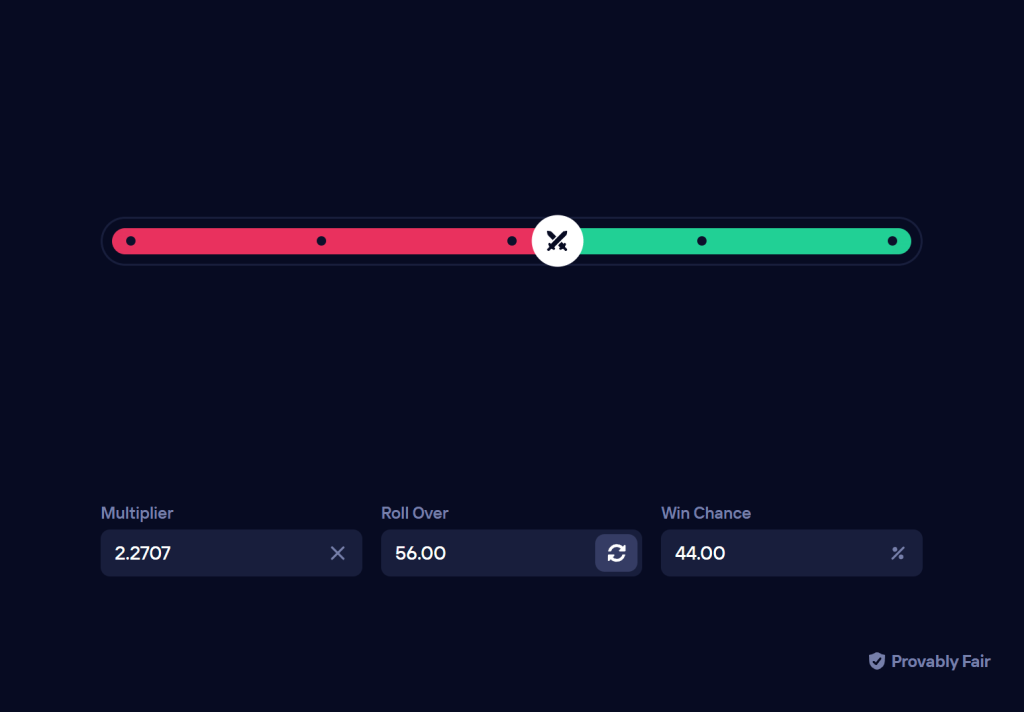
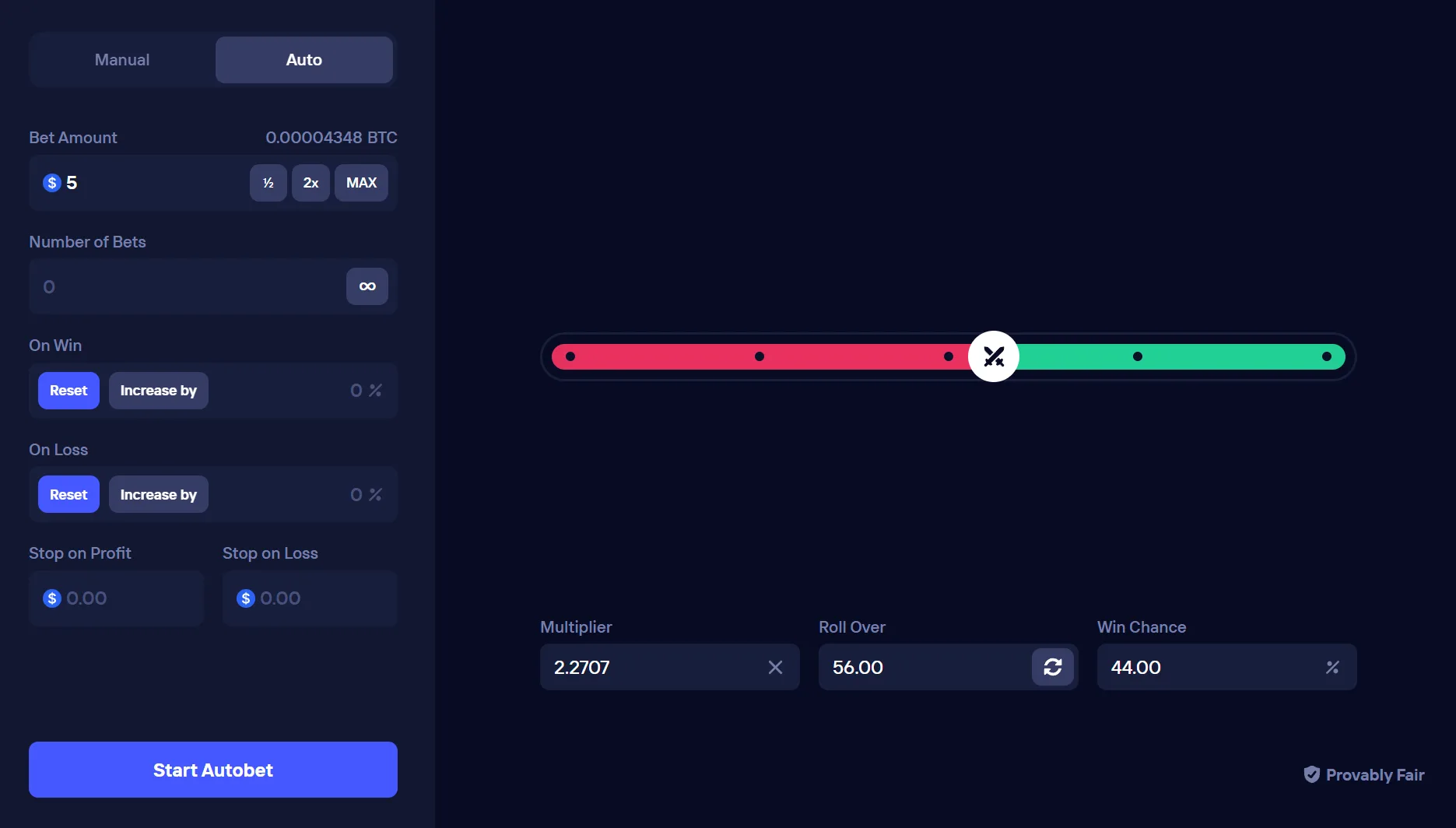
Instead of standard 1.00% to 4.00% casino house margins, compare with mathematically verified 100% RTP Originals (0.00% House Edge) on Duel Casino:
If you hold a genuine mathematical edge — say, in sports betting or value play at a casino — raw speed of growth matters less than survival. Doubling your stake does not double your compound growth. Returns multiply geometrically, so extra size adds volatility first and returns later. Push far enough and the geometric growth rate turns negative even with positive expected value.
The tool applies Kelly Criterion logic with one addition: a **Ruin Tolerance Cap**. It plots expected growth ($g(f)$) across every fraction of your bankroll ($f$), then reports the largest stake that still keeps your probability of going broke below the threshold you chose.
The formulas behind the sweep: g(f) and ruin probability
Two functions compete during the search:
1. The Geometric Growth Rate (g(f))
Expected logarithmic growth per round, expressed against the staked fraction ($f$):
g(f) = p * ln(1 + b * f) + q * ln(1 - f)
Where:
- $f$: Fraction of your bankroll placed on each round.
- $p$: Probability that the bet wins.
- $q$: Probability it loses ($1 – p$).
- $b$: Decimal payout odds (e.g., $b = 1$ for even money).
2. The Geometric Ruin Approximation
To keep you from chasing peak growth straight into bankruptcy, the tool estimates the long-run odds of hitting ruin:
P(Ruin) ≈ exp(-2 * |μ| * B / σ²)
Here $mu$ stands for your average edge in units, $B$ for bankroll size in units, and $sigma^2$ for outcome variance.
Worked example: $5,000 bankroll, 55% win rate
Picture a $5,000 bankroll and an even-money sports bet where your win probability sits at 55% ($p = 0.55$, $b = 1$, a 10% edge). You refuse any ruin probability above 5%:
- Type in your total bankroll ($5,000) plus the game metrics ($p = 0.55$, $b = 1$).
- Set the maximum acceptable Ruin Probability to 5%.
- Click “Verify.” The optimizer sweeps fractions from $f = 0.01$ up to $f = 0.30$.
- Read the growth curve. Full Kelly calls for 10% of the bankroll ($500) per game — maximum growth, but ruin risk well above your line.
- The tool lands on the “constrained optimal” stake (e.g., 5%, or $250): roughly 75% of the maximum growth rate with ruin probability forced under 5%.
Frequently asked questions
Why is “Fractional Kelly” recommended by professionals?
Full Kelly assumes your estimated edge is exactly correct. It never is. Betting half-Kelly or quarter-Kelly builds in a margin of error, so an overestimated edge costs you a dent instead of a catastrophe. Pair this with firm Session Stop Rules so a bad day ends on schedule, not at zero.
What happens if I bet past the Kelly peak?
Past the peak lies what practitioners call over-betting territory, and the arithmetic is ugly: volatility rises, long-term geometric growth falls. You accept more risk of ruin and get paid a slower compounding rate for the privilege. There is no compensation on the other side.
How does a high ruin tolerance affect my optimal bet?
Relax the cap and the selected fraction moves closer to true Kelly, lifting expected growth — along with drawdowns deep enough to end most bankrolls. That last trade is worth stating plainly: a loose ruin tolerance raises the chance you lose everything, not merely some.