
Hitting a mine on your opening click feels personal. It isn’t. This Mines verifier reconstructs the board layout of any past round from its cryptographic seed triple, showing that mine positions were locked in before you touched a single tile.
Mines Verifier
How to verify a past Mines round in 3 steps
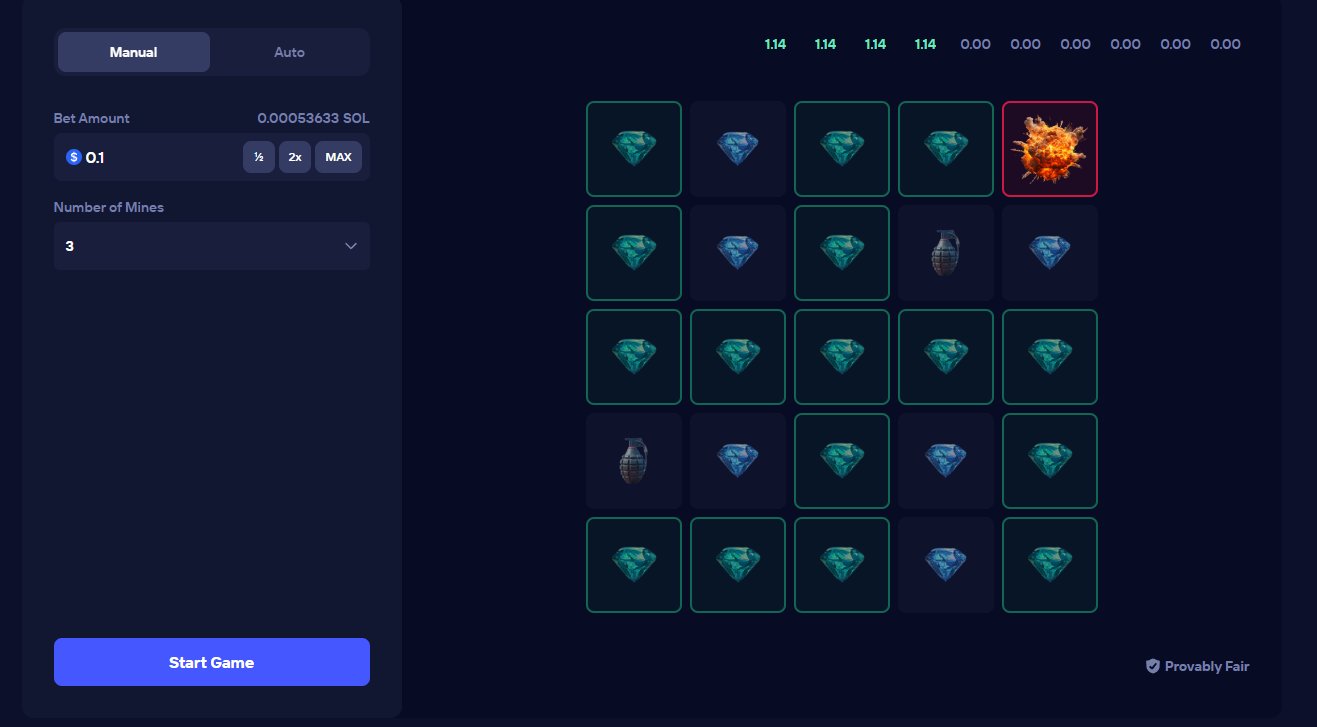

Stake, BC.Game, and most major crypto-casinos generate their 5×5 Mines boards with a provably fair engine rather than a server-side dice roll behind closed doors. Everything you need sits in your bet history panel:
- Server Seed: The revealed server seed from a rotated seed pair. While a seed pair is active, only its hash is shown — the raw seed stays hidden until rotation.
- Client Seed: The custom client seed that was active when that specific bet was placed.
- Nonce: The bet’s sequence number for that seed pair. Open the individual bet details in your casino profile and note the index shown there.
The math: How the 5×5 board is randomized
My first losing streak on Mines convinced me the casino was planting mines under whichever tile I was about to pick. Paranoia is easy to justify after ten straight early busts.
The cryptography says otherwise. All 25 tile positions are determined before your first click. Here’s how:
1. Generating the HMAC outcome stream
Server seed, client seed, and nonce go into a standard HMAC-SHA256 hash. From that hash the engine derives 25 decimal floats between 0 and 1 — enough randomness to cover the whole board.
2. The Fisher-Yates shuffle
To place mines without duplicates, the engine runs a **Fisher-Yates shuffle** over an ordered array representing all 25 tiles (indexed 0 to 24, top-left through bottom-right):
Board = [0, 1, 2, 3, 4, 5, 6, 7, 8, 9, 10, 11, 12, 13, 14, 15, 16, 17, 18, 19, 20, 21, 22, 23, 24]
The shuffle works right to left (index 24 down to 1). At each position i, one float from the stream picks an index j between 0 and i:
j = floor(Float * (i + 1))
Swap Board[i] and Board[j]
After 24 iterations the array is fully shuffled. Its first indices become the mine positions — 3, 5, or 10 of them, depending on your setting.
A concrete mapping example:
Index 0 in the shuffled result means a mine at the top-left corner; index 24 puts one at bottom-right. Our verifier replays this identical procedure and prints the coordinates of every trap on the board.
Strategy: Spotting anomalies
For risk sizing and progression logic, start with our Mines strategy guide and run scenarios through the Mines Payout Matrix. On the fairness side, remember this: because each board is derived entirely from the seed triple, the operator cannot move a mine once the round has begun. Verification is about confirming honest generation — it does not change the house edge.
- Verify early losses: Audit rounds where you busted on the first or second pick. Our Universal Verifier shows within seconds whether the mine genuinely sat on that tile pre-click.
- Check patterns: See mines lining up or clustering? Don’t assume rigging — in true randomness, lines and clusters appear naturally over thousands of rounds. What must match exactly is the Fisher-Yates output for your seed triple.
Frequently asked questions
Can the casino swap the board layout if I hit a big streak?
No. Rearranging mines mid-round would require swapping either seed, and the pre-round hash of the server seed makes any such swap instantly detectable during verification. A caught inconsistency exposes the casino, not you.
Why is my verified board layout different from the game outcome?
Nine times out of ten, an input is off. Use the revealed *server seed* — not the still-hashed active one — plus your exact client seed and the correct nonce (the bet index, which may start at 0 or 1 depending on the site). And confirm the mine count matches the round.
Is there a calculator that tells me where to click?
No, and there never will be. With HMAC-SHA256 derivation and an encrypted server seed, predicting safe tiles ahead of time is mathematically impossible. Any tool advertising a “mine predictor” exists purely to take your deposit.