
A Plinko ball rattling down the pegs feels like pure chance. It isn’t. This Plinko Verifier replays every Left/Right decision row by row and shows you the exact route to your payout.
Plinko Verifier
The deterministic path of Plinko balls
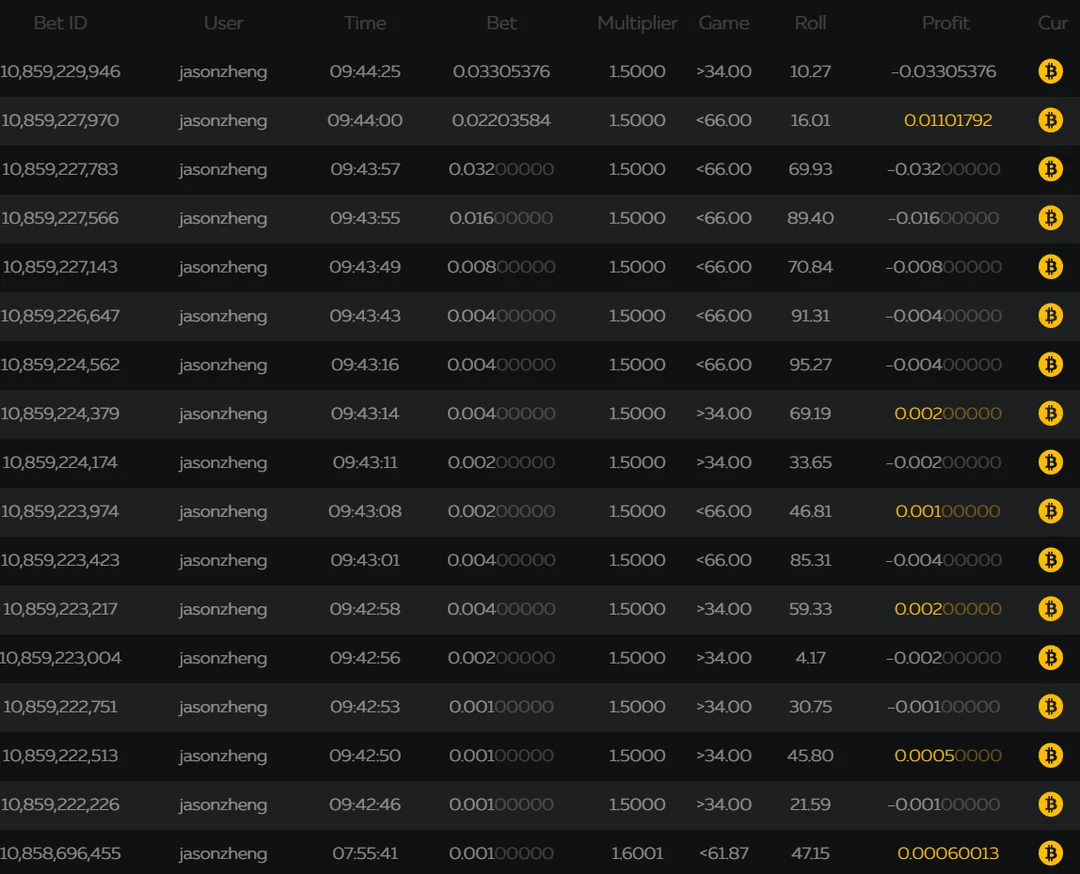
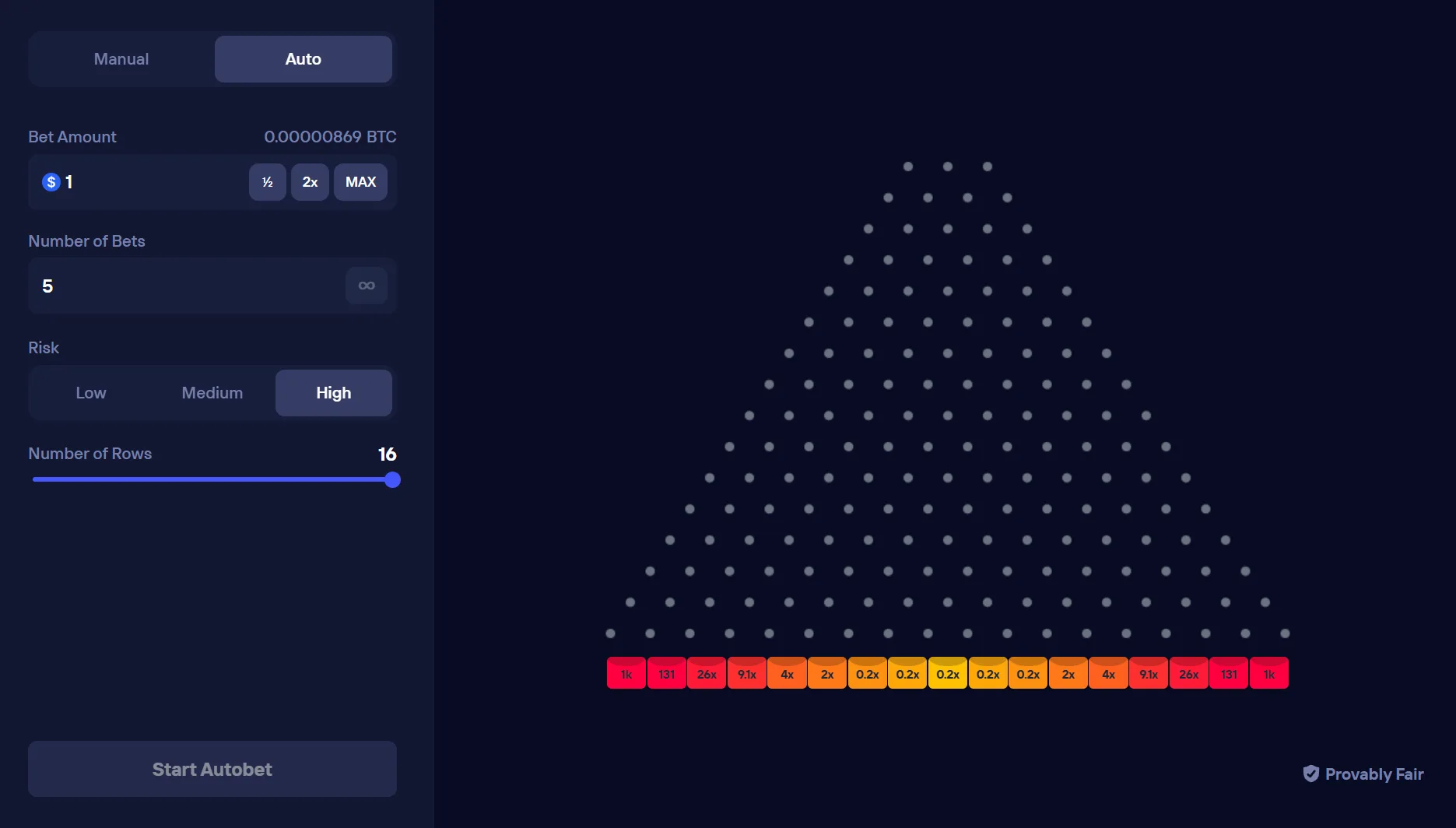
Plinko is a staple on crypto casinos such as Stake and BC.Game. Each ball drops through a grid of pegs, deflecting left or right at every row before settling into one of the multiplier pockets along the bottom.
No physics engine decides where it lands. The full trajectory is locked in the instant you press “Play,” derived from your cryptographic seeds. A provably fair Plinko verifier recomputes that bounce sequence independently, so you can see precisely how each drop unfolded.
The math: Row-by-row bounce calculations
Tracing a ball means converting raw hash output into a series of directional decisions — one float per row of the board:
1. Generating the row floats
Your seeds and nonce are combined under HMAC-SHA256. Rather than stopping after the first 4 bytes, the verifier reads consecutive 4-byte segments — one segment per row on boards of 8, 12, or 16 rows:
Float_Row_i = Hex_To_Decimal(4_Bytes_i) / 4294967296
2. Calculating Left vs Right
Each row’s float maps directly to a direction:
- Float < 0.50: **Left** (value 0).
- Float ≥ 0.50: **Right** (value 1).
3. Finding the final landing pocket
Add up every Right bounce. That sum is the landing pocket index. On a 16-row board:
Pocket_Index = Sum(Right_Bounces)
Indexes run from 0 (sixteen Left bounces, far-left pocket) to 16 (all Right, far-right).
Data Sandwich: Auditing an 8-row Plinko drop
Here’s a worked audit on an 8-row board. Your ball landed in Pocket 7 near the right edge for a healthy return. You rotated seeds and pasted them into the verifier:
- Server Seed:
b4a2c8... - Client Seed:
plinko_drop_1 - Nonce: 3
Running the HMAC yields eight floats, one per row:
- Row 1: Float 0.65 -> **Right** (1)
- Row 2: Float 0.42 -> **Left** (0)
- Row 3: Float 0.78 -> **Right** (1)
- Row 4: Float 0.81 -> **Right** (1)
- Row 5: Float 0.52 -> **Right** (1)
- Row 6: Float 0.93 -> **Right** (1)
- Row 7: Float 0.21 -> **Left** (0)
- Row 8: Float 0.71 -> **Right** (1)
Adding the Right values: 1 + 0 + 1 + 1 + 1 + 1 + 0 + 1 = 6.
Six Rights, two Lefts — the ball settles in **Pocket 6**, seventh from the left on an index-6 slot. Verifier output matches your game history line for line.
Frequently asked questions
What is the safest Plinko row count?
Fewer rows mean tamer swings. On 8-row boards the outer multipliers hit more often but top out around 29x. Boards with 16 rows swing hard: outer pockets pay as much as 1,000x yet land so rarely they can bleed a bankroll between hits. For picking risk and payout settings that suit you, see our Plinko strategy guide.
Can the casino change the peg angles?
No. The peg layout is symmetrical and immutable — every peg splits outcomes exactly 50/50. The house keeps its edge entirely through the payout table at the bottom, where each multiplier sits slightly below its fair probability-weighted value.
Why do middle pockets pay less than my bet?
Binomial probability. Balls cluster in the center because roughly half their bounces go each way. Those central pockets fire so often they return only a fraction — say 0.2x — which subsidizes the enormous payouts sitting on the two outer edges.