
Math pillar: Expected Value (EV)
Expected Value (EV) Explained: The Only Casino Metric That Doesn’t Lie
Expected Value (EV) is the quiet arithmetic underneath a loud activity. It can’t tell you what the next spin does. Nobody’s formula can. What it tells you is where you drift on average if you run the same bet thousands of times.
Why bother? Because most gambling “strategies” are folklore wearing a suit. EV is a filter. Run a claim through it and the ones built on wishful thinking disappear immediately. A negative-EV bet doesn’t improve with more play — volume just gives the house edge more chances to bill you.
EV doesn’t promise wins. It promises honesty.
What EV means in plain English

Expected Value (EV) is the average result per bet or per decision over repeated plays. Replay one identical bet a million times under the same rules, and your average profit-or-loss per attempt converges toward the EV.
Two ingredients decide everything:
- Probability (how often each outcome occurs)
- Payout (what each outcome pays or costs you)
EV has no interest in streaks, hunches, or what you think you’re owed. It reads only the structure of the bet.
If you want the probability basics that support this page, start here:
Probability Basics for Casino Games.
The simplest EV formula (the one you can actually use)
Take each possible outcome, multiply it by its probability, add them up. In a two-outcome world — win or lose — that reduces to:
EV = (P(win) × profit_if_win) + (P(lose) × loss_if_lose)
Watch the word profit. Not “payout.” Profit is net: stake already subtracted. Bet $10, get $20 back, and your profit is $10 — not $20. Mixing these two up is how people convince themselves an offer is better than it is.
Quick sanity check: If payouts are truly fair, EV sits near 0. If the casino holds an edge, EV is negative. When a promotion compensates for that edge, EV can flip positive (+EV).
EV example #1: a “fair coin” vs a casino coin
Flip a coin, bet $1, win $1 profit or lose $1, 50/50 odds either way.
EV = (0.5 × +1) + (0.5 × -1) = 0
Fair game, zero EV. Now shrink the winning side so profit is $0.95 instead of $1 — the classic casino touch.
EV = (0.5 × +0.95) + (0.5 × -1) = -0.025
An average of -2.5 cents per $1 staked, which is a 2.5% house edge. Tiny per bet. Relentless across a few thousand bets.
This is why “I hit often” proves nothing about profitability. You’re paid on both axes — frequency and amount.
EV example #2: why “high win chance” can still lose
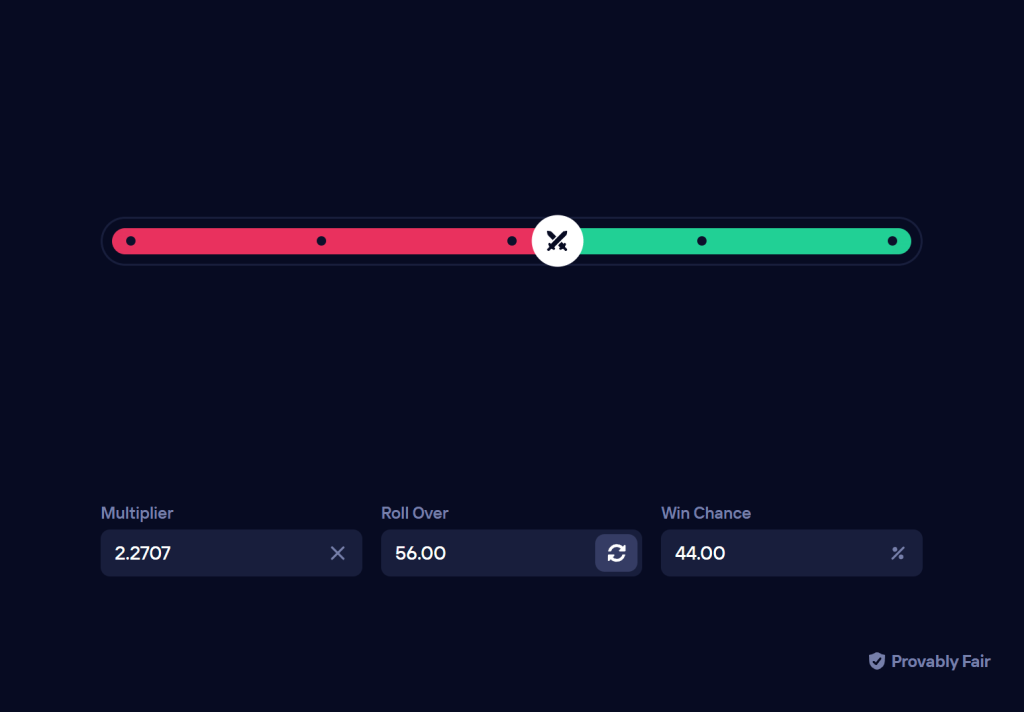
Dice-style games teach EV well because they let you dial in friendly-looking probabilities. Set a 90–95% win chance and you’ll hit constantly. Feels safe. Feels controlled.
The catch: payout shrinks to mirror that win chance, plus the house edge on top. Small frequent wins, full-size losses. The arithmetic lands negative even while your hit counter climbs.
One lesson worth tattooing somewhere visible: win frequency is not profitability. EV is profitability.
If Dice is a game you care about, this page ties the behavior side in:
Dice Strategy (Beyond Martingale).
EV vs RTP vs house edge (how they fit together)
Three labels for one relationship, used at slightly different angles.
House edge is the casino’s advantage as a percentage of total wagered. RTP looks from the other direction: what returns to players on average. In simple models:
RTP ≈ 100% - House Edge
EV converts that same idea into cash. With a 2% house edge, every $1 wagered carries roughly -$0.02 of expectation.
More detail (beginner-safe):
RTP vs House Edge and
House Edge Table.
Why EV matters more than “strategy” in most casino games
Casino games are engineered so your decisions barely move EV. Deliberately. If ordinary players could outplay the math, the business model would collapse overnight.
So what levers remain?
Two, and both are EV-friendly:
- Pick better-value games — lower house edge, stronger RTP, volatility you can actually sit through.
- Use promotions with calculation, so bonus value outweighs the expected cost of wagering through.
Then there’s one behavioral lever, and it often outweighs both: cap exposure with unit sizing, stop rules, and timeboxing. Good EV paired with reckless execution still produces wreckage.
The real place EV becomes powerful: bonuses and promos (+EV hunting)
This is where EV stops being classroom material and starts earning its keep: promotions. A casino bonus generates positive expected value when the bonus is big enough relative to the wagering terms — assuming those terms aren’t rigged against you.
The core comparison fits on a napkin:
Promo EV ≈ Bonus Value − Expected Loss from Wagering
To estimate the expected loss portion, lean on house edge:
Expected Loss ≈ Total Wagered × House Edge
Bonus value above expected loss means the promo is +EV on paper. One run can still lose — variance hasn’t signed anything — but over many attempts the arithmetic finally works for you instead of against you.
Deep dive:
How to Calculate the True Value (EV) of Casino Bonuses.
EV example #3: a bonus that looks generous vs a bonus that is actually valuable
Two stripped-down offers, same casino, same player habits, numbers kept round.
Offer A: Big headline, brutal wagering
“100% match up to $200!” Impressive until you read the fine print: 40× wagering on slots carrying roughly 4% house edge.
Total turnover: $200 × 40 = $8,000. Expected loss: $8,000 × 4% = $320.
You collected $200 of value and expect to burn $320 unlocking it. Negative EV, dressed as generosity.
Offer B: Smaller headline, better structure
“20% cashback on losses up to $200, with 10× wagering on a high-RTP game.”
$200 cashback means $200 × 10 = $2,000 of required wagering; at a 1% edge, expected loss runs about $20.
$200 received, ~$20 expected cost. Positive EV on paper — the version worth hunting.
Real promotions pile on extras: game contribution tables, max cashout caps, expiry clocks. That’s why we treat EV analysis as a checklist exercise, never a vibes exercise.
The EV trap: “I found a +EV promo, so I can’t lose”
No. +EV describes your average across many repeats, not the outcome of tonight. Variance happily produces losing runs even when the long-run sign is correct.
That’s exactly why EV thinking travels with bankroll discipline. Stack everything on one +EV offer and variance can ruin you before any “average” shows up.
Read:
Risk of Ruin (RoR) and
Bankroll Management.
EV doesn’t fix tilt (but it can prevent you from justifying it)
The slickest tilt disguise is “math cosplay”: chasing losses while narrating in statistical vocabulary. “This has to revert.” “Bigger unit recovers faster.” “My win chance is high.” None of it is math; all of it is mood.
EV gives you one question to cut through the performance:
Did the expected value change — or did my feelings change?
If EV is unchanged, bigger exposure isn’t strategy. It’s emotion holding a calculator.
Helpful pages:
Tilt Triggers and
Chasing Losses.
The EV-friendly session structure (so math survives reality)
EV knowledge dies quickly inside chaotic sessions, so give it a container built not to self-destruct. Boring by design:
- Flat staking: 1–2% units of session bankroll.
- Timeboxing: 20–45 minute session timer.
- Stop-loss + stop-win: end sessions clean (no bargaining).
- One risk profile: no volatility upgrades mid-session.
- Tilt exit: if you feel the urge to “recover faster,” stop.
Grab the ready-made version:
Session Rules Template.
Responsible play
A sharp grasp of EV is not permission to gamble harder. If play turns urgent, emotionally load-bearing, or hard to walk away from, treat that signal seriously and get support. Some sessions have only one correct EV decision: none.
Resources:
Responsible Gambling.
FAQ
Is EV the same as RTP?
Related but not identical. RTP expresses percentage return over the long run; EV is the cash figure per bet. House edge links the two.
Can EV ever be positive in casinos?
Via promotions, occasionally — when bonus value exceeds the expected loss generated by wagering. Even then individual runs lose sometimes, which keeps bankroll management non-negotiable.
Does changing bet size change EV?
Usually not. Sizing alters variance and risk of ruin. Most betting systems relocate risk rather than remove the house edge.
Why does a negative EV game still feel beatable?
Short-term variance hands out wins, near misses manufacture momentum, and neither says anything about the average. EV talks averages; sessions talk feelings.
What’s the fastest way to apply EV as a player?
Screen promos for traps first — heavy wagering, max cashout caps, excluded games — then shield every session with small units, a timer, and stops you don’t renegotiate.