
Myth demolition: Martingale
Interactive Tool: Simulate the Martingale System Over 10,000 Rounds
Watch how table limits and consecutive loss streaks cause sudden bankroll drawdown. Run the Martingale Strategy Calculator & Simulator to see the real mathematical probability of ruin.
Martingale Explained: Why the “Doubling System” Fails (Even in Fair Games)
Martingale might be the oldest confidence trick in gambling—one you play on yourself: “Double after every loss, and the first win wipes the slate clean plus one unit.” On paper, tidy. At the table, routine streaks turn into bankroll extinction events.
Below is the full teardown—no scare tactics, and no judgment about why the logic appeals. The system hooks people because it prints frequent small wins and manufactures a feeling of control. The invoice arrives later, in the form of exponential exposure, and exponential exposure is how risk of ruin stops being a probability and becomes a schedule.

Martingale doesn’t fail because you used it wrong. It fails because it assumes infinite money, infinite limits, and infinite emotional calm.
What Martingale is (and why it feels so convincing)
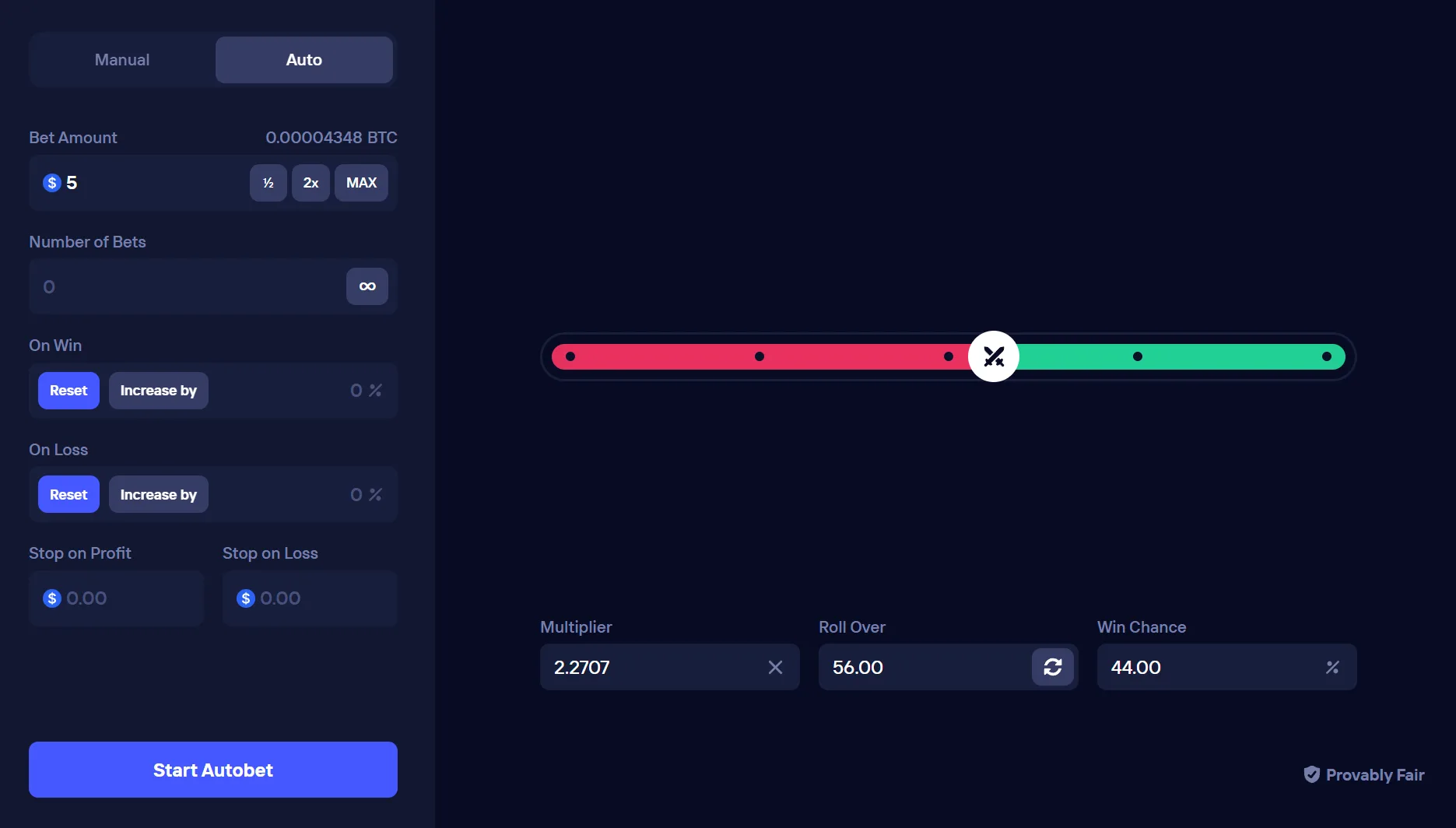

Martingale is a betting progression built on one move: after each loss, raise your stake—typically by doubling it—so a single win covers every prior loss and leaves you ahead by exactly your base unit.
The pitch is one sentence long: “Losses are temporary if I can always double.” The pitch works because it offers certainty in a domain where certainty is the one thing on sale that doesn’t exist.
Casinos don’t punish optimism, though. They punish exposure. And Martingale’s exposure compounds exponentially.
Want the underlying concepts first? These pages carry the groundwork:
The hidden mechanic: exponential bet growth
Early on, Martingale feels frictionless. Most streaks are short: lose once, double, win, pocket one unit. Repeat.
The trap is the growth rate. Each loss doubles the stake:
Bet sequence (starting at 1 unit): 1 → 2 → 4 → 8 → 16 → 32 → 64 → 128 → …
Read that as a trade: you repeatedly stake a large and climbing amount for a fixed, tiny payoff of one unit. The literal proposition is “I’ll risk my stability to earn one small unit, over and over.”
It runs fine until the first streak it can’t absorb. And that streak isn’t a rare anomaly—it’s a scheduled arrival for anyone who plays long enough.
A simple example: how a normal streak breaks a normal bankroll
Round numbers keep this clear. Your base unit is $10, your session bankroll is $1,000, and you double after every loss.
The stake ladder looks like this:
$10, $20, $40, $80, $160, $320, $640, …
Now track the cumulative damage of a losing run. Six consecutive losses means you’ve already put at risk:
$10 + $20 + $40 + $80 + $160 + $320 = $630
The next step on the ladder costs $640. Your remaining stack is $370. You can’t cover the bet, the progression snaps, and the session closes deep in the red.
Six losses did that. Six. In most casino games, a six-loss run isn’t a black swan—it’s Tuesday, given enough volume.
“But the odds are 50/50, streaks are rare!” (Nope.)
Here’s where the arithmetic illusion does its work. People compute the odds of a streak, see a small number, and file it under “won’t happen to me.”
Suppose a bet really were 50/50. The odds of six straight losses within one specific six-bet block are (1/2)^6 = 1/64. That’s not “impossible.” That’s “expect it, repeatedly.”
A session is never one isolated six-bet block, either. Every extended sequence of play contains overlapping windows where a streak can start. Volume feeds variance more chances to hand you a long run. Which makes Martingale a time bomb: the question is “when,” never “if.”
One more crack in the assumption: few real bets are actually 50/50. House edge, table rules, and game mechanics routinely make extended losing sequences costlier than intuition suggests.
The three reasons Martingale fails in real casinos
Martingale demands three unlimited resources. Real life supplies none of them.
Reason 1: Your bankroll is finite
The system’s “safety” rests on outlasting any streak. But every streak length is possible, and long ones stop being improbable as play accumulates. Given a finite stack, there exists a streak that empties it—that’s arithmetic, not pessimism.
Reason 2: Table limits exist
Even a deep bankroll hits a wall: maximum bets. Doubling is the engine of the system, and limits cut the fuel line. The moment you can’t double, the promised recovery evaporates mid-streak.
Reason 3: Your psychology is finite
Watching a stake climb from $10 to $320 to $640 isn’t abstract math—it’s cortisol. Stress breeds tilt; tilt breeds execution errors. Even if the system were airtight under ideal conditions (it isn’t), humans don’t run it cleanly under pressure.
So the honest verdict: Martingale isn’t just risky. It’s structurally incompatible with every real constraint it meets.
Martingale increases Risk of Ruin dramatically
If one concept explains the danger, it’s Risk of Ruin: the probability your bankroll hits zero before you stop.
Martingale doesn’t nudge RoR upward. It drives it toward certainty, because it stacks maximum exposure onto losing streaks—precisely the moments you can least absorb it.
That’s the mechanics behind the familiar pattern: the system “works” for days, then one session erases weeks of small gains. It collects pennies steadily and stores the catastrophe inside rare-but-guaranteed streak events.
For the calm, formula-light walkthrough, start here:
Risk of Ruin (RoR).
“What if the game is provably fair?”
Provably fair answers one question: whether outcomes were manipulated. Where verification data is provided, you can check the result chain yourself. That’s genuinely valuable for trust.
What it doesn’t do is touch variance. A provably fair game will still deal losing streaks—long ones, eventually—and long streaks are the exact mechanism that breaks Martingale.
So verification doesn’t rescue the system. It just confirms the streak that wiped you out was honestly generated.
Verification foundations, if you want them:
Provably Fair Explained and
How to Verify a Provably Fair Bet.
Martingale’s cousin traps (that look different, fail the same way)
The industry keeps repackaging Martingale under fresh names. New wrapper, same exposure curve.
- “Soft Martingale”: raises stakes after losses without full doubling. Still escalation, just slower.
- “Anti-Martingale”: raises stakes after wins. A different tilt route to the same destination: growing risk.
- “Recovery system”: any scheme claiming to “guarantee” a return to even through stake sizing.
- “I’ll just raise it a bit”: the informal version that hardens into a full progression once stress kicks in.
The tell is simple: any plan that adjusts bet size based on recent outcomes is probably feeding variance extra exposure.
What to do instead (the boring approach that survives)
Most people reach for Martingale because they want stability. The stable answer isn’t cleverness—it’s structure.
- Flat staking: hold unit size constant (commonly 1–2% of session bankroll).
- Timeboxing: cap exposure with a session timer.
- Stop-loss + stop-win: close sessions clean, block the spiral.
- One risk profile per session: no mid-session volatility upgrades to “catch up.”
- Tilt exit rule: the moment chasing sounds appealing, the session ends.
None of this promises profit. What it provides is containment: gambling that stays inside lines you drew while calm.
Assemble the full framework here:
Bankroll Management,
Stop-Loss & Stop-Win,
Timeboxing Sessions.
A quick self-check: are you about to Martingale?
Any “yes” below means you’re standing on the first step of a progression spiral:
- “I’m just trying to get back to even.”
- “I’ll increase the bet just for a few rounds.”
- “This win chance is high, so it’s safe.”
- “I’ll stop after I recover.”
- “I don’t want to end the session red.”
When those thoughts surface, apply the same rule we use for chasing:
If you feel the urge to “recover faster,” the session is already over.
Close it. Come back later with smaller units and a timer running. That isn’t weakness. That’s competence.
Responsible play
Progression systems often moonlight as coping tools: “I’ll fix this.” Urgency, panic, secrecy, or pressure to win money back are signals to pause. Martingale-style systems can speed up harm specifically because they inflate stakes while you’re under stress.
Resources and support links:
Responsible Gambling.
FAQ
Does Martingale work in the short term?
It can look that way, because most streaks are short and the system banks frequent small wins. The hidden bill comes from the rare longer streaks, which force huge bets and large losses. Over enough volume, those streaks always show up.
Is there any “safe” Martingale version?
No. Any variant that raises exposure after losses stays vulnerable to streaks, bankroll ceilings, and table limits. “Softer” versions simply take longer to hit the wall.
What if I set a cap on the number of doubles?
Then you’ve built a system that periodically locks in large losses whenever the cap triggers. Capping may shrink the disaster size, but it produces neither positive expectation nor any guarantee.
Does provably fair make Martingale safe?
No. Provably fair lets you confirm outcomes weren’t manipulated; it does nothing to variance. Martingale breaks on streaks and exponential exposure, not on rigging.
What should I use instead of Martingale?
Flat staking with small units, session timers, and firm stop-loss/stop-win rules. Dull, yes—but dull is what keeps gambling contained and ruin risk down.