
Hi-Lo moves fast. Guess after guess, the multiplier climbs. This Hi-Lo Verifier lets you audit every card in that chain, rebuilding the full draw sequence with our Universal Verifier format so you can confirm the deck stayed fixed from bet one to cash-out.
Hi-Lo Verifier
The mechanics of digital Hi-Lo card draws
How Does This Compare to 0% House Edge Protocols?
Audited 100% RTP
Instead of standard 1.00% to 4.00% casino house margins, compare with mathematically verified 100% RTP Originals (0.00% House Edge) on Duel Casino:
Each round shows a card and asks a single question: is the next one Higher or Lower (or Equal)? Correct calls stack up and push your multiplier higher. That stacking is exactly why doubt creeps in — when a big stake rides on guess six, players wonder if the operator quietly dealt themselves out of trouble.
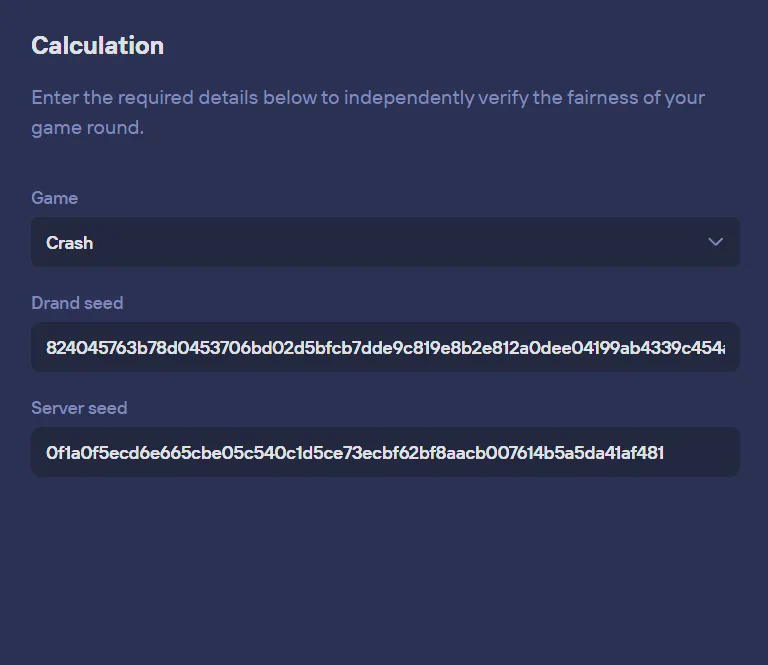
A provably fair Hi-Lo verifier answers that doubt with arithmetic. Rebuilding the card sequence from your seed pair and nonce shows that every future card was fixed mathematically before your first click — no mid-game substitutions possible.
The math: Mapping seeds to cards
To calculate the card for each step in a Hi-Lo sequence, the verifier performs a standard mapping algorithm:
1. Generating the step float
Since a single round can produce many cards, the game hashes your server seed, client seed, and nonce with a **cursor index** appended — one cursor position per draw:
HMAC_Hash = HMAC_SHA256(Server_Seed, "Client_Seed:Nonce:Cursor")
The first 4 bytes of this hash become a decimal fraction U between 0 and 1:
U = Hex_To_Decimal(First_8_Chars) / 4294967296
2. Mapping to a 52-card deck
Multiplying the fraction U by 52 and flooring it picks one slot out of a standard deck:
Card_Index = Floor(U * 52)
The index then resolves to a suit and rank:
- Ranks: Aces (0), 2-10 (1-9), Jacks (10), Queens (11), Kings (12).
- Suits: Spades (0-12), Hearts (13-25), Clubs (26-38), Diamonds (39-51).
Data Sandwich: Auditing a 3-card Hi-Lo run
Here’s a worked example. Your round opens on the King of Spades. You call “Lower” three times and win all three:
- Card 1: 8 of Hearts
- Card 2: Jack of Diamonds
- Card 3: 3 of Clubs
After rotating your seeds, feed these values into the verifier:
- Server Seed:
4f28ba... - Client Seed:
hilo_lucky_run - Nonce: 85
The first step (Cursor 0) hashes like this:
- HMAC yields
U = 0.326923 - Card_Index =
Floor(0.326923 * 52) = Floor(17.0) = 17 - 17 corresponds to rank
17 - 13 = 4(5) of **Hearts** (or 8 of Hearts depending on the site’s suit offsets).
Repeat for Cursor 1 and Cursor 2 and you get your exact three-card sequence back. Cryptographically confirmed: fair.
Frequently asked questions
Is there a house edge shift depending on my guess?
No. The casino’s house edge (typically 1.0% to 2.5%) is dynamically built into the payout multipliers. Call “Lower” while holding a King and your win probability is huge, so the multiplier is tiny. Call “Higher” on that same King and the payout balloons to compensate for how rarely it lands.
What does the “equal” card rule do?
In most Hi-Lo implementations, drawing a card of identical rank to the current one (another King after a King, say) is an instant loss unless you specifically placed an “Equal” bet. That rule is where much of the house edge lives.
How does a seed rotation protect me in Hi-Lo? (Read about the mechanics of the Server Seed, Client Seed, and Nonce)
Rotation forces the casino to publish its un-hashed server seed. Enter it here and you can prove the whole card chain was hashed in advance — untouched, even as your running stake climbed.