
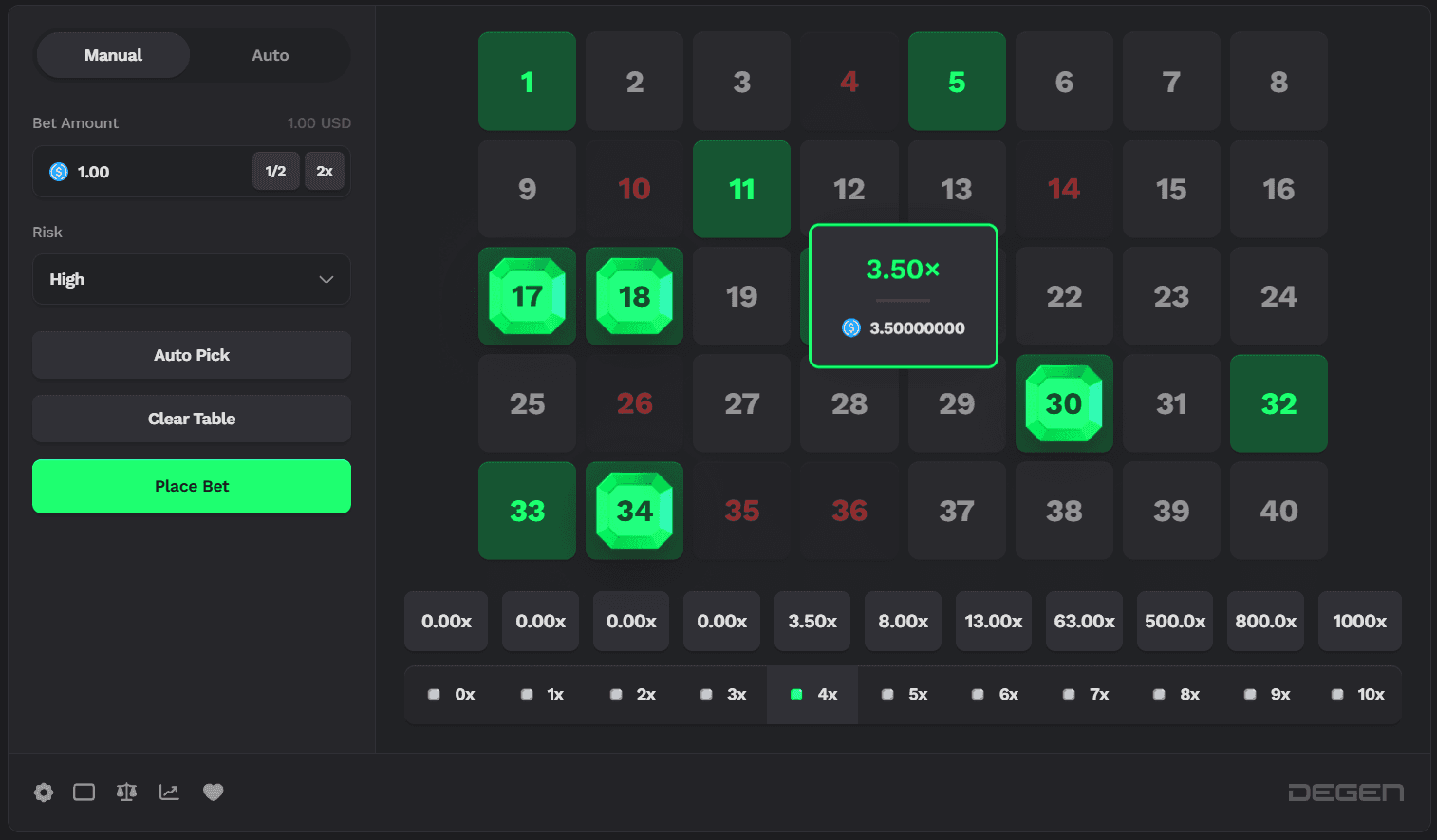
Choose up to 10 numbers from a 40-number pool; the operator draws 10. The pay table shifts with each risk profile.
Keno
Pick up to 10 numbers from 1–40. Operator draws 10. Pay table varies by risk profile.
Auto-bet
How dishonest operators rig this game 3 documented tricks
Mechanism. Auto-pick or "lucky numbers" feature recommends numbers that are statistically LESS likely to draw — but feels personalised.
Red flag. Pick your own numbers. Compare the operator's suggestions over 100 rounds — if their suggestion hit-rate is below 1/40 per number, the recommender is anti-player.
Mechanism. After a player hits a 10/10 jackpot, the operator quietly reduces the 10/10 multiplier by 20–40% for future rounds without notifying.
Red flag. Screenshot the pay table at session start. Compare end-of-session. Any change without announcement = breach of terms.
Mechanism. If the 20 drawn numbers would produce a 9/10 or 10/10 hit, the draw is silently re-rolled to a worse outcome (no PF commit at start of round).
Red flag. PF round commits the full draw at start. Operator must reveal all 20 in the same nonce — no second roll allowed.
For the full compendium across all games, see The Book of Casino Dirty Tricks.
—— pending rotation —Inside the number draw
How Does This Compare to 0% House Edge Protocols?
Audited 100% RTP
Instead of standard 1.00% to 4.00% casino house margins, compare with mathematically verified 100% RTP Originals (0.00% House Edge) on Duel Casino:
arr = [1, 2, 3, ..., 40]                       // pool
Fisher-Yates shuffle using 40 HMAC floats
drawn = first 10 of shuffled array             // the operator's draw
hits  = count of player's picks that appear in drawn
payout = bet · pay_table[risk_profile][hits]   // varies wildly by profile
The shuffle itself is clean. Where Keno gets dirty is the pay table — that’s where operators hide their margin. A “high risk” profile can offer 1500× on a full 10/10 match (probability ≈ 1/847 million), while a “low risk” profile pays just 15× for that same near-impossible outcome. The gap between what a pay table looks like and what it actually delivers is where the edge lives.
Why the pay table decides everything
Keno’s expected value formula:
EV = Σ ( P(k hits) · pay_table[k] ) − 1
In a fair game, EV equals minus the house edge. Operators adjust every cell of the table to land on a target margin while keeping the high-end payouts dramatic enough to sell the lottery fantasy.
The exploit is simple: almost nobody can eyeball a multi-row table and judge whether it’s fair. Our EV calculator checks any operator’s numbers against the true probability distribution for you.
Tricks operators pull in Keno
Covered in detail in the book:
- Hot-number suggestion bias. Auto-pick and “lucky numbers” features nudge players toward numbers that are statistically no more likely to appear.
- Pay-table silent edit. Once a 10/10 jackpot gets hit, the operator trims that multiplier by 20–40% without announcing anything.
- Drawn-numbers re-roll. A natural draw heading toward 9/10 or 10/10 gets quietly redrawn. In provably fair terms this breaks the commitment — the draw must be locked at round start.
What strategy actually means here
Keno sits among the worst-EV house games, with typical edges of 5–30% depending on the pay table. So strategy isn’t about improving EV over time — the math won’t let it. It’s about:
- Pick count. One pick behaves very differently from ten. Most pay tables keep EV identical; the shape of your outcomes changes dramatically.
- Lottery-tier moments per dollar. If what you want is the long-shot “hit big” rush, the 10/10 multipliers provide it — at frequencies the math honestly reports (roughly 1 in ~847 million on uniform 40-of-80 draws).
- Bonus clearing. Keno’s unhurried pace suits grinding through wagering requirements at low session intensity. Remember variance still applies regardless of pace.
Frequently asked questions
Do “lucky number” suggestions work?
No. Every number has a 10/40 = 25% chance of appearing each round. Previous draws carry zero predictive weight. That feature exists to drive engagement, not accuracy.
Why does the high-risk profile pay so much for fewer hits?
Fewer picks make full matches rarer. Hit all 3 of 3 picked: probability C(10,3)/C(40,3) ≈ 1.2%. Hit all 10 of 10: about 1 in 847M. Multipliers scale inversely to balance those odds.
Can my number choices affect the draw?
No. The operator’s 10 numbers come solely from the round’s seed. Your selections only decide which drawn numbers register as hits once results are revealed.