
A $3 transfer fee on a $20 deposit is a 15% handicap before the first spin. This Crypto Deposit Fee Planner sizes up the real transaction overhead across major blockchain networks (assembled under our editorial methodology) and shows how that overhead erodes bankroll efficiency — with reminders to keep play inside responsible limits.
Crypto Deposit Fee Planner
Transaction friction: the cost nobody adds to their +EV math

BTC

ETH

SOL

XRP

USDT

LTC
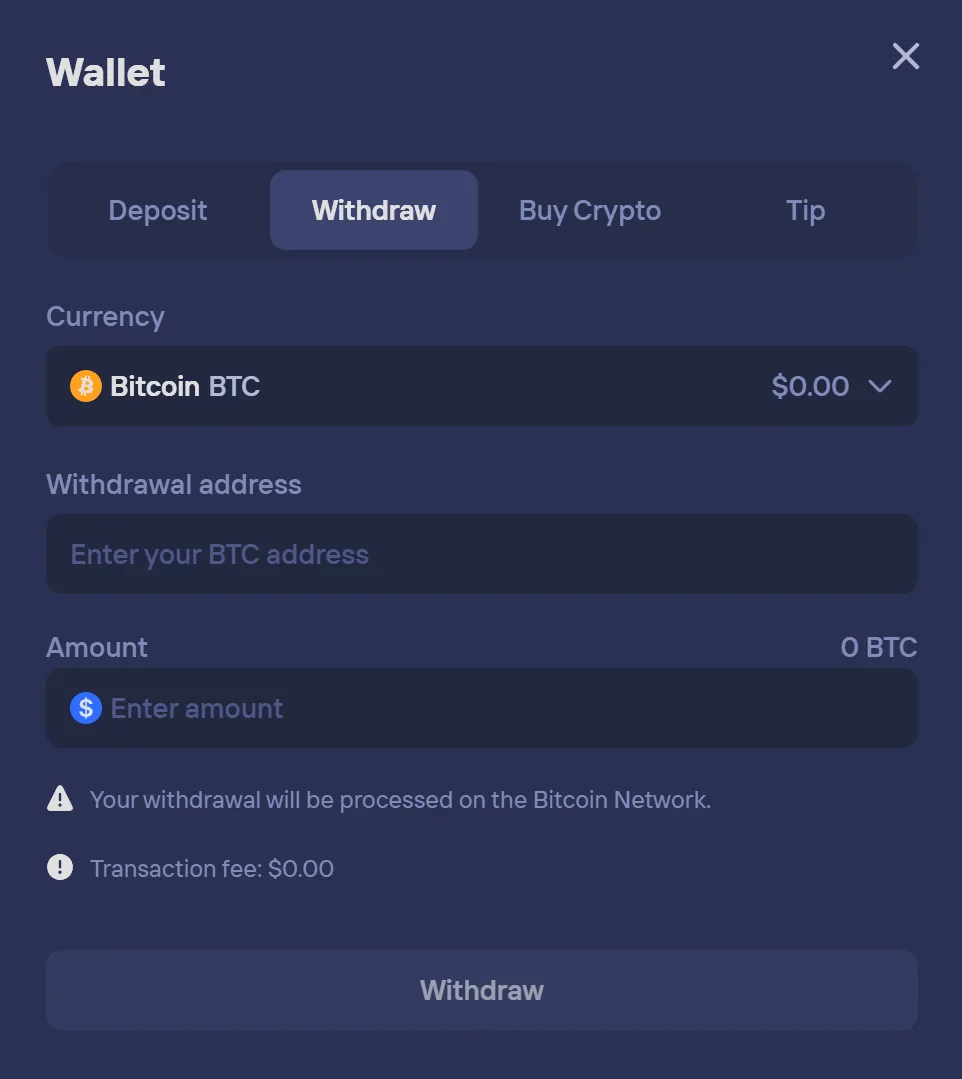
Most players doing expected value calculations track house edge, bonus rollover, and bet sizing to the decimal — then forget the toll booth at each end of their bankroll. Moving money onto an operator and cashing out costs money every single time. That cost has two parts: blockchain gas (network fees) and withdrawal surcharges set by exchanges or casinos themselves.
Scale changes everything here. On a $5,000 deposit, a couple of dollars in gas rounds down to zero in your spreadsheet. On a $20 top-up, a $3 Ethereum fee is a **15% penalty** applied before variance even gets a vote. You would need an improbable winning streak just to climb back to breakeven.
The math behind fee drag
Fee impact comes down to one ratio — fees divided by deposit size — and what that ratio does to your effective return.
1. Effective Starting Bankroll
Subtract total transfer costs ($F_{transfer}$) from your raw deposit ($D$) to get usable capital ($B_{effective}$):
B_effective = D - F_transfer
2. Drag on Expected Return
Take a game with a 1.0% house edge: playing through your full deposit once expects a loss of $D times 0.01$. Now add a $3 transfer fee to a $100 deposit. Your upfront drag is 3.0% — three times the entire house edge cost for that cycle.
Fee_Drag = F_transfer / D
3. The Lifetime Fee Equation
Multiply by frequency. Across $N$ deposit-withdrawal cycles per month:
Monthly_Friction = N × (F_deposit + F_withdrawal)
Side-by-side network cost table
Consensus design and block space economics make fee profiles wildly different from chain to chain. Here’s how each network behaves in practice:
+-------------------+-----------------+----------------+--------------------+-------------------------+
| Blockchain        | Avg Network Fee | Transfer Speed | Optimal Deposit    | Practical Rating        |
+-------------------+-----------------+----------------+--------------------+-------------------------+
| Litecoin (LTC)    | $0.01 - $0.05   | 2 - 10 minutes | All Stakes (>$10)  | Elite (Cheap & Stable)  |
| Solana (SOL)      | < $0.001        | $10)  | Elite (Ultra-fast)      |
| Tron (TRX / USDT) | $1.00 - $2.00   | 1 - 3 minutes  | Mid-Stakes (>$100) | Great for Stablecoins   |
| Bitcoin (BTC)     | $0.50 - $5.00+  | 10-60 minutes  | High-Stakes (>$200)| Moderate (Slow & Variable)|
| Ethereum (ETH)    | $2.50 - $20.00+ | 15-60 seconds  | Whale Only (>$1000)| Poor (Extremely Expensive)|
+-------------------+-----------------+----------------+--------------------+-------------------------+
Chain-by-chain notes for gaming deposits
Picking the wrong rail is the most avoidable leak in crypto gaming. Here’s where each network wins and loses:
1. Ethereum (ETH) – ERC-20
Security and support are excellent; micro-stakes economics are not. During congestion spikes, a simple transfer can run anywhere from $5 to $20, which makes small deposits outright unviable on this network.
2. Bitcoin (BTC)
Bitcoin pricing swings with mempool depth — expect roughly $0.50 to $5.00 per transfer. Fine for deposits north of $100. For anything smaller or more frequent, confirmation times and variable fees work against you.
3. Litecoin (LTC) & Dogecoin (DOGE)
The old reliable pair of crypto gambling rails. Litecoin clears transactions within minutes and holds its fee range to **$0.01 to $0.05** almost without exception. Among widely supported coins, it offers the least fee drag per dollar moved.
4. Solana (SOL) & Tron (TRX)
Built for high-frequency small transfers. Solana settles for a fraction of a cent (under $0.001), while USDT moves over Tron’s TRC-20 rail typically cost $1.00 to $2.00. Both are efficient conduits for shuffling stablecoins between exchanges and casino accounts.
Three habits that cut deposit and cashout costs
Every dollar paid to intermediaries comes straight off your expected value. Apply these rules:
- Bulk your deposits: One $100 transaction beats ten $10 ones on pure arithmetic — transaction count drops 90%, and fee drag collapses from punishing to trivial.
- Pick the coin to match the stake: Below $50, BTC and ERC-20 tokens are simply the wrong tool. Route through LTC, SOL, or TRX and keep fees at penny level.
- Cash out to Web3 wallets: Send winnings to a non-custodial wallet such as Metamask or Phantom instead of back to a centralized exchange. Exchanges slap flat withdrawal fees on every movement out again; a Web3 wallet lets you pay only the raw network rate.
Frequently asked questions
Why do some casinos credit less crypto than I withdrew from my exchange?
Because some centralized exchanges subtract their flat withdrawal fee out of the amount itself rather than billing your account balance separately. Withdraw $100 in BTC with a 0.0005 BTC fee attached, and only what remains after deduction actually arrives at the casino — so your opening balance lands lower than expected.
Are stablecoin (USDT/USDC) deposits cheaper than native coins?
The host network decides, not the token. USDT on Ethereum runs as a smart contract call and costs more than a plain ETH transfer. Shift the same token to Tron (TRC-20) or Solana and the price drops to a few cents.
How do I check current blockchain transaction fees before depositing?
Gas trackers are public and free: Etherscan Gas Tracker covers Ethereum, mempool.space covers Bitcoin. When fees spike after a market move or a major NFT mint, hold off for a few hours until activity normalizes — the network won’t mind waiting.