
Mines rewards patience and punishes greed. Our Mines Payout Matrix Calculator lists the exact multiplier and win probability for every (mines, safe reveals) pair, so you can decide in advance where your cashout point sits. For deeper play planning, see our Mines Strategy Guide.
Mines Payout Matrix
| Safe reveals | Cashout multiplier | P(next tile safe) |
|---|
How combinatorics drives the 5×5 grid
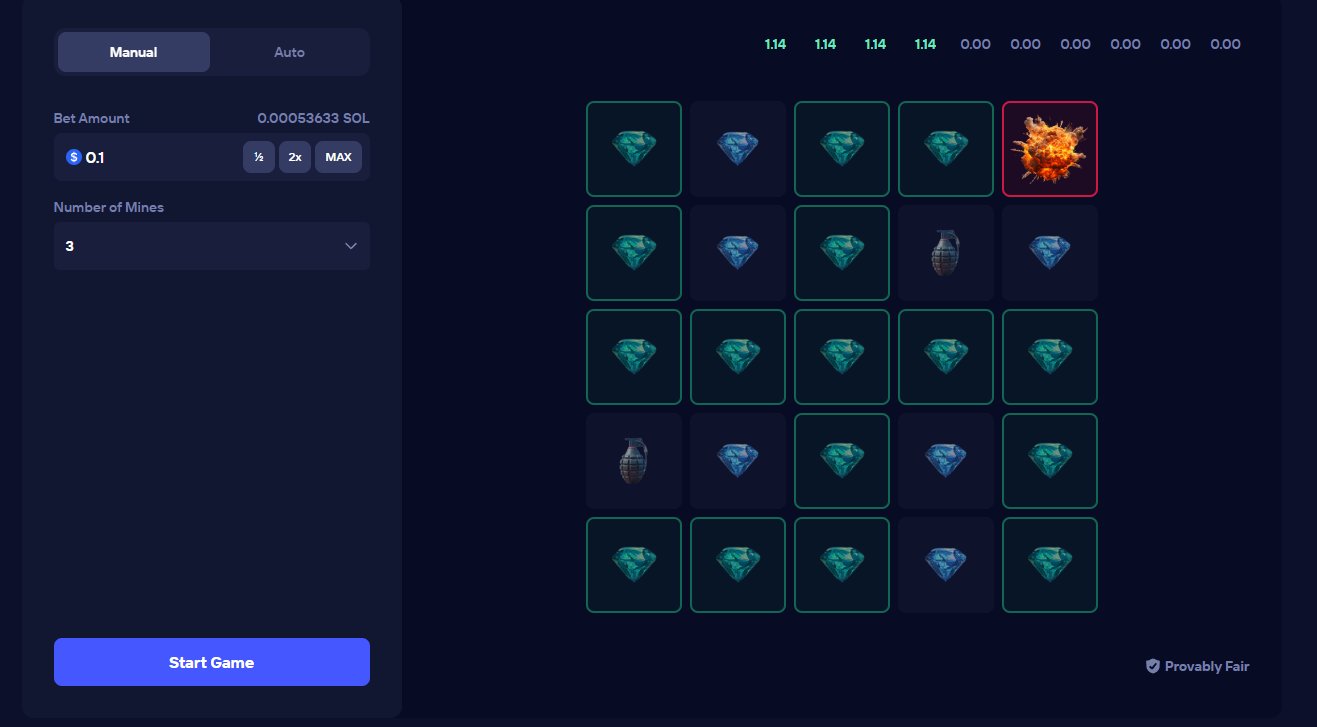

Casino Mines uses 25 covered tiles. Before the round starts you pick how many mines hide beneath them — anywhere from 1 to 24 — and place your bet. Each coin you uncover raises the payout multiplier and gives you a decision: bank the win or click again. One mine ends the round and takes the whole stake.
A stubborn myth says some squares are “hot.” They aren’t. The outcome is pure combinatorial probability: after every safe reveal, the mine-to-safe ratio on the remaining board worsens, so the danger of the next click climbs fast.
The math: Combinations and multipliers
The matrix is built from binomial coefficients — the count of ways to select $r$ safe tiles from a board holding $M$ mines:
1. Probability of Success
The probability ($P$) of uncovering $r$ safe tiles without touching any of the $M$ mines is:
P(Success) = C(25 - M, r) / C(25, r)
With the combinations function $C(n, k)$ defined as:
C(n, k) = n! / (k! * (n - k)!)
2. Calculating the Fair Multiplier
The operator then scales the fair odds by the house edge ($HE$), producing the payout multiplier ($Multiplier$):
Multiplier = (1 - House_Edge_Percentage) / P(Success)
Multiplier = (1 - House_Edge_Percentage) * C(25, r) / C(25 - M, r)
Step-by-step audit: Auditing 3 Mines, 3 Clicks
Take a round set to 3 Mines ($M = 3$) with a planned cashout after exactly 3 safe clicks ($r = 3$), on a game advertising a 1.00% house edge:
- Total ways to choose any 3 tiles from 25: $C(25, 3) = 2,300$.
- Ways to choose 3 tiles that avoid all mines (22 safe tiles): $C(22, 3) = 1,540$.
- Survival probability across 3 clicks: $1,540 / 2,300 = 66.96%$.
- Fair multiplier at zero edge: $1 / 0.6696 = 1.493x$.
- After the 1% house edge: $1.493 times 0.99 = mathbf{1.478x}$ payout.
The audit confirms the advertised figure matches the combinations exactly. If a site pays less than about 1.47x for this setup, its real edge exceeds the stated 1%.
Frequently asked questions
Is there a sweet spot for the number of mines?
No. Expected value ($EV$) is flat across the range: 1 mine and 23 mines both cost you precisely the house edge percentage. What changes is variance — more mines means larger multipliers and wilder swings in results.
Does the order in which I click tiles matter?
Not at all. Every covered tile carries the same uniform chance of hiding a mine, so tile selection has zero effect on win probability. A fixed pattern performs identically to random clicking.
Why does the house edge remain constant? (Verify that your board positions were fair with our Mines Verifier)
Because each click recalculates the multiplier through the same combinatorial formula. Every reveal is a separate conditional event, letting the operator extract its fixed edge percentage from the running wager at every stage.