
Martingale promises a guaranteed profit and delivers bankruptcy with mathematical precision. This Roulette Martingale Reality Check runs raw probability formulas plus Monte Carlo simulation to show exactly how table limits and losing streaks break the system (for the full argument, see Why the Martingale Fails).
Roulette Martingale — Reality Check
The allure and the mathematical trap
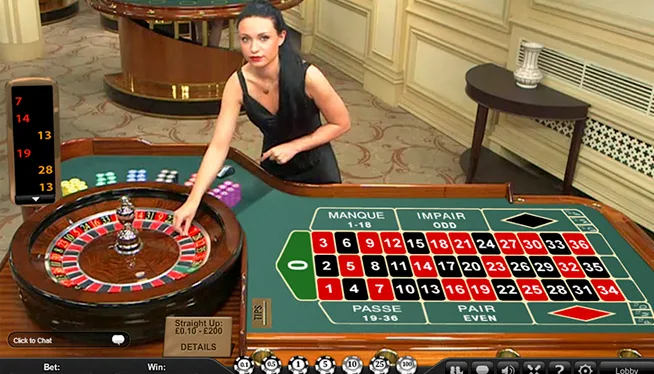

Here is the pitch. Bet $10 on red. Win, pocket $10, reset to $10. Lose, bet $20 instead. Lose again, go to $40, then $80, doubling each time. The sales logic: red has to land eventually, so one win wipes out every prior loss and leaves a clean $10 on top.
The flaw sits in that word “eventually.” A single spin rarely loses twice in a row, but sessions run hundreds of spins, and long streaks are not rare events over that span — they are near certainties. Each extra loss doubles your required stake exponentially, so either you hit the table limit or you empty your own bankroll first.
The math: European vs. American wheels
Zero pockets are what kill every progression system. They tilt even-money bets below 50% before you place a single chip:
1. Win Probabilities (p)
- European Roulette (37 pockets): $p = 18 / 37 = 48.65%$ (House edge is 2.70%)
- American Roulette (38 pockets): $p = 18 / 38 = 47.37%$ (House edge is 5.26% due to the double zero pocket)
2. Probability of Consecutive Losses
For exactly $L$ consecutive losses on even-money bets, use:
P(L_Losses) = (1 - p)^L
- On a European wheel, the probability of 8 consecutive losses is: $(0.5135)^8 = 0.49%$ (roughly 1 in 204 series).
- On an American wheel, the probability of 8 consecutive losses is: $(0.5263)^8 = 0.59%$ (roughly 1 in 169 series).
3. The Session Streak Probability
One in 204 sounds tolerable — until you count rounds. Across a standard 500-spin session, the odds of seeing a streak of 8 or more consecutive losses exceed **70%**. Per-series rarity and per-session frequency are very different numbers, and only the second one matters when real money is down.
Step-by-step audit: Simulating the collapse
Watch it happen in numbers: a 500-spin session on European Roulette, a $1,000 bankroll, a $10 base bet, and a $1,000 table limit:
- Set the starting bankroll ($1,000), base bet ($10), and game type (European Roulette).
- Input the table limit ($1,000).
- Run the simulator. The engine will run 10,000 independent sessions of 500 spins.
- Analyze the outcomes. You will see that in roughly 70% of those sessions, you will hit a streak of 7+ losses.
- Because the 7th loss requires a bet of $1,280, you cannot place the bet due to both your bankroll limit ($1,000) and the table limit ($1,000). The progression halts, and you lock in a massive loss.
Frequently asked questions
Does the “La Partage” rule help the Martingale system?
The “La Partage” rule (available in some French/European roulette games) returns half of your even-money wager if the ball lands on zero. While this reduces the house edge to 1.35% and slightly slows your rate of loss, it does not prevent the exponential growth of the Martingale system from eventually hitting the table limit.
Can I beat the Martingale by using a huge bankroll?
No. Even if you have an infinite bankroll, the casino’s table limit acts as an absolute shield. The casino limits the maximum bet (typically $1,000 or $5,000) to ensure that high-bankroll players cannot double their bets past a certain point, guaranteeing the house edge wins in the end.
What is the “Reverse Martingale” system? (Watch out for the Roulette Odds & House Edge)
The Reverse Martingale (or Paroli) system involves doubling your bet after every win, rather than after every loss. This is a positive progression that seeks to capitalize on winning streaks while capping your losses. It is significantly safer than the Martingale, but still cannot alter the negative expected value of the game.