
Crypto Dice: Win Chance, Payout Math, Verified Rolls
Pick a win chance, get a payout—the edge is identical at every setting. ProvablySmart breaks down the formula, the auto-bet trap, and why Martingale kills bankrolls.
Dice: As Transparent as Casino Games Get
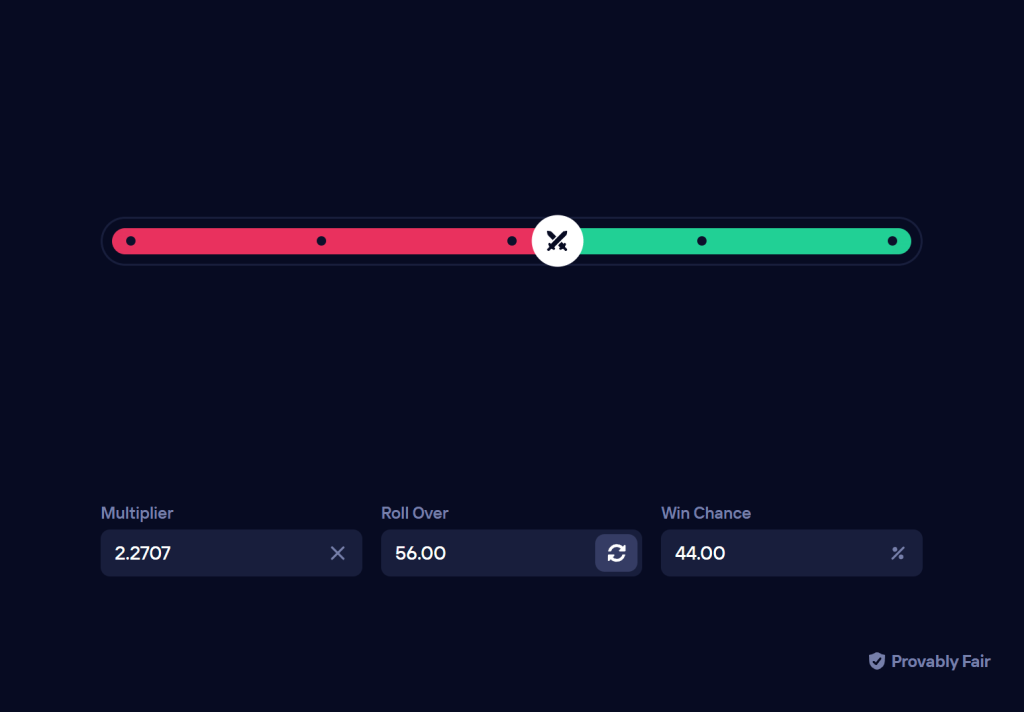
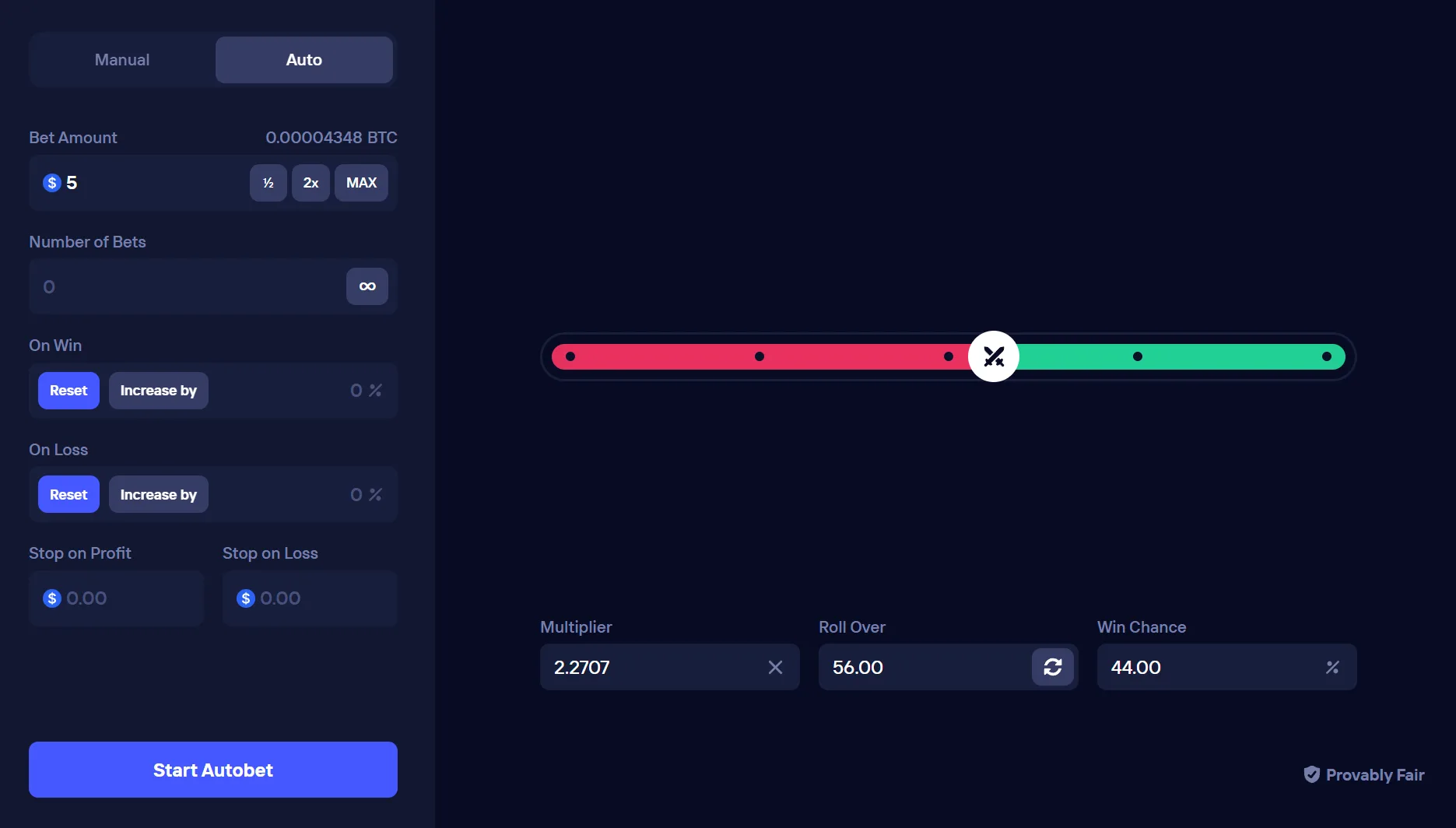
Dice predates almost everything else in crypto gambling. It was running years before Crash, case openings, or any of the polished provably fair originals casinos push today. SatoshiDice launched in 2012, and the core mechanic has barely moved since then: a number between 0 and 99.99 is generated, you pick a target, and you bet whether the result lands above or below it. That’s the whole game.
No animations. No social lobby. No climbing multiplier engineered to provoke greed. You set a win probability, the game computes the payout, you click. It is the dullest game on any crypto casino, and that dullness is exactly why it deserves study. If you can’t keep discipline playing Dice, nothing else on the site will treat you better.
How Dice Actually Works
Interfaces differ between platforms, but every Dice game shares the same structure underneath:
The Roll
The game produces one number between 0.00 and 99.99. On provably fair sites, that number is derived from the server seed, your client seed, and the current nonce before you click. The result exists before your bet does. The casino never sees your wager and then adjusts the outcome around it.
Roll Over and Roll Under
You pick a target and a direction. “Roll Over 55.00” wins on 55.01 or higher. “Roll Under 45.00” wins on 44.99 or lower. Target sets win chance; win chance sets payout.
The Win Chance Slider
One control governs everything. Slide right: win chance rises, payout falls. Slide left: win chance shrinks, multiplier climbs. You are always swapping probability for reward—there is no setting delivering both. That trade-off is where the house edge hides.
The Payout Math (Why Dice Cannot Be Beaten)
Few casino games expose their house edge formula this plainly. No hidden mechanics. Here it is:
Multiplier = (100 – House Edge) / Win Chance
With a 1% house edge and a 49.50% win chance, your multiplier is (100 – 1) / 49.50 = 2.00x. A fair coin flip would pay 2.00x with zero edge. The casino nudges your win chance down to 49.50% and pockets that 1%. Every payout at every win chance follows this formula exactly.
Some worked examples make the pattern obvious:
- Win chance 75% → Multiplier 1.32x. You win three of four rolls on average. Each win pays 32% profit; each loss costs 100%. Over four rolls: three wins of $0.32 ($0.96) minus one $1.00 loss = net -$0.04. That is the 1% house edge on $4 wagered.
- Win chance 49.50% → Multiplier 2.00x. Coin-flip territory, slightly tilted. Over 100 rolls at $1 each, you win roughly 49.5 times ($99) and lose 50.5 times ($50.50). Net: roughly -$1 on $100 wagered. One percent.
- Win chance 10% → Multiplier 9.90x. High risk. You lose 9 of 10 rolls on average; the one win pays 9.90x. Over 100 rolls at $1: 10 wins of $9.90 ($99) minus 90 losses ($90). Net: +$9 in this sample—but expected value over infinite rolls is still -$1.
- Win chance 1% → Multiplier 99.00x. Rare wins, massive payout, extreme variance. The other 99% of rolls fund the casino. The house edge is identical.
The fundamental truth about Dice: your win chance setting does not change your expected loss rate. A 95% win chance and a 5% win chance both bleed at the same pace over time. Only the volatility changes—how bumpy the ride feels.
House Edge Comparison Across Sites
Edge varies between platforms, and fractions of a percent compound across thousands of rolls:
- 1% house edge: The industry standard. Stake, Duelbits, Gamdom, and most major platforms run Dice at 1%—low compared to nearly every other casino game.
- 2% house edge: Some skin gambling sites and smaller platforms run 2%, doubling your expected loss rate. Over 10,000 rolls at $1 each, the gap between 1% and 2% is $100 in extra losses. Check the game info page before playing.
- 0.5% or lower: Rare. A few sites run promotional periods with reduced edge to pull in volume. A legitimate 0.5% Dice game is among the best expected values in any online casino game.
Dice Strategies (The Graveyard of Good Intentions)
Martingale on Dice
Set win chance to 49.50% (2x payout). Bet $1. Lose? Bet $2, then $4, $8, $16, $32. When you finally win, the 2x payout covers all losses plus $1 profit. Reset and repeat.
Our Crash guide covers why Martingale fails, and the logic carries over: the strategy requires an infinite bankroll to guarantee success, and yours is finite. A streak of 10 consecutive losses at 49.50% happens roughly once every 1,100 attempts. When it hits, your bet is $1,024 to recover $1 in profit. The risk-reward ratio is indefensible.
Auto-bet makes Martingale dangerously convenient. Set “on loss: multiply by 2x” and walk away—and you shouldn’t walk away. During a bad streak the script burns through your balance in minutes, and by the time you check your phone, it’s done.
Reverse Martingale (Paroli)
The mirror approach: double after wins, not losses, riding hot streaks and minimizing during cold ones. Same flaw as every streak-based system: each roll is independent. The RNG has no memory of last round. Your brain finds patterns in randomness because it is built to; the dice don’t care.
The D’Alembert System
Add one unit after a loss, subtract one after a win. “Martingale lite”—gentler progression, smaller catastrophe risk, slower recovery. Over enough rolls, the house edge grinds you down at exactly the same rate. The softer scaling just means it takes longer to go broke: more merciful, mathematically identical.
Flat Betting (The Only Sane Approach)
Same bet every roll. No progression, no adjustments based on results. Expected loss equals house edge times total wagered—nothing more. Flat betting produces no comeback stories and no wipeouts. If you play Dice for entertainment or VIP wager volume, it is the only approach that keeps variance manageable.
Auto-Bet Scripts: The Most Dangerous Button on the Page
Nearly every Dice game ships with auto-bet. You set bet amount, win chance, roll count, and conditional rules (“on loss multiply by 2x,” “on win reset to base bet”), and the system fires rolls at full speed—some platforms run 3-5 rolls per second.
Run the numbers. At 3 rolls per second with a $1 base bet, that’s 180 bets per minute. A 10-minute session wagers $1,800; at 1% house edge, expected loss is $18. That sounds tolerable until you notice nobody runs auto-bet for 10 minutes. An hour at $1 per roll is $10,800 in volume and $108 in expected losses.
Now bolt Martingale onto it. In a bad streak, bets escalate from $1 to $2 to $4 to $8 to $16 to $32 to $64 to $128 within seconds. Before your brain catches up, the script has placed $256. If that loses, $512. Auto-bet with Martingale progression is the fastest way to empty a balance anywhere in gambling.
If you use auto-bet at all, use it with flat bets only. Set hard “stop on profit” and “stop on loss” limits first, and close the tab the moment either hits. Auto-bet exists because faster bets mean more volume and more revenue for the house. It serves the casino, not you.
Why Dice Is Actually the Best Game for VIP Grinding
Here’s the counterintuitive point experienced players know: Dice’s low edge and high speed make it the most efficient way to accumulate wager volume toward VIP tiers.
Reaching Gold or Platinum requires a specific dollar amount wagered. The question is which game costs least per dollar of volume. Dice at 1% edge costs $1 per $100 wagered. Slots at 3-5% cost $3-$5 per $100. Crash at 3-4% costs $3-$4 per $100. Dice is the cheapest grind available, full stop.
Set a moderate win chance (around 49-50%), flat bet at a reasonable stake, and run a controlled session. Rakeback and VIP rewards can exceed your expected Dice losses, making the net cost of a higher tier roughly zero or slightly positive—but that depends entirely on the platform’s reward structure, not on any guarantee.
Provably Fair Verification for Dice
Dice is the easiest game to verify provably fair because the outcome is a single number. Most platforms combine the server seed, client seed, and nonce via HMAC-SHA256, then convert a portion of the hash into a number from 0.00 to 99.99. That number is your roll.
To verify: rotate your server seed (revealing the old one), take any past roll’s nonce and your client seed from that time, run them through the formula published on the site’s provably fair page, and confirm the calculated result matches the roll you saw. Match means legitimate; mismatch means tampering. Our provably fair guide walks through the full process.
Because Dice outcomes are a single number with no complex game state—unlike Mines’ grid or Plinko’s path—verification is as simple as it gets. If you verify any game, start here. Note that verifying outcomes confirms fairness of the roll, not that the game is profitable; the edge still applies.
The Psychology of Dice (Subtler Than You Think)
Dice lacks Crash’s visual drama or Mines’ grid tension. It’s just a number on a screen. The hooks are quieter, but they’re there:
- The illusion of control. The win chance slider feels like a strategic decision. It isn’t—every position has the same expected loss. The act of choosing creates engagement and a sense of agency that keeps you playing.
- Auto-bet detachment. Watching auto-bet fire hundreds of rolls, your brain stops registering individual bets. You see a fluctuating balance instead of discrete decisions, which makes it far easier to let a session overrun, because you’re not consciously choosing each wager.
- The “almost” factor. Rolling 50.01 when your target was “under 50.00” feels like robbery. It isn’t—it’s the mathematical boundary working as designed. But near-misses trigger frustration, and frustration triggers impulsive play: nudging the win chance higher or bumping bet size to “recover” a round that was never stolen.
- Session length creep. Dice sessions run long because nothing forces a pause. Crash has visible round endings; slots have spin-and-wait cycles. Dice is a continuous stream of numbers. Players who plan “20 quick rolls” routinely end up at 500.
Common Dice Mistakes
- Running Martingale on auto-bet with no stop-loss. Said three times already; worth a fourth. Automated Martingale is a bankroll execution script. Set a stop-loss or skip Martingale entirely.
- Chasing a specific profit target. “I’ll stop at $120.” The game neither knows nor cares about your target. Adjusting bet size as you approach an emotional goal means overexposing yourself exactly when variance can hurt most.
- Playing 2% edge when 1% is available. If you’re grinding volume, the platform’s edge matters. A 2% Dice game costs twice as much per dollar wagered as a 1% game. Some players forfeit hundreds to extra edge over a lifetime simply by never comparing.
- Confusing low variance with low risk. A 95% win chance bet feels safe—you win 19 of 20 rolls. But each loss costs your entire bet while each win pays only 4% profit. Expected loss per dollar is identical to a 5% win chance at 19x payout. “Feels safe” and “is safe” are different things.
- Not withdrawing during profitable sessions. If auto-bet runs 30 minutes and you’re up 15%, stop and withdraw. Expected value of continuing is negative; every extra roll erodes session profit at the house edge rate. Quitting while ahead is the only winning strategy in any negative-EV game.
Where We Stand on Dice
Dice is the purest and most mathematically honest game on any crypto gambling site. The edge is posted, the formula is public, verification is trivial, and nothing obscures the fact that you’re playing a negative expected value game. It is gambling stripped to its skeleton.
ProvablySmart respects that honesty—if every casino game were this transparent, players would be measurably better off. The real danger isn’t the game; it’s the auto-bet button, the Martingale scripts, and the way long sessions bleed a balance without dramatic warning signs. Flat bets, hard limits, and a clear view of what the game is: a clean, low-edge grind that happens to be the most efficient VIP wager-volume tool available.