
A 5×5 grid, a Fisher-Yates mine shuffle locked in before your first click, and one decision: when to cash out.
Mines
5×5 board, hidden mines. Cash out anytime — multiplier rises per safe reveal. 1% house edge.
Auto-bet
How dishonest operators rig this game 5 documented tricks
Mechanism. Layout is not committed at round start. Each click re-rolls the mine map with a higher mine-density bias as your multiplier rises.
Red flag. Stake-style PF commits the FULL Fisher-Yates shuffle at round start. If the operator can't reveal all mine positions after a single click, they're cheating.
Mechanism. To feel generous, the first click is forced safe — but the next mine is moved closer to your likely-next click. Net EV worse than advertised.
Red flag. In a proper PF Mines, the first click can land on a mine. If you've never busted on click 1 in dozens of rounds, the layout is biased.
Mechanism. When current multiplier approaches your displayed cashout target, the button becomes unresponsive for 300ms. You either accept staler value or wait into a mine.
Red flag. Click-to-confirm timing must be deterministic. Variability tied to multiplier value = intentional friction.
Mechanism. Displayed multiplier for "3 mines, 5 safe" is 2.5× but actual payout 2.45×. Sub-cent skim per click multiplies over a session.
Red flag. Compute m(M, r) = (1 − HE) · C(25, r)/C(25 − M, r) yourself for your config. Operator must match to 4 decimal places.
Mechanism. Auto-cashout triggers fire AFTER the next reveal — if that reveal is a mine, you lose even though you "cashed out".
Red flag. Order of operations must be: cashout request → operator confirms → bet closed → THEN you can reveal more. Any race condition is house-favorable by design.
For the full compendium across all games, see The Book of Casino Dirty Tricks.
—— pending rotation —How Mines math works
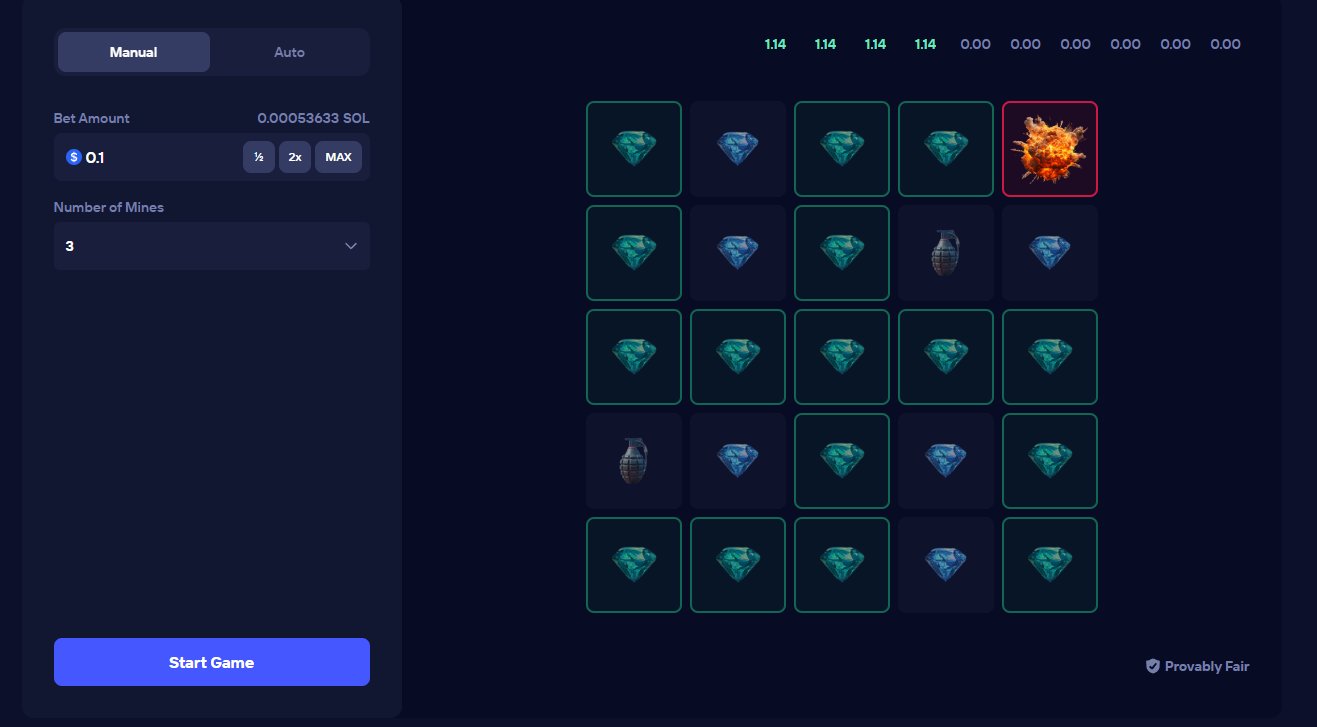

Twenty-five tiles. M of them hide mines. A properly built provably-fair version commits the full mine layout the moment the round opens, running an inside-out Fisher-Yates shuffle on HMAC-derived floats:
arr = [0, 1, 2, ..., 24]
for i from 24 down to 1:
    j = floor( float[24 − i] · (i + 1) )
    swap(arr[i], arr[j])
mines = arr[0 .. M-1]      // first M positions = mine indices
After R safe reveals, your multiplier comes from binomial counting:
m(M, R) = (1 − HE) · C(25, R) / C(25 − M, R)
C denotes the binomial coefficient. The Mines payout matrix tool builds the complete table for any mine count you enter.
The “first click safe” trap
Some operators ship Mines variants where your opening click can never hit a mine. That sounds like a gift. It isn’t — it’s precisely the pattern flagged in the Dirty Tricks book: committing the layout at round start means revealing it must be possible after any single click. If mines are regenerated after that first click, they can be nudged toward where players statistically click next.
EV per click is constant — but variance is enormous
Elegance check: at any safe-reveals count R, the expected return from flipping another tile equals exactly −house edge. Verify it yourself — safe probability times the ratio of next-multiplier to current-multiplier, minus one. Variance is a different animal entirely.
Set 20 mines and bank 4 safe reveals and your multiplier sits near 121×. One more tile: 80% chance of roughly 242×, 20% chance of nothing. On a $100 bet, a single flip swings between $0 and $24,200. Identical expected value to a Crash round at 1.01× — with none of the same sleep.
Where strategy actually applies
- Treat your cashout target as a risk profile. Locking 5× while the board offers 4.8× preserves equity sensibly; refusing to stop at 5× while dreaming of 100× is pure gambler’s fallacy.
- Mine count dictates bet size. More mines mean steeper multipliers paired with worse odds on every individual click, so shrink stakes relative to bankroll. The bet sizing optimizer handles the arithmetic.
- Catch suspicious layouts. Expected first-click bust rate is about M/25. If reality diverges sharply across 100+ tracked rounds, commitment may be missing entirely.
Frequently asked questions
Can I figure out where mines are mid-round?
You cannot. The committed layout stays hidden by design — each click exposes exactly one tile. All strategy lives in the choice of when to stop flipping and take the payout.
Why does the payout grow so fast?
Combinatorics. After R safe reveals with M mines, the chance of having flipped R safe tiles in sequence is C(25−M, R) / C(25, R). The multiplier is essentially that probability’s reciprocal, trimmed by house edge. Long runs have tiny probabilities, so their reciprocals balloon.
What’s the maximum multiplier?
M = 24 mines leaves one safe tile, and the first click pays ~24.75× (one-in-25 odds less 1% HE). M = 1 mine produces the same ~24.75× only after 24 consecutive safe reveals. Your mine count shapes the whole curve.