
The exact scoring system behind our operator listings, what qualifies as a verified incident, and the lines we will not cross for affiliate revenue.
Our methodology
How we decide what goes on the Fairness Ledger, how we score operators, and what we explicitly refuse to do for affiliate money.
The five audit criteria
Every operator we review is scored 0–5 against the same five tests. Pass = ✓, fail = ✗, mixed = ½. Public ranking is the sum.
Server-seed commitment
Does the operator publish a SHA-256 of the server seed BEFORE accepting bets? The hash must be visible client-side, not buried in a docs page.
Seed reveal on rotation
When the server seed rotates, the OLD seed must be revealed. We re-compute its hash and verify it matches what was published.
Player-editable client seed
The player must be able to set their own client seed. Operator-only RNG = no provably fair.
Bias-free derivation
The outcome formula must avoid modulo bias (use rejection sampling or a domain that divides cleanly). We test this with the modulo bias detector and a chi-square sample.
Published algorithm
The exact outcome-derivation algorithm must be documented. "Trust us" is not provably fair.
What counts as a "verified" incident
An incident moves from alleged to verified only on one of:
- A court ruling or regulator order against the operator.
- The operator's own public admission (post-mortem, statement).
- Independent, reproducible technical evidence (e.g. published HMAC mismatch, hash chain break) — we re-derive it ourselves before publishing.
Reddit threads and Twitter screenshots are alleged-tier — useful as starting points, never enough on their own.
What we will not do
- No paid placements. We don't take money to add, suppress, or remove Ledger entries.
- No affiliate gating. We will not list an operator as "verified" because they pay us — only because they pass the five criteria above.
- No anonymous removals. If an operator wants an entry retracted, we publish their argument and our response. The Wall is a record.
- No copy-paste. Every entry is hand-checked against its sources. If we can't verify, we don't publish.
Affiliate disclosure
We do accept affiliate revenue, but ONLY from operators currently scoring 5/5 on the five criteria. If an operator's score drops, the affiliate link comes off the same day. Current list is on the operators page.
Submitting a tip
Send leads (with sources) to [email protected]. We publish credit unless you ask for anonymity. Corrections to existing entries go to [email protected].
Why we publish the scoring rules
Strip away the wording on most review sites and you find affiliate programs. Commission tiers shape editorial verdicts: a larger revshare means a better star rating. The result is predictable — leaderboards that quietly favor whoever pays most, which is rarely who treats players best. Operators aggressive enough to skim players usually spend heavily on affiliates to hide it.
Our answer is falsifiability. Five technical criteria apply identically to every operator listed here. Fail one, lose points — no exceptions. We also decline affiliate deals from any operator failing even a single criterion, so nobody is paying for grade inflation.
What “verified” demands in practice
Criterion 2 — seed reveal on rotation — gets violated more than any other. Faking it costs an operator almost nothing: hash a fixed string, skip rotation entirely, slap “PF” on the homepage. Since few players bother re-hashing seeds, the marketing arrives without the engineering.
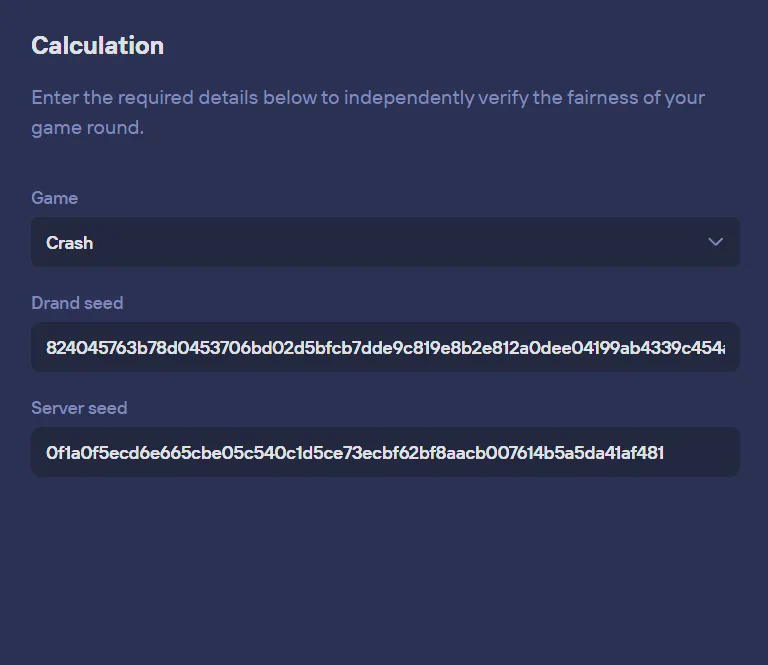
We check anyway. Regularly. Sampled hashes are pulled from covered operators, rotation is awaited, SHA-256 verification runs against each revealed seed, and outcomes get published verbatim. No rotation? Flagged. Reveal that doesn’t match its published hash? Straight onto the Fairness Ledger.
Affiliate money cannot buy these four things
- Paid placement: no listing can be purchased at any price. Passing the audit is the only route in.
- Takedown of negative coverage: Ledger entries persist until the operator publicly acknowledges the issue and fixes it — or until hard evidence forces a retraction.
- Buried audit dates: every review shows its last audit date. Once an audit goes stale, the operator drops to “unverified” pending a refresh.
- Manual score overrides: scoring stays mechanical. A 3/5 cannot become 5/5 through persuasion, however friendly the call.
How tips and submissions get vetted
Submissions go to [email protected]. Nothing publishes without independent reproduction first:
- We follow the tip’s reproducer steps against the live operator, or against a captured server response when live access isn’t possible.
- A second, independent source is sought wherever it exists — Reddit threads, Discord logs, court records, regulator actions.
- The operator receives right of reply, published inside the entry word-for-word. Aggressive responses included.
- All entries carry versions. Prior versions remain readable; history is never rewritten silently.
The standing invitation
Covered operators may dispute any entry they like. Produce technical evidence contradicting ours and we amend the record with attribution. Here’s the track record: we have never softened a finding for promotional consideration. We have revised findings repeatedly — every single time for evidence. Those aren’t interchangeable currencies.