
Provably Fair pillar: Core Mechanics
Server Seed, Client Seed & Nonce: How Provably Fair Actually Works
Forget the cryptography lecture. Provably fair runs on three values and one guarantee: once your bet is placed, the casino can no longer touch the randomness — and you can prove that to yourself with a calculator-level effort.
The trio looks like this:
Server Seed (the casino’s hidden string), Client Seed (your visible input), and Nonce (a counter that ticks up per bet).
Grasp those three and you’ve covered most of the system. The remainder is just each site’s packaging.

Seeds set the recipe. Nonce picks the page. The result is reproducible from all three.
A mental model you won’t lose mid-session
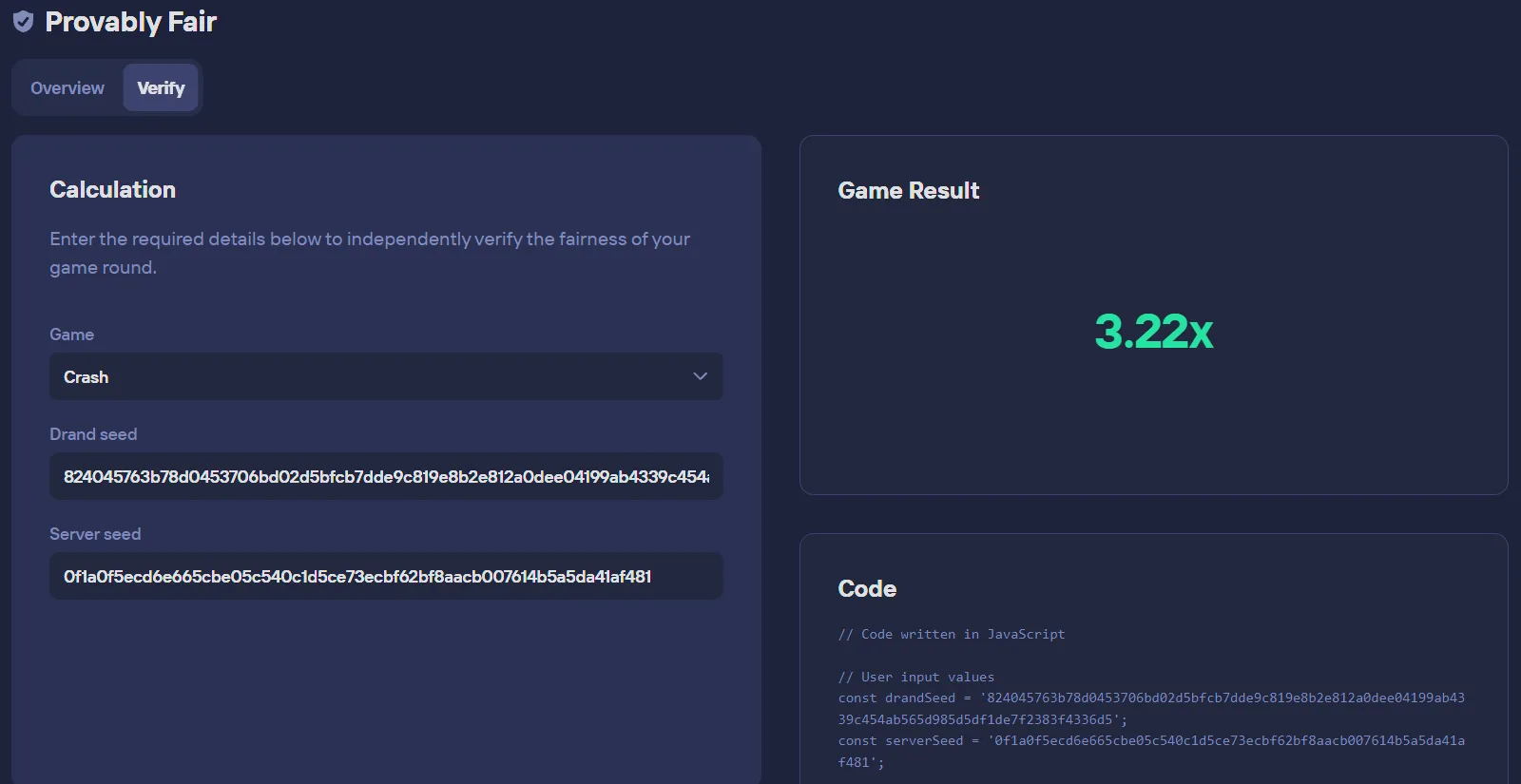
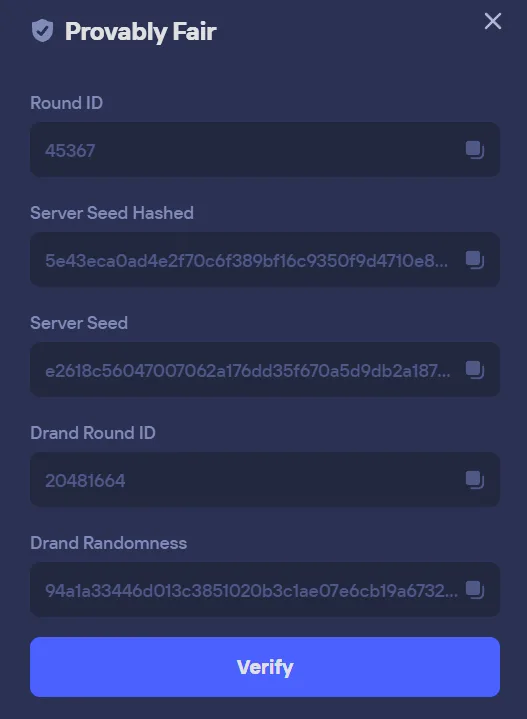
Three everyday objects, three jobs:
Server Seed = the sealed envelope
The site generates a secret value and publishes its hash upfront. When the seed is eventually revealed, you hash it yourself and check it against that earlier fingerprint.
Client Seed = your fingerprint on the outcome
This is the part of the randomness you contribute. It gives you zero predictive power; its job is making sure one party alone doesn’t generate results.
Nonce = the round counter
Every bet bumps the nonce by one, so identical seeds still produce different rounds.
The core idea: outcomes are computed deterministically from (Server Seed + Client Seed + Nonce). Hand me those three values and I’ll reproduce your result bit for bit.
Want the broader definition first? Read:
Provably Fair Explained.
Server seed: why the published hash matters more than the seed itself
Server Seed is the random string living on the casino’s server. It stays hidden while you play — with good reason, since knowing it would let anyone compute future outcomes. What you see instead:
Server Seed Hash — a one-way fingerprint of the seed, published before any bets.
The hash is a commitment device. From the moment it’s displayed, changing the underlying seed would change the hash too, so tampering becomes detectable rather than deniable.
After a seed cycle ends, the actual server seed is revealed. Hash it yourself. Does it match what was shown earlier? Good.
If it doesn’t match? That isn’t variance. That’s an integrity failure, full stop.
The classic player error: reproducing the game result but never comparing the revealed seed against the original hash. Always do both. The hash check is the part that proves nothing was edited.
Client seed: the real job and the fantasy job
Client Seed is your public contribution to the input. Sites usually auto-generate one, and many let you swap it whenever you like.
What it genuinely does:
- Stops the casino being the sole source of the randomness.
- Ties every outcome to a value visible to you — sometimes even one you picked.
- Gives verification its meaning as a shared-input process.
What it absolutely does not do:
- Improve your odds in any way.
- Predict upcoming results.
- Create a player edge over the house.
Why no prediction? Simple: without the server seed, the next outcome stays unknowable — even if you fully control the client seed.
A new client seed reshuffles the sequence. It leaves the expected value untouched.
Anyone selling “seed manipulation” as a winning tactic deserves the same credibility as a mattress salesman citing clinical trials.
Nonce: dull to describe, the #1 cause of failed verifications
Nonce is typically a plain integer that rises by 1 per bet (or per generated result) under the same seed pair.
Its entire purpose is uniqueness. Same seeds forever, no counter — same result, bet after bet. That would break every game on the site.
Thanks to the nonce, Round 1 differs from Round 2 even when neither seed changed.
Practical note: verify with the nonce recorded in that specific bet’s history — not whatever number the current counter shows now.
Implementations vary across casinos:
- One global counter shared by all provably fair games.
- Separate counters per game type.
- A reset whenever seeds are rotated.
None of these approaches are wrong in themselves. They just mean the correct verification input is always the nonce logged alongside the bet you’re checking.
From three values to one outcome, minus the code drowning
Nearly every provably fair implementation follows the same skeleton:
- Merge Server Seed + Client Seed + Nonce into one input string
- Feed it through a cryptographic function (frequently HMAC)
- Convert a slice of that output into a number
- Map the number onto a game outcome (roll, multiplier, board position, etc.)
Conceptually, sketching it out:
input = server_seed + ":" + client_seed + ":" + nonce
output = HMAC_or_HASH(input)
result = map(output)  →  game outcome
The property doing all the work here is deterministic reproducibility. Identical inputs produce identical outputs. Every single time.
When a casino documents its method and exposes its values, verifying stops being trust and becomes arithmetic.
Seed cycles explained: why you wait for the reveal
Most sites organize this into “seed cycles”:
- You receive the hash of an upcoming server seed (the commitment).
- You play many rounds against that hidden seed.
- On demand or automatically, the server seed gets revealed.
- A fresh server seed takes over, its hash published for the next cycle.
Nothing suspicious here. Reveal the seed early and future results become computable by anyone paying attention. Secrecy until after the fact is the mechanism working as designed.
Player tip: only try to verify rounds belonging to a finished cycle — ones where the server seed has actually been disclosed.
Seed hygiene: habits of a calm, competent player
Nobody needs to audit constantly. A few routine habits keep verification available when it counts.
1) Rotate your client seed now and then
Not because it changes RTP — it doesn’t — but because poking around the fairness settings keeps you alert instead of running on autopilot. Players who ignore seeds tend not to verify when they should.
2) Run one sample audit at a new casino
Take 5–10 bets, run them through verification once. After that, spot-check occasionally or whenever something looks strange.
3) Missing data = red flag
If there’s no way to retrieve a nonce or the revealed server seed for completed rounds, “provably fair” has degraded into marketing copy.
Full list here: Provably Fair Common Red Flags.
Working tools sit at:
Provably Fair Verifiers and
Provably Fair Checklist.
What provably fair cannot protect you from
This distinction matters more than almost anything else on this page: provably fair is proof of fairness, not a safety certificate.
It says nothing about:
- fast withdrawals
- reasonable KYC
- fair bonus terms
- good RTP
- short-term results (variance still exists)
We untangle the “safe vs fair” confusion on its own page:
Does Provably Fair Mean Safe?
For streaks occurring inside fair games:
Variance & Volatility Explained and
Why High RTP Still Loses Short-Term.
The mini-checklist before trusting any “provably fair” badge
If a single routine sticks, let it be this one:
- A server seed hash is visible before I play.
- The revealed server seed for completed rounds is accessible afterward.
- My client seed and the exact nonce per bet are retrievable.
- A clear, reproducible verification method exists — built in or documented.
- An independent verifier lets me cross-check results.
Missing any item? Then the casino is demanding trust while claiming it doesn’t need any.
Carry on with:
How to Verify a Provably Fair Bet.
FAQ
Why can’t the casino just reveal the server seed before the bet?
Early disclosure would make future outcomes computable by anyone. The scheme only holds if the casino commits via a hash first, plays against the secret, and reveals afterward — verifiable without being predictable.
If I choose my client seed, can I influence results?
You shape the sequence, since every result depends partly on your client seed. You cannot predict them, though, because the server seed stays unknown until it’s revealed. Participation in the input is not steering the output.
What is nonce and why does it matter?
It’s a per-bet counter keeping rounds unique despite unchanged seeds. Most failed verifications trace back to using the wrong one — the live counter instead of the value stored with that bet. Use the nonce in the bet’s own history entry.
Do all provably fair games use the same formula?
The cryptographic ingredients often overlap, but mapping hash output onto outcomes varies between games — Dice, Crash, and Mines all do it differently. Match your verification method to the specific game.
Does provably fair mean the casino is safe?
No. It proves the randomness wasn’t edited post-bet. Withdrawal speed, KYC handling, bonus policies, and operator conduct are separate questions entirely. Start here: Does Provably Fair Mean Safe?