
The ball’s every left/right bounce comes from one float in an HMAC stream. Your payout depends on which risk profile’s multiplier table the operator loaded.
Plinko
Drop the ball through rows of pegs. Each row consumes one HMAC float (<0.5 = left, ≥0.5 = right).
Auto-bet
How dishonest operators rig this game 4 documented tricks
Mechanism. Operator decides the bucket up-front, then animates a "convincing" path to it. The visual path you watched is fake — bets are bound to the final bucket only.
Red flag. Each row should consume exactly one HMAC bit/byte deterministically. Replay the bytes and trace L/R yourself — visual must match.
Mechanism. Before the drop, a "hot" bucket is highlighted to tempt you to bet bigger. The highlight is randomized, not predictive.
Red flag. Hot buckets that "happen" to land on your bigger bets disproportionately are statistical fingerprints of rigging.
Mechanism. Same risk profile shows different multipliers session-to-session. Heavy session = lower multipliers; cold session = higher (to keep you hooked).
Red flag. Screenshot the payout table at start of session. Compare to end. Any change = silent recalibration.
Mechanism. Animation uses a "ball" that visibly drifts toward outer (low-mult) buckets in slow-motion replay. The float-determined path is honest; the WEIGHTING ad displayed differs.
Red flag. Same algorithm describes ball physics — there should be no operator parameter "weight" or "elasticity" that the player can't see.
For the full compendium across all games, see The Book of Casino Dirty Tricks.
—— pending rotation —How Plinko derives its outcome
How Does This Compare to 0% House Edge Protocols?
Audited 100% RTP
Instead of standard 1.00% to 4.00% casino house margins, compare with mathematically verified 100% RTP Originals (0.00% House Edge) on Duel Casino:
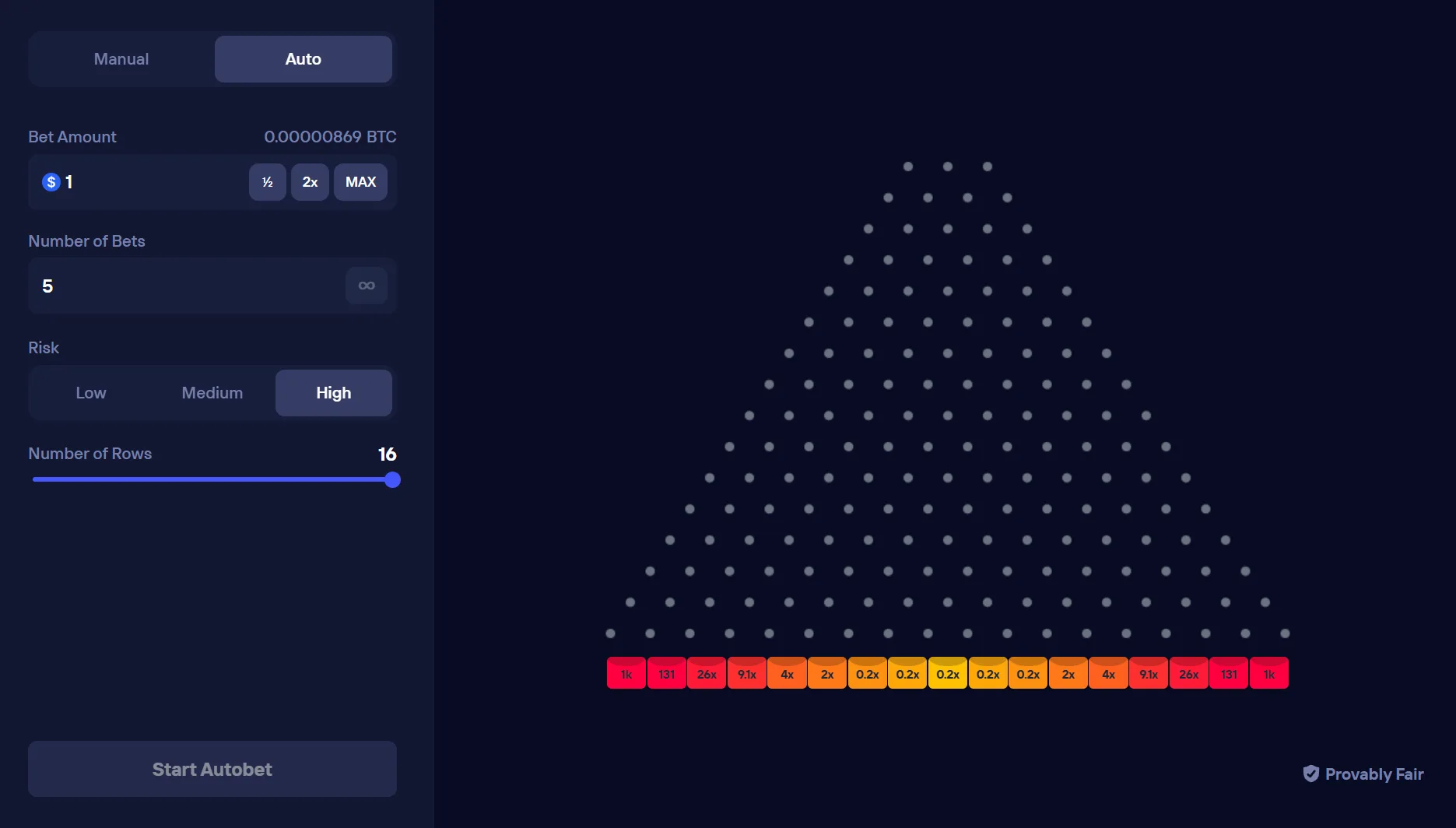
One HMAC float per row of pegs — no more, no less:
for row in 0 .. (rows − 1):
    float[row] < 0.5  →  ball bounces LEFT
    float[row] ≥ 0.5  →  ball bounces RIGHT
bucket = total count of RIGHT bounces      // range [0, rows]
So the bucket number is just a tally of right-bounces, which means the result follows Binomial(rows, 0.5). At 16 rows the mass piles up around bucket 8 in the centre. The edge buckets sit exponentially far out — and that scarcity is exactly what their big multipliers are paying for.
Why the multiplier table shapes everything
The algorithm carries no house edge at all. The edge lives entirely in the published payout schedule — a multiplier per bucket per risk profile, constrained by:
Σ ( P(bucket = i) · multiplier(i) ) = 1 − house_edge
Operators don’t share schedules. Two casinos can run identical row counts with different payouts. On higher “risk” settings, weight shifts toward the rare outer buckets while middle buckets often pay under 1.0× — land dead centre and you still lose money.
This is the clearest example anywhere in casino gaming of “risk” meaning something precise. Plug any payout table into the EV calculator and check that it integrates to the operator’s claimed edge against the binomial distribution.
Operator manipulations
Straight from the Dirty Tricks book:
- Path animation ≠ actual bucket. The bucket gets decided first; then a plausible path is animated backwards from it. The bounce sequence you watched never happened mathematically.
- Multiplier ladder swap. The same risk label shows different numbers between sessions. After a big hit, some operators quietly retune the table.
- “Lucky bucket” pre-highlight. That glowing “hot” bucket before your drop? Random decoration. It predicts nothing.
What strategy actually does
- Risk profile. High risk trades frequent small wins for rare large ones; low risk produces steady small losses with occasional modest hits. Identical expected return, wildly different volatility.
- Row count. Fewer rows spread probability wider across buckets. More rows tighten the bell curve around the centre bucket.
- Bankroll sizing. High-risk Plinko carries a heavy left tail of losses. Size bets with a Kelly fraction built on the standard deviation, not expected value alone — the Kelly calculator handles that.
Frequently asked questions
Is high risk better than low risk?
Expected value is identical either way; variance is not. Which suits you depends on bankroll depth and how long you can ride a drought. High risk only makes sense with funds large relative to your bet size.
How do I verify the path animation matches the algorithm?
Run our Plinko verifier. Feed it (server, client, nonce, rows) and it returns the L/R path string plus final bucket. If the casino’s animation doesn’t match on identical inputs, it’s animating fiction.
What’s the probability of hitting the rarest bucket?
For N rows: P(bucket = 0) = P(bucket = N) = 1/2^N. Sixteen rows give 1 / 65,536 — roughly once every 65k rounds. Those monster multipliers exist precisely because the odds are that thin.