Nonce Tracking: A Spreadsheet Method for Long Sessions

the author
ProvablySmart Research Desk
date post
Aug 28, 2026

Share


Long sessions create a verification problem. The casino publishes seed hashes, but once you have placed 2,000 or 10,000 bets, reconstructing which nonce corresponded to which bet and whether any outcome was altered is no longer a memory task. It is a bookkeeping task. This article describes a spreadsheet-based nonce tracking method that lets you verify every bet in a session against the provably fair data, without relying on the casino’s own history page as the sole source of truth.
Why Nonce Tracking Matters
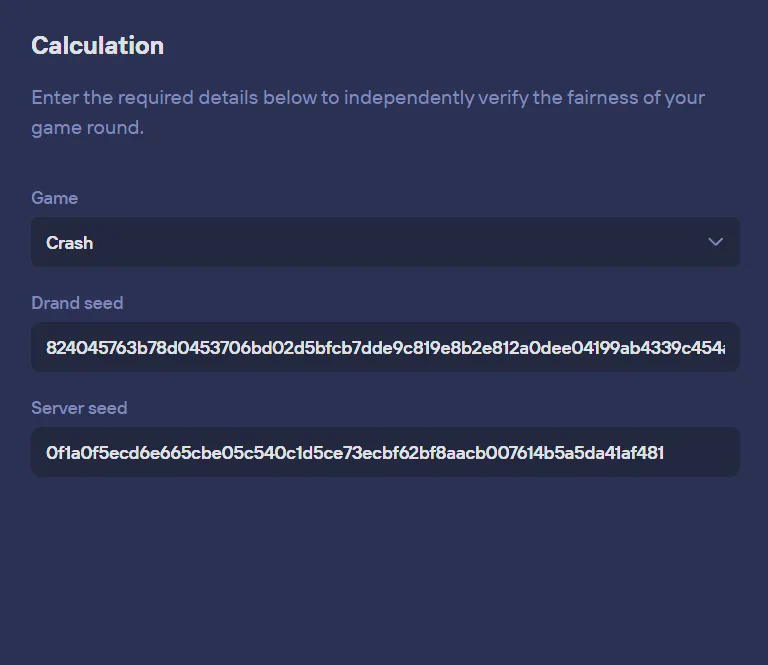
In a standard provably fair scheme, the server seed, client seed, and nonce are fed into a HMAC-SHA256 or similar function to produce each bet outcome. The nonce is a monotonically increasing integer included in each round. If you only record win/loss and amount, you cannot later reproduce the outcome. If you record the nonce along with the seeds, you can recompute the result offline and confirm it matches what the platform displayed.
Tracking nonces is also the only practical way to detect seed reuse or nonce resets. If a casino resets a nonce counter after a server seed rotation, the same seed pair plus nonce combination can repeat. That does not automatically mean fraud, but it does mean the game is not behaving as documented. A spreadsheet that records seed changes and nonce ranges makes such resets visible.
What the Spreadsheet Should Record
How Does This Compare to 0% House Edge Protocols?
Audited 100% RTP
Instead of standard 1.00% to 4.00% casino house margins, compare with mathematically verified 100% RTP Originals (0.00% House Edge) on Duel Casino:

The sheet has one row per bet. Do not compress by grouping identical results. The goal is an auditable log that matches the casino’s own bet history row-for-row, so each row must contain enough data to reproduce the result independently.
| Field | Example | Purpose |
|---|---|---|
| Timestamp (UTC) | 2026-04-12 14:03:22 | Matches platform history ordering |
| Game ID / Round ID | d4f8a1c9… | Unique identifier for cross-reference |
| Server Seed (at bet time) | ab12… (truncated) | Required for recomputation |
| Client Seed | user-provided string | Required for recomputation |
| Nonce | 1044 | Session counter input |
| Bet Amount (units) | 0.00025 BTC | RTP calculation denominator |
| Payout Multiplier | 1.98x | Stated result for comparison |
| Outcome (Win/Loss) | Win | Quick filtering and statistics |
| Profit (units) | +0.000245 BTC | Bankroll tracker input |
The server seed column does not need the full 64-character string on every row. Record the full server seed when it is first revealed, then use a short identifier or the first 8 characters for each subsequent row. The critical point is that the exact seed value at the time of each bet is determinable. If the platform reveals the server seed only after you roll over to a new one, you must copy the full seed into the sheet at that moment.
Building the Sheet: Columns and Formulas
Use any spreadsheet software that supports formulas. The layout below is for a sheet with headers in row 1 and data starting in row 2. Adjust column letters to your actual layout.
Core formulas
- Session nonce delta:
=IF(A3="","",A3-A2)placed in a helper column. This highlights gaps or resets. If the delta is not exactly 1 during an uninterrupted session, you have missed a bet or the nonce was reset. - Profit calculation:
=IF(G2="Win", (F2*H2)-F2, -F2)where F is bet amount, G is outcome, H is payout multiplier. This assumes a standard multiplier where 1.00x is a loss of stake. Adjust for edge cases like split payout tiers. - Running total:
=SUM($I$2:I2)in a cumulative profit column. This feeds directly into bankroll management calculations. - Running RTP:
=SUM(actual payout)/SUM(bet amount)over a nonce range. Compare this against the theoretical RTP for the game. A long-run deviation of more than a few percent for thousands of bets warrants checking your data entry against the platform history.
Conditional formatting
Set conditional formatting on the nonce delta column: highlight any value that is not 1 while the same server seed and client seed are active. Highlight negative values. These are the two anomalies that indicate a nonce reset or a skipped entry.
Verification Workflow
The spreadsheet becomes useful when paired with an independent recomputation step. This is a manual process, but the sheet makes it fast enough for spot checks on a long session.
- Export the casino’s bet history as CSV or copy it from the game page after the session. Most platforms provide a history with game ID, timestamp, and nonce.
- Sort both the platform export and your spreadsheet by timestamp or game ID. They should align row-for-row.
- Pick a sample of rows — every 100th row works for a 5,000-bet session — and recompute the result using the recorded seeds and nonce. Use an offline tool or a local script; do not use the casino’s built-in verifier as the only check.
- If all sampled rows match, the probability of an undetected alteration is low for that sample size. Increase sample density for any row where the nonce delta was not 1.
- Record the server seed reveal date and hash. When a new server seed is generated, the old seed’s hash becomes available. Confirm the stored server seed hashes to the published value.
For a full guide to the seeds and verification parameters, see the provably fair verification guide. That guide covers the exact formula ordering and edge cases like games that include additional inputs such as bet amount or game mode in the hash.
Spotting Anomalies
The spreadsheet method is designed to make deviations visible. The specific anomalies to look for:
- Nonce reset without seed rotation: Same server seed and client seed, but the nonce counter restarts. This changes the outcome space and can be intentionally used to avoid paying out certain results. Red flag.
- Nonce skip: A gap in the nonce sequence while both seeds remain the same. The platform may have hidden losing bets or failed to record a bet. Investigate.
- Seed rotation too frequent: If the server seed changes every few hundred bets, check whether the previous seed hash was published before you started betting with it. If not, you were betting against an unrevealed seed — which is normal — but confirm the eventual reveal matches.
- Outcome mismatch on verification: One mismatch in 5,000 samples can be a data entry error or a platform bug. More than one, or a pattern around large bet sizes, requires escalation to the casino’s support with your exported sheet as evidence. Cross-check the casino review notes and licensing details before escalating, so you know which jurisdiction covers the dispute.
Limitations
A spreadsheet cannot protect you from a casino that controls the server seed and the client seed generation simultaneously, or one that changes the verification algorithm without documentation. It also cannot detect a rigged house edge that is embedded in the game logic rather than the seed. What it does is create a tamper-evident local record that would need to be faked in coordination. For most casual verification purposes, that is sufficient.
Keep the file in a format with a modification history — CSV is simple but has no audit trail. Use a plain text file under version control, or a spreadsheet app that stores revision history. If you ever need to present evidence to a dispute resolution body, the file’s provenance matters as much as its contents.
FAQ
How often should I update the spreadsheet during a session?
Update it after every bet if you are running a high-stakes or short-nonce session. For low-stakes long sessions, update in intervals of 50 to 100 bets and reconcile against the platform history immediately afterward. The longer you wait, the harder it is to assign correct timestamps and game IDs to each row.
Can I use a pre-built betting history export instead of typing rows manually?
Yes, if the casino provides CSV export with a nonce column. Paste the export into a second sheet and use a lookup formula to match your manual row against the platform row. If the casino does not export nonces, the platform history page itself is the only source — which defeats part of the purpose, since you are trusting the same data that you are trying to verify.
Does nonce tracking work for all provably fair games?
For games that use the standard server seed, client seed, and nonce scheme, yes. For games with additional variables — such as crash games that derive a multiplier from a hash chain and then assign nonces per round — the nonce alone is insufficient. You also need the round hash chain and the crash point calculation. Check the game’s stated verification method before relying on the spreadsheet alone.