
Client Seed Generator: 256-Bit Hardware CSPRNG for Crypto Casinos (2026)
In provably fair crypto gambling, your Client Seed is your only cryptographic lever against predetermined outcomes. If you leave your client seed set to the operator’s default (e.g., “seed_1”, “stake”, or a predictable sequential counter), a rogue casino could theoretically pre-mine server seeds whose hashes match, but whose roll distribution is heavily skewed against you.
A client seed is client-side cryptographic entropy provided by the player that feeds directly into the casino’s HMAC-SHA256 outcome formula alongside the pre-committed server seed. Changing your client seed guarantees that the casino cannot know or pre-calculate winning nonces in advance.
High-Entropy Client Seed Generator & Auditor
WebCrypto CSPRNGwindow.crypto). When combined with the server's committed hash, the casino is mathematically unable to predict or manipulate any future outcome.HMAC_SHA256(ServerSeed, ClientSeed : Nonce). The casino reveals the SHA256(ServerSeed) hash BEFORE you roll. If you keep using a generic default client seed (e.g. "seed_1", "stake"), the operator could theoretically pick a server seed whose hash matches, but whose roll distribution is heavily unfavorable. Injecting a fresh, high-entropy client seed breaks any possibility of pre-generation.The Mathematical Imperative: Why Client Seed Entropy Protects Your Bankroll
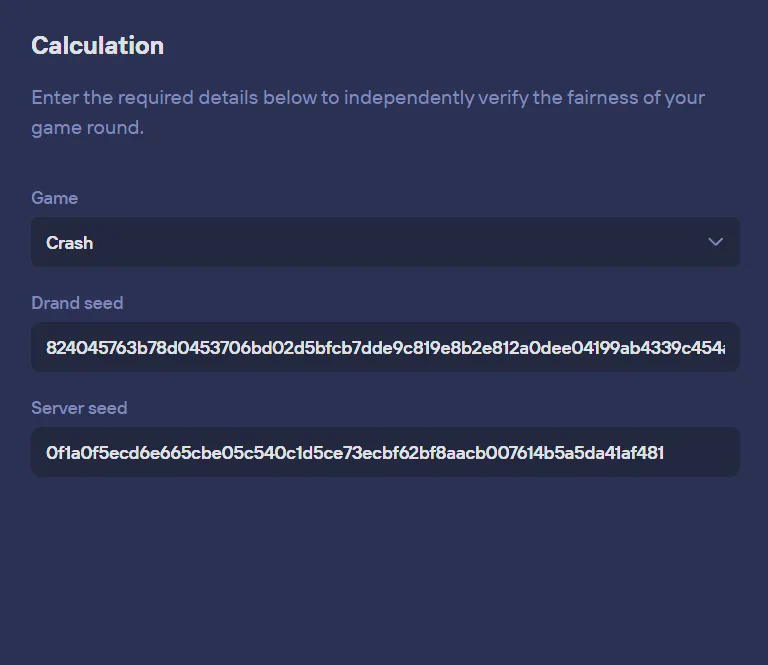
Every provably fair crypto game—from Duel Casino to Stake and Roobet—relies on a two-party cryptographic commitment scheme governed by the HMAC-SHA256 algorithm:
Here is how the chronological trust model functions:
- The Casino’s Commitment: Before you make a single bet, the operator creates a
Server_Seedand publishes its cryptographic hash:SHA256(Server_Seed). Because SHA-256 is a one-way collision-resistant hash function, the casino cannot alter the server seed later without breaking the published hash. - The Player’s Control Vector: The player provides the
Client_Seed. Because the casino committed to their server seed before seeing your fresh client seed, they cannot manipulate which side of the probability curve your bets land on. - The Default Seed Hazard: If you never change your client seed, or if you use an easily predictable string, the casino knows your seed in advance. A compromised operator could generate millions of server seeds offline, cherry-pick one that triggers disastrous losing streaks against your known seed, and publish its hash.
- The 256-Bit Antidote: Using our WebCrypto CSPRNG generator produces 256 bits of true physical entropy from your device’s hardware. The odds of a casino guessing your 64-character hex seed in advance are 1 in 1.15 × 10⁷⁷—higher than the number of atoms in the observable universe.
Provably Fair in Action: Verifying Round Results
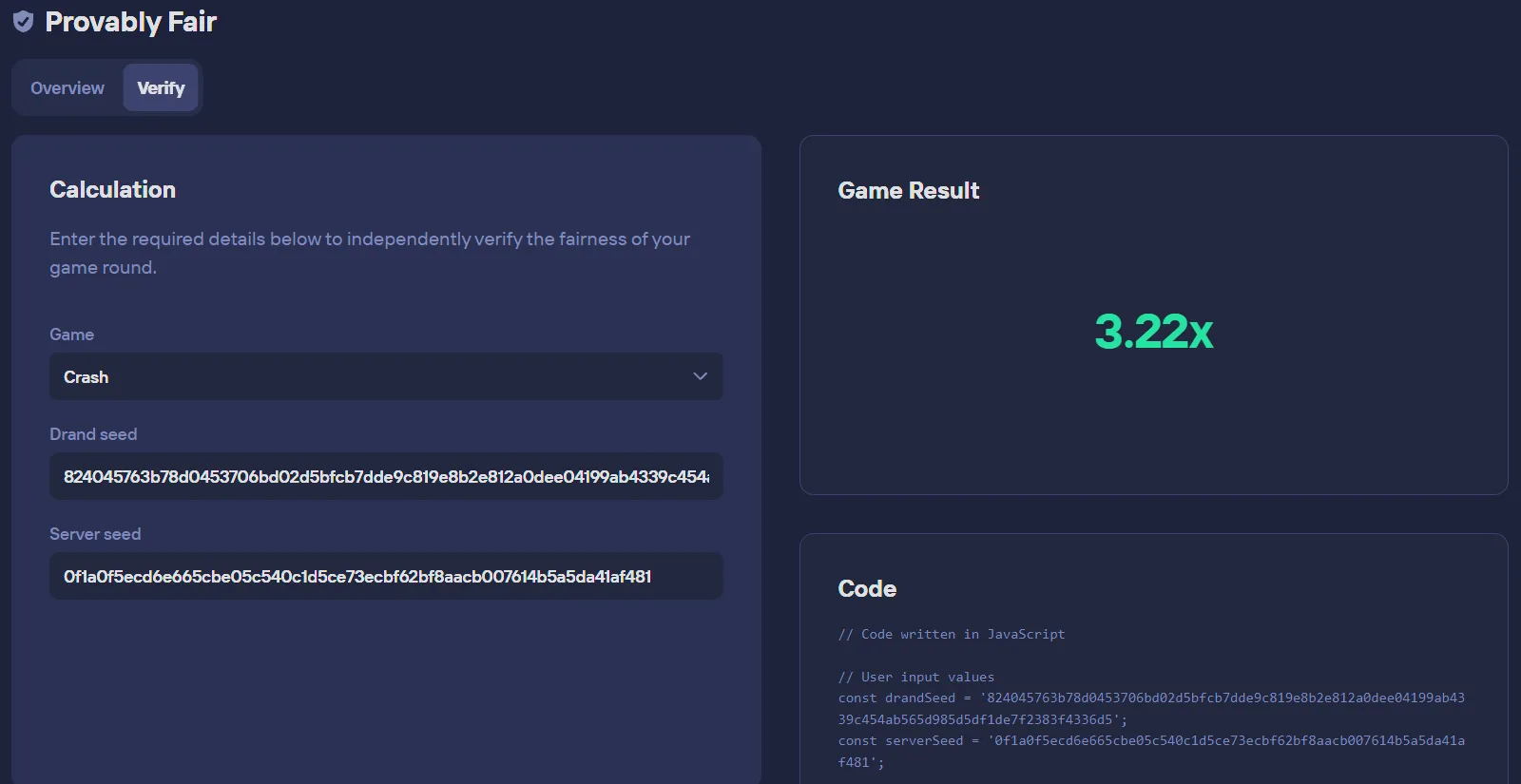
Once you set your custom client seed, every single roll can be audited independently using cryptographic verifiers. Below is an authentic verification modal from Duel.com, illustrating how the revealed server seed, custom client seed, and round nonce reconstruct the exact outcome:
Where to Play with 100% RTP & Verifiable Randomness
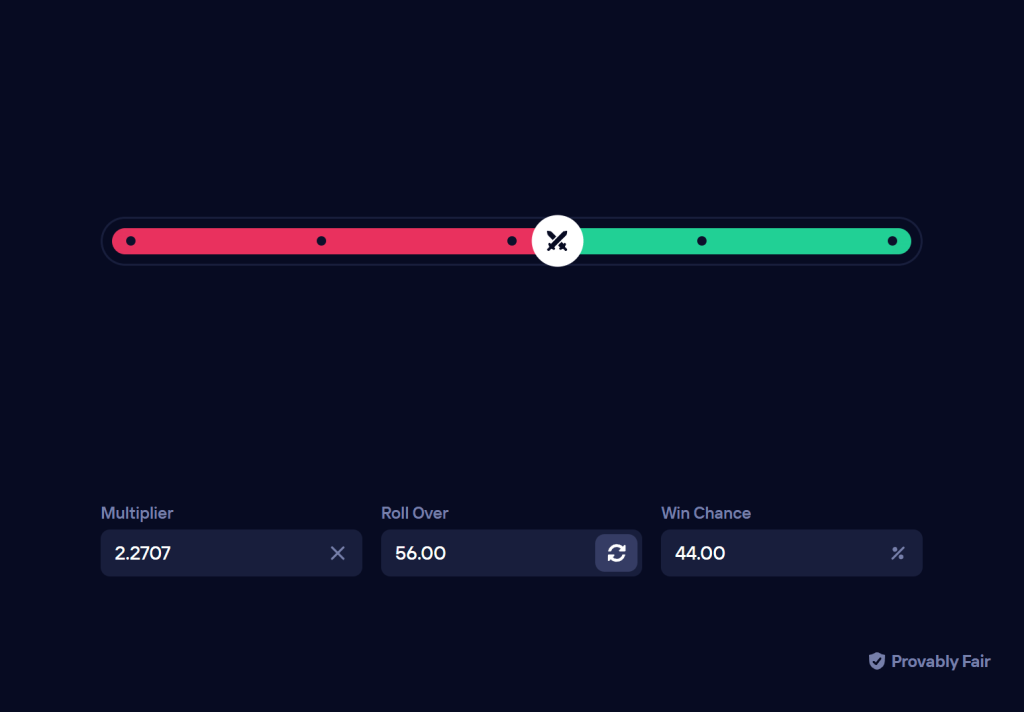
While standard crypto casinos extract a 1.00% to 5.00% house edge on every wager, our research lab has audited Duel Casino‘s proprietary in-house Originals (Dice, Plinko, Crash, Mines, Blackjack).
Duel’s Originals run at true 100.00% RTP (0.00% House Edge), powered by both customizable client seeds and the decentralized drand League of Entropy beacon.
Ready to Play with Zero Edge?
Copy your generated 256-bit client seed, register with code Vip on Duel, and test 100% RTP Originals.
Frequently Asked Questions: Client Seeds & Provably Fair
What is a client seed in crypto casinos?
A client seed is an arbitrary string chosen by the player that feeds directly into the casino’s outcome generation formula: HMAC_SHA256(ServerSeed, ClientSeed:Nonce). It guarantees that the casino cannot predetermine or rig the results of future bets, because the outcome is unknown until both the server seed and client seed are mathematically combined.
How often should I change my client seed?
We recommend generating and updating your client seed at the beginning of every gaming session, or whenever you rotate the casino’s server seed. Regularly updating your client seed ensures that no historical betting patterns can be exploited.
Can the casino see my client seed before I roll?
Yes, the casino receives your client seed string before the roll executes. However, because the casino has already committed to its secret server seed by publishing the SHA-256 hash beforehand, they cannot change their server seed to counter your client seed without invalidating the cryptographic hash proof.
Does a lucky client seed increase my chance of winning?
No. In probability theory, there is no such thing as a “lucky” seed. Every valid cryptographic seed produces an independent, uniformly distributed sequence of outcomes with the exact same expected value (EV). The purpose of changing your seed is cryptographic security against precomputation, not altering mathematical probabilities.
{
“@context”: “https://schema.org”,
“@type”: “FAQPage”,
“mainEntity”: [
{
“@type”: “Question”,
“name”: “What is a client seed in crypto casinos?”,
“acceptedAnswer”: {
“@type”: “Answer”,
“text”: “A client seed is an arbitrary string chosen by the player that feeds directly into the casino’s outcome generation formula: HMAC_SHA256(ServerSeed, ClientSeed:Nonce). It guarantees that the casino cannot predetermine or rig results.”
}
},
{
“@type”: “Question”,
“name”: “How often should I change my client seed?”,
“acceptedAnswer”: {
“@type”: “Answer”,
“text”: “We recommend generating and updating your client seed at the beginning of every gaming session, or whenever you rotate the casino’s server seed.”
}
},
{
“@type”: “Question”,
“name”: “Can the casino see my client seed before I roll?”,
“acceptedAnswer”: {
“@type”: “Answer”,
“text”: “Yes, but because the casino has already committed to its server seed by publishing the SHA-256 hash beforehand, they cannot change their server seed without invalidating the cryptographic hash proof.”
}
},
{
“@type”: “Question”,
“name”: “Does a lucky client seed increase my chance of winning?”,
“acceptedAnswer”: {
“@type”: “Answer”,
“text”: “No. Every valid cryptographic seed produces an independent, uniformly distributed sequence of outcomes with the exact same expected value (EV).”
}
}
]
}
{
“@context”: “https://schema.org”,
“@type”: “WebApplication”,
“name”: “Provably Fair Client Seed Generator & Entropy Auditor”,
“url”: “https://provablysmart.com/client-seed-generator/”,
“applicationCategory”: “CryptographicApplication”,
“operatingSystem”: “All modern web browsers”,
“description”: “Hardware-backed WebCrypto 256-bit client seed generator and Shannon entropy auditor for provably fair crypto casinos.”,
“offers”: {
“@type”: “Offer”,
“price”: “0”,
“priceCurrency”: “USD”
}
}