Multi-Seed Verification Systems: How They Differ From Single-Seed

the author
ProvablySmart Research Desk
date post
Aug 28, 2026
Share


Multi-seed verification systems are becoming more common in casino provably fair implementations. They are not a single standard. They include hash chains, per-round seeds, and Merkle-tree-based commitments. This article compares those designs with the traditional single-seed model and lists the concrete checks a technical player can run.
Single-Seed Verification in Brief
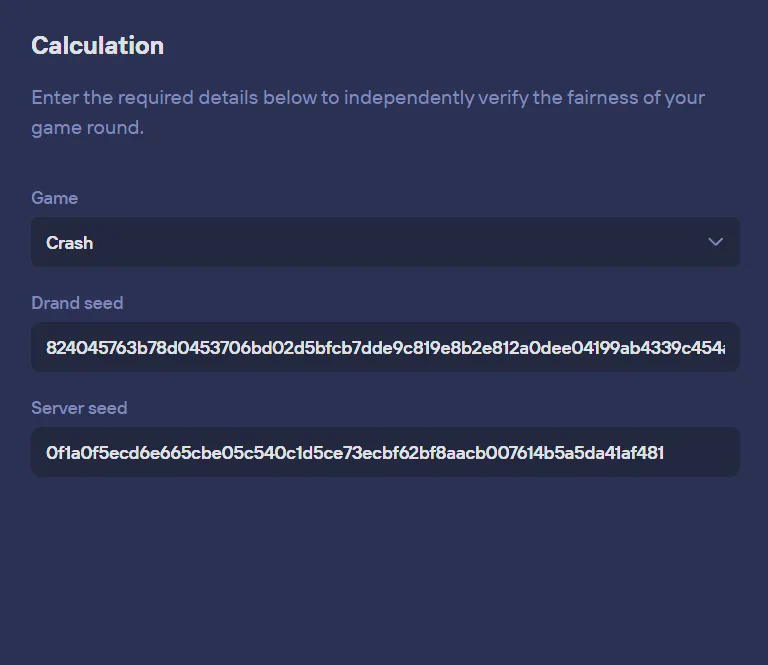
The simplest provably fair model uses one server seed for a betting session. Before any wagering, the casino publishes a hash of that server seed. The player also has a client seed, and a nonce increments per round. After the round, the casino reveals the server seed. The player recomputes the outcome using a function such as HMAC-SHA256 with the server seed, client seed, and nonce as inputs.
The security property is commitment: the server seed was fixed before the outcome was known. Once you verify that the revealed seed matches the earlier hash, and that the outcome function matches what the game displayed, you know the round was not changed after you bet.
Single-seed systems are easy to audit because there is only one hash to check. The weakness is that the entire session relies on one secret value. If that seed is compromised before the session ends, all future nonces in that session become predictable to anyone who has the seed. For this reason, many operators now use a different structure.
What Multi-Seed Systems Add
How Does This Compare to 0% House Edge Protocols?
Audited 100% RTP
Instead of standard 1.00% to 4.00% casino house margins, compare with mathematically verified 100% RTP Originals (0.00% House Edge) on Duel Casino:

A multi-seed system does not mean merely “several random seeds.” It usually means the casino commits to a structure of seeds before any bets are placed, then reveals only the parts needed for each game round. There are three common designs worth separating.
Independent per-round seeds
In this design, each round has its own server seed. Before a new round starts, the operator publishes the hash of that round’s seed. At verification time, the player receives the seed and checks it against the promised hash. A separate random seed is used for the next round.
This avoids the single-seed failure mode: a leak of one round’s seed does not expose any other round. The operator cost is higher, because every round needs a separate commitment and reveal. If the operator publishes all round hashes at the start of a session, a player can independently verify the entire sequence after the fact.
One-way hash chains
A more compact multi-seed structure is the hash chain. The operator generates a final seed and iteratively applies SHA-256 backward to create a chain: anchor = H(seed_1), seed_1 = H(seed_2), and so on. Only the anchor is published before betting. To reveal round N, the operator provides seed_N. The player walks the chain forward from the anchor to confirm that the revealed seed is the one placed at that exact position.
The advantage is that one published value anchors many rounds. The disadvantage is that verification is sequential: if you want to check round 10, you must compute hashes from the anchor through round 10. Multi-seed hash chains also require careful generation order. If the operator generates from the wrong direction, someone who sees one seed may be able to compute all future values.
Merkle-tree commitments
Merkle-tree multi-seed systems publish a single root hash. Each leaf of the tree is the hash of a per-round server seed. To verify a specific round, the operator sends that round’s seed plus the sibling hashes needed to recompute the root. The player not only checks the seed against a leaf, but also validates that the leaf is part of the published root.
This is the strongest form of multi-seed commitment for large round counts. It gives per-round independence and a single public anchor, and it allows constant-time proof size rather than walking an entire chain. The trade-off is more complex verification code.
Comparing the Two Models
| Aspect | Single-Seed | Multi-Seed |
|---|---|---|
| Commitment | One hash before all rounds | Per-round hashes, chain anchor, or Merkle root |
| Reveal | One server seed at session end | Different seed or proof per round |
| Verification | Hash equals committed value; run outcome function | Recompute chain or Merkle path; then run outcome function |
| Risk of seed leak | Affects every future nonce in the session | Usually limited to one round or one branch |
| Implementation complexity | Low | Moderate to high |
| Player-side tooling | Simple scripts | Needs chain/Merkle verification code |
Both models can be fair if correctly implemented. The word “multi-seed” is not a guarantee. It is a structural choice.
What You Can Verify Yourself
Before using a casino that claims multi-seed verification, check the following points in the operator’s published documentation or open-source client code:
- Commitment timing. The anchor, root hash, or per-round hash must be produced before the round or session begins. If the operator can generate the commitment after seeing your bets, the system is not provably fair.
- Hash function and encoding. The documentation should state SHA-256 or a similar function, and the exact hex or base64 encoding. You can recompute the hash from the revealed seed and compare it to the published commitment.
- Chain direction. For hash chains, verify the direction explicitly. If the operator says
seed_{n-1} = H(seed_n), then revealingseed_nmust make the earlier value equal the already-seen anchor. Test this on at least two consecutive rounds. - Merkle paths. If a root is used, the proof must include all sibling hashes. Recompute the root yourself. A real proof will also bind the round number or nonce to the leaf; otherwise the same seed could be replayed in another round.
- Outcome mapping. The seed is only half the story. Verify that the same seed/nonce pair produces the same displayed game result. If the casino uses additional hidden inputs, those inputs must also be committed or derived from public values.
Our verification guide covers the basic calculation pattern for standard single-seed games. Multi-seed systems require either a more advanced script or the operator’s own verifier, which you should inspect rather than blindly trust.
Security Considerations
Multi-seed systems reduce certain risks but introduce new ones. An operator might publish a Merkle root but keep the leaf-to-seed mapping in a private database, making it difficult for you to independently discover the seed for a past round. That is a transparency problem even if the math is sound.
Another issue is cross-game reuse. If the same per-round seed is used to generate both a dice roll and a card hand, correlation between those outputs must be analyzed. Single-seed systems at least use a nonce to vary outputs. Some multi-seed designs separate seeds by game; that separation is usually better.
Also check whether the casino lets you change your client seed after a round but before the server seed for that round is revealed. In a single-seed model, that is safe if the server seed hash was fixed in advance. In a multi-seed model, the same condition applies: no revealed seed can be changed, but you need to know which server seed corresponds to which round.
When reviewing an operator, we look for a public commitment log and a verifier that works from raw seed data rather than from a database lookup. You can apply the same principle. The strongest setup publishes the anchor or root, reveals per-round seeds, and provides enough audit trail for you to reconstruct every outcome from the seeds.Our casino review process uses these criteria. If you are tracking your bets across many rounds, also consider tying your verification checks into your regular bankroll management routine, because a mathematically fair game still requires disciplined staking.
FAQ
Is a multi-seed system always more reliable than a single-seed system?
No. Reliability depends on commitment timing, seed isolation, and public verifiability. A single-seed system with a pre-published hash can be fully sound. A poorly implemented multi-seed system with a late root or hidden branch mapping can be worse.
Can I use the same verification script for both systems?
Usually not. A single-seed script computes one hash comparison and then the game outcome. A hash chain requires iterating from the anchor. A Merkle proof requires recomputing the root from sibling hashes. If your script only handles single seeds, it will not validate the structure of a multi-seed commitment.
What should I do if the casino says ‘multi-seed’ but does not publish a root or anchor hash?
That is a red flag. The whole point of a multi-seed commitment is that one published value binds many future reveals. Without a root, anchor, or per-round pre-published hashes, the operator can technically claim multi-seed while retaining the ability to choose seeds after rounds. In that case you are relying on the casino’s database, not on provable fairness.