Client Seed Best Practices: Rotate Every Session or Keep One Forever?

the author
ProvablySmart Research Desk
date post
Aug 28, 2026

Share


The client seed is a user-supplied string in provably fair gambling systems. It is combined with the server seed and a nonce to generate bet outcomes. Whether to rotate it every session or keep one indefinitely is a recurring question among players who audit their own results. This article examines both approaches from a cryptographic, statistical, and practical record-keeping perspective.
How the client seed fits into provably fair verification
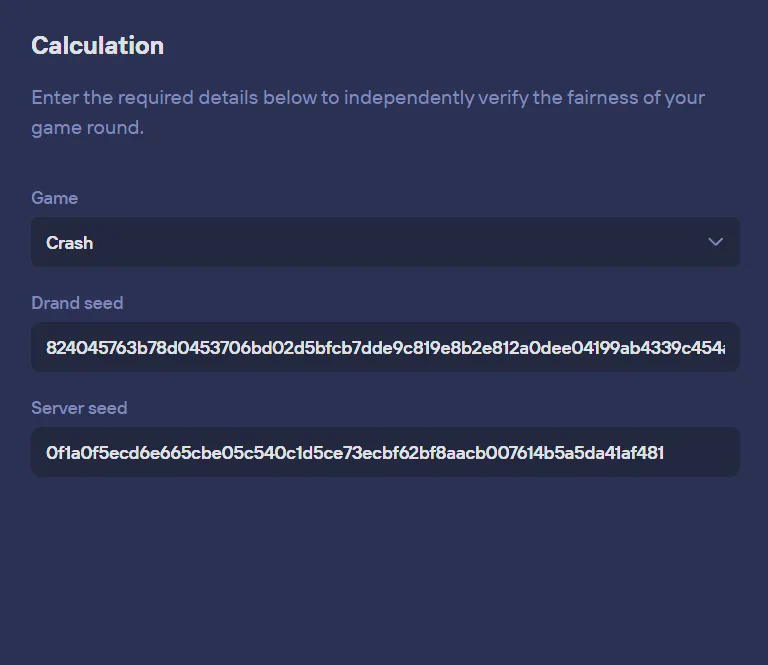
Most provably fair schemes work as follows: the casino commits to a server seed by publishing its hash before any bets. The player chooses a client seed. Each bet is identified by a nonce (a counter) that increments after every wager. The outcome is typically calculated as HMAC_SHA256(server_seed, client_seed:nonce) or a similar construction. When the server seed is later revealed, the player can recalculate every bet and confirm that the casino did not manipulate the results. The important point is that the client seed never needs to be secret; it is part of the public input allowed by the player.
Since the nonce already changes with every bet, the client seed does not provide uniqueness. If you never rotated the client seed, the concatenation client_seed:nonce would still be unique for every bet as long as the nonce is unique. This is the first reason why rotation is not a mathematical requirement.
Comparing the two policies
How Does This Compare to 0% House Edge Protocols?
Audited 100% RTP
Instead of standard 1.00% to 4.00% casino house margins, compare with mathematically verified 100% RTP Originals (0.00% House Edge) on Duel Casino:

To make the trade-offs concrete, consider the table below. It compares one permanent client seed with per-session rotation for the properties that a technical player is likely to care about.
| Property | One permanent seed | Rotate every session |
|---|---|---|
| Uniqueness of each bet | Guaranteed by nonce | Guaranteed by nonce and new seed |
| Verification effort | One seed to record and use with all nonces | Must record a seed per session and map nonce ranges |
| Session-level RTP tracking | Requires separating logs by nonce range | Simpler: each seed corresponds to a session |
| Impact on distribution | Uniform over nonce sequence | Uniform over seed and nonce combinations |
| Security impact | None; client seed is not secret | None; no extra security |
Neither policy changes the expected return. Over a large number of bets, the empirical RTP converges to the theoretical RTP regardless of how often you rotate. The difference is purely administrative.
Arguments for keeping one client seed forever
For a single player, a permanent client seed is the simplest approach. You can verify your entire betting history at once after the server seed is revealed, using one known string and the nonce sequence. This is convenient if you want to perform independent verification with scripts or spreadsheets.
There is also a record-keeping benefit. If you lose track of a client seed you used two months ago, you lose the ability to verify that period. One seed eliminates that class of error. It is also easier to audit the casino: with one seed and a sequential nonce, you can detect any out-of-order or missing bet in the casino’s logs.
Some players worry that keeping the same seed allows the casino to “aim” at a more favorable sequence. The hash commitment prevents that, because the server seed is fixed before the client seed is known, and the nonce is under the casino’s control but strictly sequential. There is no practical attack vector that depends on client seed lifetime.
Arguments for rotating every session
Rotation becomes useful when you run your own experiments. Suppose you are testing whether a particular casino’s outcomes match its stated RTP. If you rotate the client seed at the start of each session, each session becomes an independent sample. This makes it easier to compute confidence intervals per session and to detect any bugs in the casino’s RNG implementation.
Rotation also helps with accountability when multiple users share a machine. If you and another player both use the same client seed across different sessions, the nonce ranges can become tangled. Rotating creates a clear boundary between sessions.
Some players rotate for psychological reasons: it feels like a “fresh start” and makes it easier to apply bankroll management rules that reset after each session. That is a valid bookkeeping choice, even if it has no effect on the underlying probability distribution.
What the math says about randomness
Let the outcome function be f(server_seed, client_seed, nonce). If f is a cryptographically secure pseudo-random function, then for a fixed server seed and a fixed client seed, the outputs for nonces 1, 2, 3, … are independent and uniformly distributed over the output space. If you instead rotate client seeds, you are effectively relabeling the nonces: seed A with nonce 1 is just a different input to f. The set of all possible (client_seed, nonce) pairs has the same cardinality as the set of all nonces, assuming your client seeds are drawn from a sufficiently large space. Thus, rotation changes the index set, not the distribution.
There is one edge case: if the casino implements provable fairness incorrectly, for example by using the client seed as a direct multiplier instead of as an input to a hash, rotation might break an accidental bias. But that is an implementation flaw, not a reason to rotate. You should always verify the exact algorithm used by the casino before trusting it. If the casino’s algorithm is sound, seed rotation is neutral.
How to verify the impact yourself
The only way to be confident about your chosen policy is to test it. You can do this with any casino that provides a verified provable fair mechanism. Start by recording the server seed hash before you bet. Choose a client seed, then place a fixed number of bets. After the server seed is revealed, compute the expected outcome for each nonce using the casino’s documented algorithm. Repeat the process with a different client seed once the server seed changes.
- Record the server seed hash before any bets.
- Define and store your client seed and nonce policy.
- After the server seed is revealed, recompute outcomes for all bets.
You will find that the actual results fall within the expected variance for both policies. Over thousands of bets, the observed RTP will converge to the casino’s stated RTP, regardless of rotation. This is also covered in our latest coverage of provable fairness and RTP verification.
Practical recommendation
There is no universal mandate. For most players, the simpler policy is better: keep one client seed you have stored securely, and let the nonce do its job. If you want session-level accounting, rotate, but maintain a log that records the client seed and the first and last nonce for that session. The log itself is more important than the rotation decision.
Before you adopt either policy, check the casino’s terms and documentation. Some sites reset the nonce when you change the client seed; others keep a global nonce counter. This affects how you can verify past bets, and it should be reflected in your records. See our casino reviews for details on which sites expose clear seed and nonce metadata.
FAQ
Is it safe to keep the same client seed forever?
Yes. The nonce increments for every bet, which guarantees a unique input to the outcome-generating function. The client seed is not secret and has no effect on long-run fairness as long as the casino’s provable fair algorithm is cryptographically sound.
What happens when I rotate my client seed?
In most casinos, the nonce resets to 1 for the new client seed. Bets made with the old seed remain verifiable as long as you recorded the old seed and the relevant nonce range. You effectively start a fresh session with a new sequence of outcomes.
Can rotating client seeds improve my chances of winning?
No. Each bet outcome is a deterministic function of the seeds and nonce. Rotation changes which inputs are used, but the output distribution is the same. The expected RTP is unchanged in the long run.