
Sports Betting: Odds, Vig & Bankroll Math
Don’t bet until you understand the vig. Decimal odds, spreads, props, and why line shopping across crypto sportsbooks is the cheapest edge available.
Sports Betting on Crypto Casinos: What You Need to Know Before Placing a Single Bet
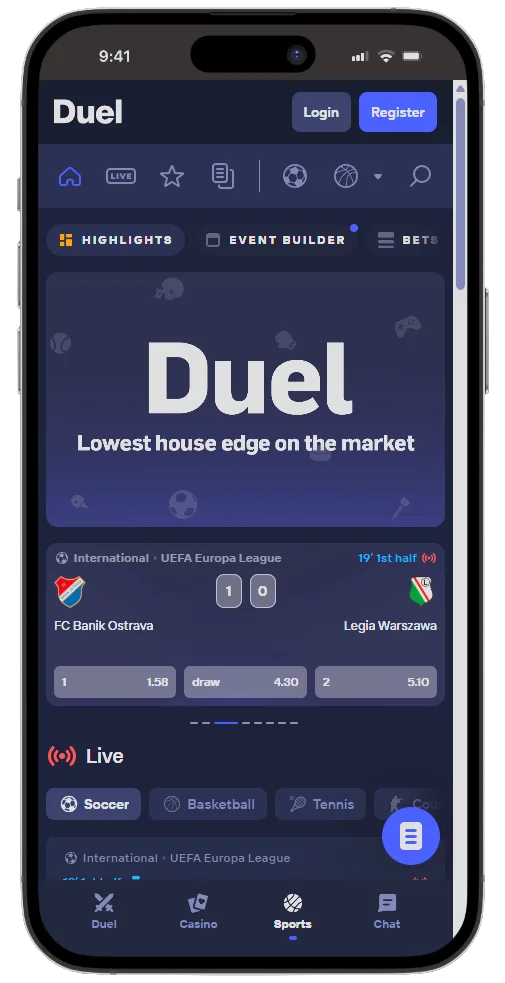
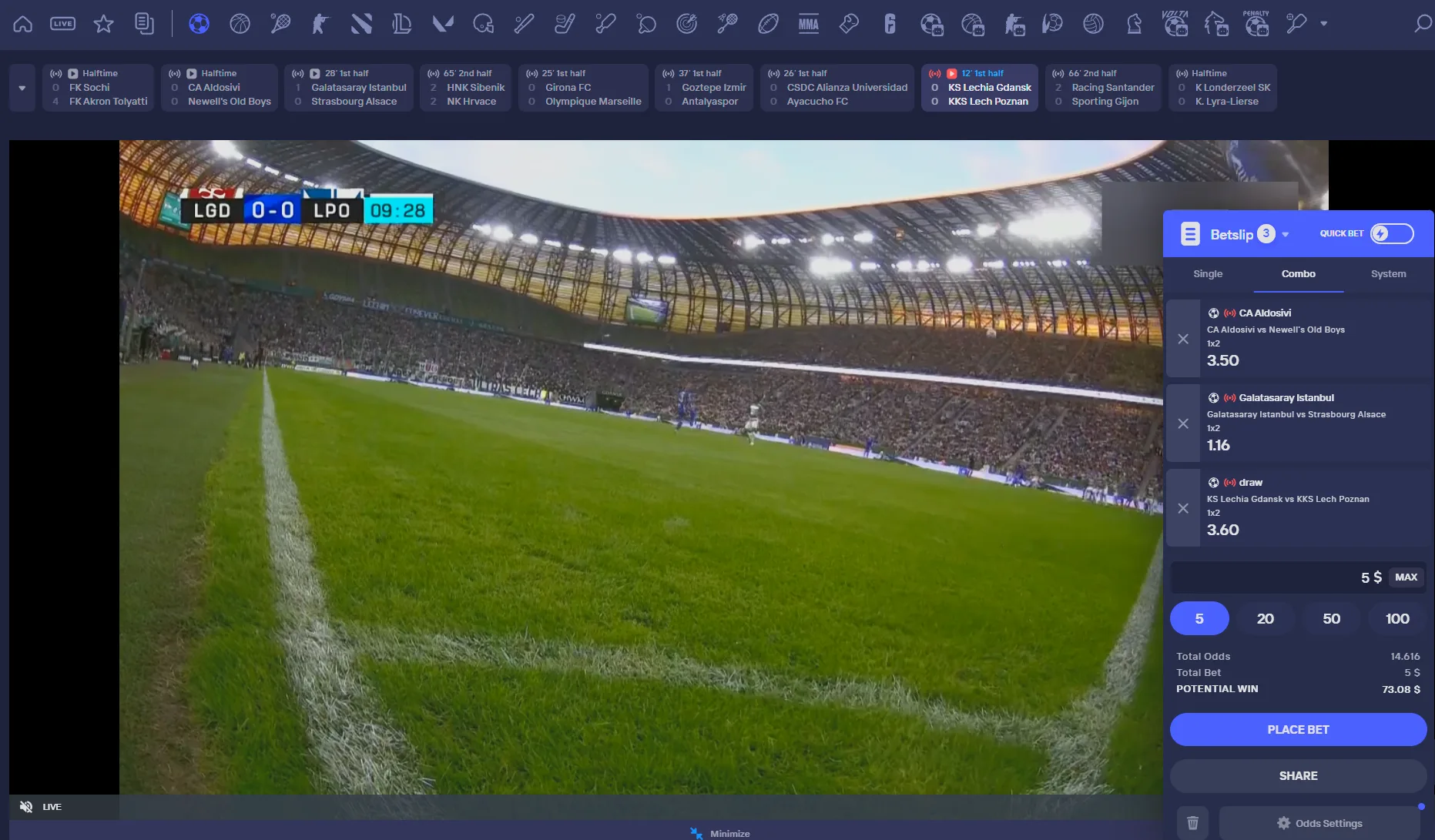
Most crypto casinos began as pure gambling platforms—crash, dice, slots, maybe a roulette wheel. The market moved on, and nearly every major site bolted a sportsbook onto the casino. Stake, Duelbits, Rainbet, Thunderpick, Gamdom, Roobet all run sports markets next to their casino games. Some are genuinely competitive with traditional bookmakers. Others are an afterthought with thin markets and ugly odds.
If you’re coming from the casino side, the learning curve is steep but worth the climb. Sports betting is the only form of gambling where a skilled bettor can be profitable long-term, because you aren’t fighting a fixed house edge—you’re betting against a line set by oddsmakers, and lines can be wrong. That doesn’t mean you’ll profit. Most people don’t. But the possibility exists in a way it never will with slots or roulette. Verification, not trust: check the numbers yourself.
Understanding Odds (The Foundation of Everything)
Before betting anything, understand what odds represent. Odds are not predictions. They are prices. The sportsbook sells you a ticket; the odds set what that ticket costs and what it pays.
Decimal Odds (Most Common on Crypto Sportsbooks)
Decimal odds show total return per dollar staked, including your original stake. At 2.50, a $10 bet returns $25 total ($15 profit plus your $10 back). At 1.40, a $10 bet returns $14 total ($4 profit plus your $10 back).
The lower the decimal, the more likely the sportsbook thinks the outcome is. Odds of 1.10 imply roughly a 91% chance. Odds of 5.00 imply 20%. Implied probability is simply 1 divided by the decimal: 1 / 2.50 = 0.40, or 40%.
American Odds
American odds use plus and minus signs. A -200 favourite means staking $200 to win $100 profit. A +300 underdog means a $100 bet wins $300 profit. Most crypto sportsbooks default to decimal, but some let you toggle to American format in settings.
The Vig (Juice) — How the Sportsbook Makes Money
This is the part beginners skip. If two outcomes are equally likely—a true coin flip—fair odds would be 2.00 on both sides. Instead, the sportsbook sets both at something like 1.91. That gap is the vig, or juice: the book’s built-in commission on every market.
To calculate it, convert both sides to implied probabilities, add them, and subtract 100%. At 1.91 each side implies 52.4%, totaling 104.8%. The 4.8% over 100% is the vig. Lower vig means better value. Top-tier crypto sportsbooks run 3-5% juice on major markets; the bad ones run 8-10%, which is robbery.
Types of Bets
Moneyline (Match Winner)
The simplest bet: pick who wins. No spreads, no totals, just the result. Moneylines on heavy favourites pay very little ($100 staked to win $20 on a -500 favourite), which is why sharp bettors hunt underdog value instead. A +250 underdog only needs to win 28.6% of the time to be profitable at those odds. If your read puts the true probability at 35%, you hold a real edge.
Point Spread (Handicap)
The book assigns a points handicap to level the matchup. Lakers -6.5 against the Hornets means they must win by 7 or more for your bet to cash. Take the Hornets +6.5 and they can lose by up to 6 points and you still win.
Spreads are where serious money moves in traditional sports. Lines are usually set so both sides draw roughly equal action, and the book profits from the vig. When a line moves hard one way, sharp money has often hit that side.
Over/Under (Totals)
The book sets a number for the combined score. You bet whether the actual total lands over or under. An NFL total of 47.5 means betting whether the teams combine for more or fewer than 48 points.
Totals respond to weather (outdoor sports), pace of play, and defensive matchups. A rainy NFL game between two run-heavy teams with elite defences trends under; a shootout between two pass-first offences in a dome trends over. The data is public. The question is whether the line already priced it in.
Parlays (Accumulators)
A parlay bundles multiple bets into one ticket, and every leg must win. A three-leg parlay at 2.00 per leg pays 8.00 total (2 x 2 x 2). The payout beats betting each leg separately, but the odds of hitting all three collapse fast.
Let’s be blunt: parlays are the sportsbook’s best friend. The vig compounds every leg. A two-leg parlay with 4.8% juice per leg carries roughly 9.4% combined vig. Five legs? You’re paying 20%+ in hidden commission. Books promote parlays because the hold is enormous. Betting them for entertainment is fine. Believing they’re a strategy means you’re the product.
Props (Proposition Bets)
Prop bets target events inside a game rather than the final score: “Will Player X score over 25.5 points?” “Which team scores first?” “Total yellow cards over 3.5.” Books are weakest here because they have less historical data to set accurate lines. Sharp bettors who specialize in player performance data find genuine edges in props, especially in smaller leagues.
Futures (Outright Winners)
Long-term bets on outcomes decided weeks or months out: “Who wins the Premier League?” or “Who wins the Super Bowl?” placed before or during the season. Your money is locked until the event settles. Odds shift constantly with results, injuries, and market action. The best futures value usually sits before the season starts, when the market is least efficient.
Sports You Can Bet on at Crypto Casinos
Major crypto sportsbooks cover roughly the same sports as traditional bookmakers. Market depth varies. Here’s what most platforms carry:
- Football (Soccer): The most liquid market globally. Premier League, La Liga, Champions League, and World Cup matches carry the sharpest odds and highest limits. Lower leagues have softer lines and more value for specialists.
- American Football (NFL/NCAA): The NFL is the biggest US betting market by volume. Lines are sharp, vig is low on major markets, and the weekly schedule makes researching every game manageable.
- Basketball (NBA/NCAA): High-volume, fast markets with heavy live betting. NBA player props are massive and frequently mispriced.
- Tennis: Strong for live betting because momentum swings constantly. Research is manageable—two players to study, not two rosters.
- MMA/UFC: A growing market with notoriously volatile outcomes. Underdogs cash at a high rate in MMA because one punch changes everything, and heavy favourites are frequently overpriced.
- Esports: CS2, Dota 2, League of Legends, Valorant. Our dedicated CS2 betting page covers that in depth. Esports lines on crypto sportsbooks are often softer than traditional sports because the pricing algorithms have less historical data to work with.
Crypto Sportsbooks vs. Traditional Bookmakers
Where Crypto Sportsbooks Win
- Anonymity and speed. Many platforms skip KYC until you hit a withdrawal threshold. Deposits and withdrawals clear in minutes via Bitcoin, Ethereum, or Litecoin—no three-day bank transfer.
- Global access. Traditional bookmakers are geo-restricted. Crypto sportsbooks generally accept players from anywhere, though the legal grey area is real: know the risks in your jurisdiction.
- No account limitations (usually). Traditional books famously limit or ban winning players. Many crypto sportsbooks don’t, because their revenue leans on casino margins rather than sportsbook profits. Win consistently on Stake’s sportsbook and you’re less likely to get restricted than at Bet365.
- VIP and rakeback integration. Sports bets count toward casino VIP progress. $10,000 wagered on football contributes to your rakeback tier the same as $10,000 on slots. Traditional books run loyalty programs, but they’re usually siloed from any casino offering.
Where Traditional Bookmakers Win
- Market depth. Bet365 or Pinnacle lists 200+ markets on a single Premier League match. Most crypto sportsbooks offer 30-50. If you bet niche props, corners, or cards, crypto platforms are often thin.
- Line accuracy. Pinnacle’s closing lines are the industry benchmark. Crypto sportsbook odds are generally derived from those sharp markets with a wider spread—you pay a premium for convenience.
- Regulation and dispute resolution. If Bet365 refuses to pay a legitimate bet, the UK Gambling Commission investigates. If a crypto sportsbook does the same, your recourse is mostly public complaints on social media. Regulatory protection matters, especially on large bets.
Live Betting (In-Play Markets)
Live betting is where crypto sportsbooks have improved most in the last two years. You can bet on updated odds mid-game as the score changes, momentum shifts, and conditions evolve. Odds update in near-real-time, and settlement happens within seconds of the event.
In-play betting rewards people actually watching. Algorithms adjust to score changes quickly, but they’re slower on context: a key player limping after a tackle, a formation switch, a goalkeeper shaky on crosses. Spot something the model hasn’t priced yet, and that’s your window.
The catch: in-play vig runs higher than pre-match. The book needs a bigger margin to offset the speed of line adjustment. A pre-match market at 3% vig might run 6-8% live. You’re paying for immediacy.
Bankroll Management (The Boring Part That Keeps You Alive)
Nobody reads this section for fun. Everyone wants hot picks. The reality, though: even a bettor with a genuine 55% win rate—which is very good—will hit losing streaks of 10+ bets. Reckless sizing means a normal variance swing kills your bankroll before your edge ever shows up.
- Flat betting at 1-3% of bankroll. A $1,000 bankroll means $10-$30 standard bets. Boring? Yes. It also keeps you alive long enough for your edge, if you have one, to compound.
- Never chase losses. Doubling your stake after a loss to “get back to even” is the Martingale system, and it has destroyed more bankrolls than any sportsbook ever could. The math works until it doesn’t—and then you lose everything.
- Separate your sports bankroll from casino funds. If you play both sides of a crypto platform, keep a mental (or actual) wall between them. Losing $200 on a parlay and chasing it on a crash game is the exact spiral that empties accounts.
The Biggest Sports Betting Mistakes
- Betting with your heart. If you’re a Liverpool fan, you’re biased toward Liverpool. Normal, and it makes you a worse bettor on their matches. The line already prices public sentiment, and fan money pushes favourites to overpriced levels. Either bet against your team when the value is there—a discipline test—or skip those games entirely.
- Ignoring line movement. A line opening at -3.5 and moving to -5.0 means significant money moved it. Understanding why—injury news, weather, sharp action—gives you information the static odds hide. Track opening versus closing lines on major markets. The gap tells a story.
- Treating parlays as strategy. Said above, worth repeating: parlays are entertainment products with compounding vig. The book’s margin on parlays runs multiple times higher than on straight bets. Bet singles if you’re serious.
- Not line shopping. If Stake offers 1.85 on a market and Duelbits offers 1.92 on the same outcome, bet Duelbits. Across hundreds of bets, consistently getting 1.92 instead of 1.85 is the difference between losing and breaking even. Accounts at multiple books and a pre-bet price check is the cheapest edge any bettor can get.
- Overcomplicating your research. You don’t need seventeen models and a subscription to every analytics service. Recent form, head-to-head record, injury reports, and line movement cover 90% of what matters in most sports. The last 10% comes from watching actual games. The bettor who watches every match in one league beats the one running numbers on six leagues without watching any.
Where We Stand on Sports Betting
Sports betting is the sharpest form of gambling on crypto platforms. Unlike casino games with a fixed, unbeatable house edge, sports allows skilled bettors with disciplined bankroll management and sound analysis to generate positive expected value. That’s the theory. In practice, most bettors lose because they bet too many games, chase losses, and never track results.
If you’re betting sports through a crypto sportsbook, treat it like a serious hobby, not a casino game. Log every bet. Calculate your true win rate over hundreds of wagers, not one lucky weekend. Compare your closing line value. And if the numbers say you’re losing, cut your stakes or stop. The sportsbook will still be there tomorrow.