
The UltimateBet God-Mode Scandal: The Cheat That Forced the Creation of Provably Fair Crypto Casinos
Between 2004 and 2008, online poker was experiencing its golden age. But behind the glitz of televised tournaments and million-dollar cash games, the biggest heist in internet gambling history was taking place: an insider was viewing players’ hidden hole cards in real time, stealing over $22 million through a rogue server backdoor known as God Mode.
The UltimateBet scandal occurred when former World Series of Poker champion Russ Hamilton and internal developers engineered a backdoor client that transmitted cleartext hole cards of opponents directly to malicious observer accounts (like
Niobe and Potripper). The cheating was uncovered through mathematical anomaly analysis of hand histories: the cheater played with a win rate 43 standard deviations above normal distribution (p < 10^-400). This catastrophic breach of centralized trust directly motivated the invention of Provably Fair cryptography (HMAC-SHA256 and public drand beacons) in modern crypto gaming.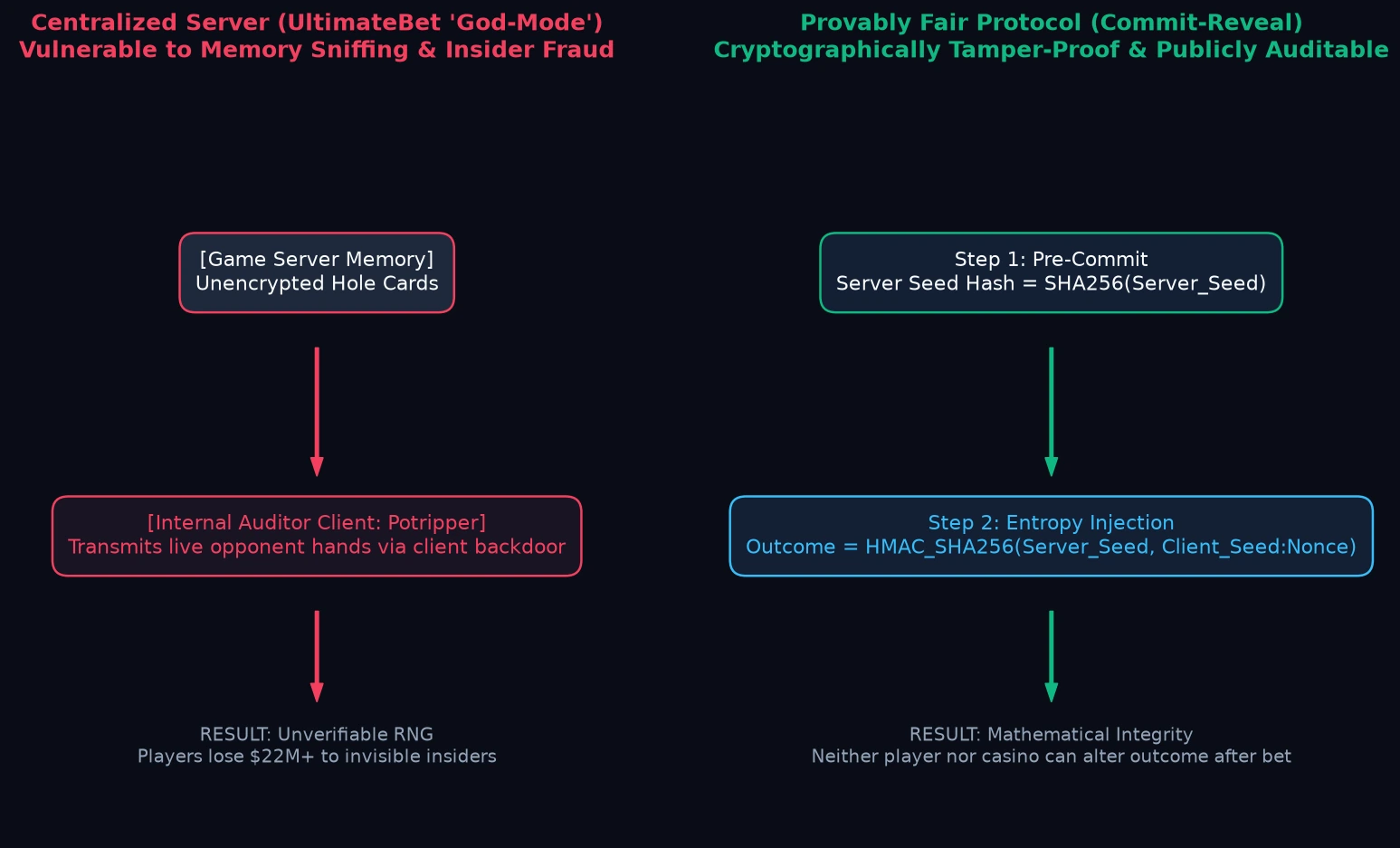
How Math Busted the Impossible Cheat
The cheat was uncovered not by gaming regulators, but by victimized players on the Two Plus Two poker forums. In January 2008, an account named Potripper won an UltimateBet tournament by making astonishing, mathematically incomprehensible plays:
- Calling large river bets with 9-high when opponents bluffed with 8-high.
- Folding full houses when opponents held four-of-a-kind.
- Never calling a single bet when behind.
A team of mathematical sleuths, led by Michael Josem, obtained over 500,000 hand histories and performed a statistical z-score analysis. In normal poker, even the world’s best players win between 5 and 10 big blinds per 100 hands (BB/100). Potripper’s win rate was over 115 BB/100.
More damning was Potripper’s showdown win rate: when calling on the river, Potripper won an impossible 94% of hands. The probability of such a win rate occurring through luck was calculated at:
p < 10^-400 (43 Standard Deviations from the Mean)
To put this in perspective: there are only approximately $10^{80}$ atoms in the observable universe. The probability that Potripper was playing honestly was zero.
The Centralized Black Box vs Provably Fair Web3 Architecture
| Architectural Feature | Centralized Casino (UltimateBet 2008) | Provably Fair Protocol (Duel 2026) | Security & Integrity Advantage |
|---|---|---|---|
| Card / Number Generation | Hidden server-side script | drand Public Beacon + Client Seed | Zero possibility of insider peeking |
| Commitment Mechanism | None (State changed on fly) | Pre-committed SHA-256 Hash | Operator cannot alter result post-bet |
| Independent Verification | Impossible (Trust operator) | 100% Client-Side JS Verifier | Player verifies hash independently |
| Admin Superuser Risk | Critical ($22M stolen) | Mathematically Impossible | Admin has no cryptographic access |
The Legacy: The Birth of Provably Fair Cryptography
When Satoshi Nakamoto released Bitcoin in 2009, crypto pioneers vowed never to repeat the UltimateBet catastrophe. In 2012, SatoshiDice pioneered the first Provably Fair gaming engine:
- The casino commits to a Secret Server Seed and provides its public SHA-256 hash to the player before the bet is placed.
- The player supplies their own Client Seed (or browser entropy).
- The outcome is derived from
HMAC-SHA256(ServerSeed, ClientSeed + Nonce).
Today, platforms like Duel Casino take this cryptographic integrity a step further by integrating decentralized drand (League of Entropy) randomness beacons. Even if an insider wanted to cheat, the cryptographic architecture makes “God Mode” physically and mathematically impossible.