Verifying Plinko: Drop Paths, Buckets and Hash Chains Explained

the author
ProvablySmart Research Desk
date post
Aug 28, 2026
Share


Plinko is presented as a ball falling through pegs, but in a crypto casino the actual outcome is determined before the animation starts. The verification process is straightforward once you understand three components: the deterministic drop path, the payout bucket table, and the server seed hash chain. This guide explains how to check each one with data you can access from the game history.
The Deterministic Drop Path
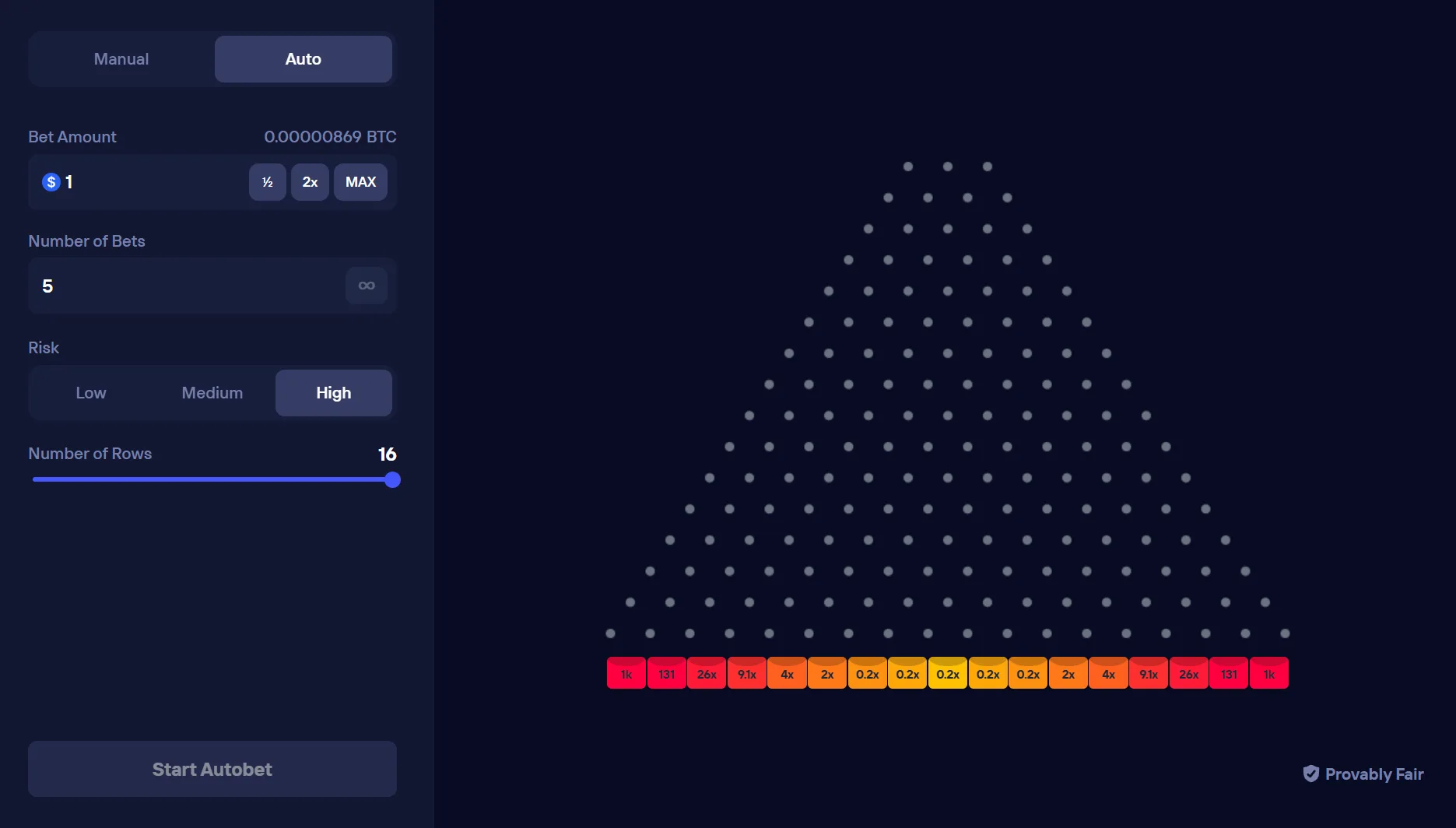
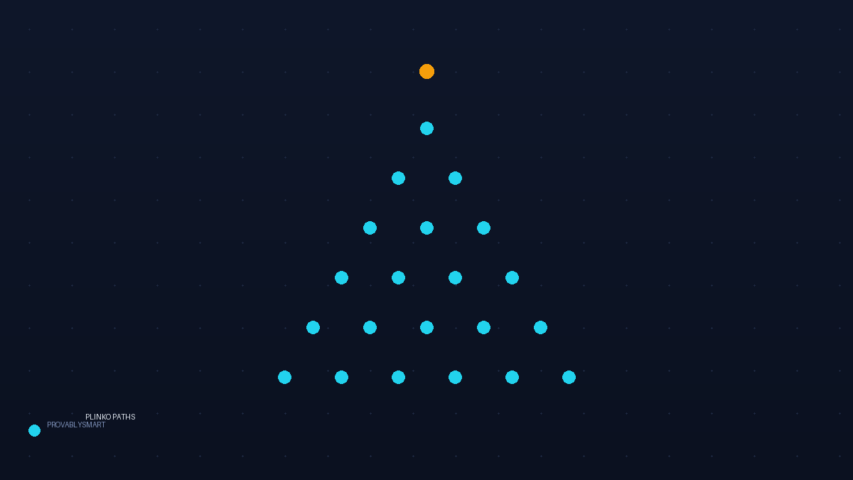
Every Plinko round can be reduced to a fixed-length sequence of left/right decisions. If the board has 16 rows, there are 16 decisions; the final column is the number of right decisions in that sequence. This sequence is called the drop path. The path is generated by a pseudo-random function whose inputs are the server seed, the client seed, and a per-bet nonce. The operator is expected to document this function as part of its provably fair system; without that documentation, verification is not possible.
A common construction is:
HMAC-SHA256(server_seed, client_seed + ':' + nonce)
The 32-byte digest is then converted into row decisions. For a 16-row board, one simple mapping is to take the first 16 bytes of the digest, one byte per row, and interpret each byte as left if even and right if odd. Because the 256 byte values are split exactly 128/128, the parity bit is unbiased. Counting the right decisions gives the final column index. If the board has more than 32 rows, the digest alone does not provide one byte per row; the operator must describe an expansion method, for example an iterative counter appended to the HMAC input.
From Final Column to Payout Bucket
How Does This Compare to 0% House Edge Protocols?
Audited 100% RTP
Instead of standard 1.00% to 4.00% casino house margins, compare with mathematically verified 100% RTP Originals (0.00% House Edge) on Duel Casino:
The final column is a number between 0 and the row count. If every decision is unbiased and independent, column probabilities follow the binomial distribution. For a 16-row board:
- P(0) = P(16) = 1/65536
- P(1) = P(15) = 16/65536
- P(2) = P(14) = 120/65536
- P(3) = P(13) = 560/65536
- P(4) = P(12) = 1820/65536
- P(5) = P(11) = 4368/65536
- P(6) = P(10) = 8008/65536
- P(7) = P(9) = 11440/65536
- P(8) = 12870/65536
A payout table groups these columns into buckets so that the game can offer a small set of multipliers. The bucket assignment is part of game configuration, not part of the random process. A bucket can contain two or more column indices. The expected return for a bucket is the sum of the probabilities of its columns times the bucket multiplier. The total RTP is the sum over all buckets. You can perform this calculation yourself if the operator provides the exact bucket definitions.
Example bucket list for illustration only:
| Columns | Return multiplier |
|---|---|
| 0, 16 | 1000 |
| 1, 15 | 130 |
| 2, 14 | 26 |
| 3, 13 | 9 |
| 4, 12 | 4 |
| 5, 11 | 2 |
| 6, 10 | 0.5 |
| 7, 9 | 0.3 |
| 8 | 0.2 |
The table above is not a recommendation and does not describe any specific casino; it only shows how columns become buckets. When you inspect a real game, check whether the displayed payout table matches the bucket definitions in the provably fair documentation. One common error is to calculate RTP with profit multipliers instead of return multipliers; clarify which one the operator uses.
Hash Chains and Seed Commitments
The purpose of a server seed hash is to prove that the seed was chosen before any results were generated. A simple commitment has the operator show SHA256(S) before using seed S. After S is used and eventually revealed, you compute SHA256(S) and compare it to the shown hash. If they match, the result was generated under the same seed you saw before betting.
A hash chain extends this to a sequence of seeds. One backward construction is S_i = SHA256(S_{i+1}). Suppose S_0 = SHA256(S_1). Publishing S_0 commits to S_1 without revealing it. When S_1 is later revealed, you check that SHA256(S_1) equals S_0. At that point S_1 can also be used as the commitment for S_2, because S_1 = SHA256(S_2). Continuing this pattern, a single starting hash verifies an entire sequence of seed reveals. Some casinos use this structure; others use a simpler independent seed schedule. What matters is that each server seed’s hash is visible before the seed is used for Plinko rounds, not after.
To assess an operator’s implementation, read the provably fair section in the casino reviews and compare it with the code/API offered in the game’s help page.
Step-by-Step Verification Procedure
You do not need to trust the visual animation. Replay the calculation yourself. What to check in order:
- Before you play, record the current server seed hash, your client seed, the exact number of rows, and the nonce of the drop you want to verify.
- After the server seed is rotated, get the revealed server seed from the account history.
- Run SHA256 on the revealed server seed. It must equal the hash that was displayed before that seed was used.
- Recompute the HMAC-SHA256 digest using the documented input format.
- Convert the digest to left/right decisions for each row. If the operator uses a different bit-to-direction rule, use that rule.
- Count the right decisions to obtain the final column.
- Look up the payout bucket for that final column in the published payout table.
- Compare the bucket multiplier with the credit that appears in the transaction history.
If all eight checks pass, the drop path was generated from the committed seed and mapped to the published bucket. If any check fails, the game cannot be verified, regardless of how good the animation looks. The replay logic is the same as in any provably fair game guide, with Plinko-specific mapping for rows and buckets.
Variance and Bankroll
Verification proves the outcome was derived from a fixed seed. It does not change the variance of the game. Buckets with multipliers of 100x or higher occur with very low probability. A player betting for a long session can expect many dead buckets before a large one. Before playing, set a bankroll policy that treats each drop as a single trial; see bankroll management for position sizing.
FAQ
Does Plinko’s physics determine the outcome?
No. In a provably fair casino, the result is determined by the PRNG and the bucket map. The ball animation is generated to match the predetermined column. The only valid verification is replaying the hash calculation, not watching the animation.
Why do two near columns have very different multipliers?
Because final columns do not have equal probabilities. The center columns are much more likely than the edges. Multipliers are adjusted to compensate for these probabilities. You can verify the probabilities with binomial coefficients and calculate whether the sum of probabilities times multipliers matches the stated RTP.
Can a casino change the server seed after my Plinko bet?
In a sound provably fair system, no. The hash of the server seed is published before the seed is used, and the seed becomes available only after it is rotated. If SHA256 of the revealed seed does not match the earlier hash, the operator is not following its own disclosure. In that case the historical result should be considered unverifiable.