The True Cost of Bonus Buy Features in Expected Value Terms

the author
ProvablySmart Research Desk
date post
Aug 28, 2026
Share


Bonus buy features have become a standard offering in many online slots, allowing players to pay a fixed multiple of their bet to instantly trigger a bonus round. While this eliminates the uncertainty of waiting for a natural trigger, it also introduces a discrete cost that can be analyzed in strict expected value (EV) terms. For the skeptical technical reader, understanding whether a bonus buy is ‘worth it’ requires comparing the EV of buying the bonus against the EV of playing the same slot normally. This article provides a mathematical framework to quantify that cost, using verifiable metrics where possible.
The Mechanics of Bonus Buys
A bonus buy is a transaction: you pay X times your current bet (e.g., 100x) and immediately enter a bonus round that would otherwise be triggered by landing a specific combination of symbols during base game play. The operator determines the buy price based on the slot’s mathematical model. In 2026, the vast majority of slots that offer bonus buys are from studios that publish theoretical RTP (Return to Player) figures for both the base game and the bonus round separately. However, those figures alone do not reveal the EV of buying.
The key variables for any bonus buy analysis are:
- Base Game RTP (R_base) – the long-term return from the main game, including the probability of triggering the bonus naturally.
- Bonus Round RTP (R_bonus) – the average return of the bonus round, expressed as a multiple of the total bet placed per spin during the bonus (often 1x per spin).
- Bonus Trigger Frequency (f) – the probability of triggering the bonus naturally per base game spin (e.g., 1/200).
- Average Bonus Win (W_avg) – the expected total win from the bonus round, in units of the base bet.
- Buy Cost (C) – the multiplier of the base bet charged for the buy.
These variables are intrinsically linked: for a slot with overall RTP R_total, we have R_total = R_base + (f * W_avg). The fair price of the bonus (in terms of its expected value) is simply W_avg. Any buy cost above W_avg represents a negative-EV premium.
Expected Value Analysis: Normal Play vs. Bonus Buy
How Does This Compare to 0% House Edge Protocols?
Audited 100% RTP
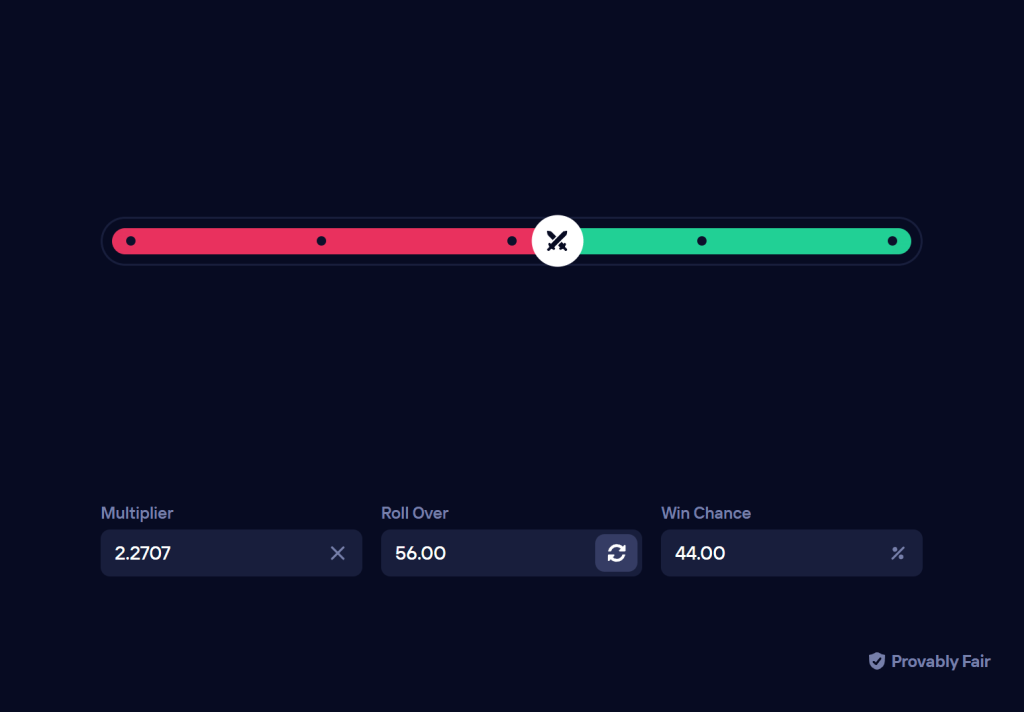
Instead of standard 1.00% to 4.00% casino house margins, compare with mathematically verified 100% RTP Originals (0.00% House Edge) on Duel Casino:
Normal Play EV per Spin
In normal play, you bet 1 unit per spin. The expected loss per spin is 1 – R_total. For example, if R_total = 0.96, your expected loss per spin is 0.04 units. The number of spins you must play to trigger a bonus naturally is 1/f on average, so the expected cost to reach one bonus naturally is (1/f) * 1, plus the expected loss of (1 – R_total) * (1/f). But more simply, the EV of the entire normal play session is the sum of EV of base spins and the EV of the bonus when it triggers.
Bonus Buy EV per Transaction
When you buy a bonus, you pay C units upfront. The expected return from the bonus round is W_avg. Therefore, the expected profit (or loss) from one buy is W_avg – C. The EV as a percentage of the buy cost is (W_avg – C) / C. This is the effective RTP of the buy transaction. For example, if W_avg = 90 units and C = 100 units, the buy’s RTP is 90% – a 10% house edge.
The critical comparison is between the house edge of normal play (1 – R_total) and the house edge of the buy (1 – (W_avg/C)). In most cases, operators set C such that the buy’s house edge is higher than the normal play house edge, often by 2-5 percentage points. This premium is the true cost of convenience – the price of skipping the base game variance.
Worked Example
Consider a hypothetical slot with the following published parameters (as verified by the operator’s provably fair system):
| Parameter | Value |
|---|---|
| Overall RTP | 96.5% |
| Bonus frequency (f) | 1/150 |
| Average bonus win (W_avg) | 120x bet |
| Buy cost (C) | 150x bet |
Check: R_total = R_base + f * W_avg – we can solve for R_base if needed. But more importantly, the buy’s EV = 120 – 150 = -30 units, giving an effective RTP of 120/150 = 80%. The normal play RTP is 96.5%, so the buy carries a 16.5% house edge versus 3.5% for normal play. That is a huge premium. Even if the bonus round itself has a high RTP (e.g., 97% of its own bet size), the pricing of the buy makes it a poor value proposition.
It is common for buy costs to be set at 2-3 times the average bonus win, leading to effective RTPs in the low 80% range. Players should always compute the buy’s EV using the same approach before purchasing.
Variance and Volatility Trade-offs
While the EV of buying is usually worse than normal play, the primary appeal of bonus buys is the reduction in variance. Normal play requires you to survive potentially hundreds of losing spins before a bonus triggers. A bonus buy collapses that variance into a single transaction: you pay a fixed cost and immediately experience the bonus round’s distribution. However, the distribution of the bonus round itself can be highly volatile – many bonuses pay out less than the buy cost, and only a few large wins compensate.
From a bankroll management perspective, buying bonuses can accelerate losses if the EV is negative, because each buy is a concentrated bet. For example, a slot with a normal house edge of 3.5% might have a standard deviation per spin of 10 units. Buying a bonus for 150 units with an 80% RTP not only has a higher house edge but also a much larger bet size, leading to faster expected depletion of bankroll. Our bankroll management guide covers how to size bets relative to volatility, including bonus buys.
Additionally, the variance of the bonus round itself is often higher than the base game, because bonuses include multipliers, free spins with retriggers, or other mechanics. The net effect is that the probability of a net loss after a single buy is high, even if the long-term EV is negative. This is why many players feel that bonus buys are “rigged” – but the math is simply worse than normal play.
How to Verify the True Cost
For crypto casinos that use provably fair technology, the theoretical RTP and the bonus buy cost are usually disclosed in the game’s information panel or in the provider’s documentation. To verify the true cost yourself:
- Locate the slot’s overall RTP and the bonus round’s separate RTP if published. Some providers list the “bonus contribution” to RTP.
- Calculate the expected bonus win as W_avg = (R_total – R_base) / f, where f is the natural trigger frequency. If R_base is not given, you can approximate it from the paytable and the probability of each winning combination, but that is tedious.
- Compare W_avg to the buy cost C. The ratio W_avg / C is the buy’s effective RTP. If it is lower than R_total, the buy is a worse deal.
- Check the operator’s casino reviews to see if historical data or community analyses exist for the specific slot.
Because slots are pseudo-random, the actual short-term results can deviate from the theoretical EV, but over many buy transactions the average should converge to the published figures. For a more rigorous approach, you can simulate the slot’s bonus round using the seed and hashes provided by the casino’s provably fair system – though this requires programming skills.
For a broader understanding of how RTP and buy costs interact, see our guide to slot RTP calculations.
FAQ
Is a bonus buy ever a good value in EV terms?
In the vast majority of slots, the bonus buy cost is set so that the effective RTP of the buy transaction is lower than the base game’s RTP. This means the buy is always a negative-EV decision relative to normal play. The only exception would be if the buy cost is lower than the average bonus win, which rarely happens because operators are not charities. Always compute the ratio yourself.
Can I verify the bonus buy’s EV using provably fair data?
Yes, if the casino provides full provably fair verification, you can check the distribution of the bonus round outcomes by analyzing the seeds and the game’s code. However, the theoretical RTP is usually stated by the provider. Trustworthy casinos will have this information clearly displayed. You can cross-reference against community-maintained data and our news section for updates on provider behavior.
Does the buy cost affect the house edge differently for high-volatility slots?
The house edge of the buy is a fixed number regardless of volatility, because it is based on the average bonus win. However, higher volatility means that the actual outcome of a single buy is more likely to be far from the average. This can lead to a higher risk of ruin if you use a large portion of your bankroll on a single buy. We recommend using a separate bankroll for bonus buys and limiting each buy to a small percentage of your total funds.