Stop-Win Rules: Superstition or Valid Risk Management?

the author
ProvablySmart Research Desk
date post
Aug 28, 2026

Share


Stop-win rules are one of the most common pieces of gambling folklore in 2026. The instruction to quit when you are ahead by 20% sounds prudent, but the key question is whether the rule changes the game itself, your expected return, or simply the shape of your session outcomes. The short answer is that it does not change the odds, but it can change the distribution of outcomes. That distinction is often lost in discussion, so this article walks through the mathematics that can be verified with seeds, hashes, and a simple spreadsheet simulation.
What a stop-win rule actually changes
Suppose a game has an independent output each round with expected value μ < 0 and variance σ². If a player plans to play a fixed number of rounds n, the expected profit is nμ. If the player instead stops at a profit target +L or a loss limit -M, the session is a random stopping time T. Under mild conditions, the expected profit of the first T rounds is μ times the expected number of rounds. Because μ is fixed and negative, the expected session profit is still negative if the expected number of rounds is positive and finite. Therefore, no stop-win rule converts a negative-expectation game into a positive-expectation one. That effect is mathematically independent of how the target is chosen.
What the rule does change is the probability distribution of the session result. By using a small win target and a large loss limit, the player increases the chance of ending the session with a small profit. That same configuration also increases the size of the tail loss. The rule raises the probability of a win at the cost of the magnitude of losses.
Verifiable mathematics of session stoppage
How Does This Compare to 0% House Edge Protocols?
Audited 100% RTP
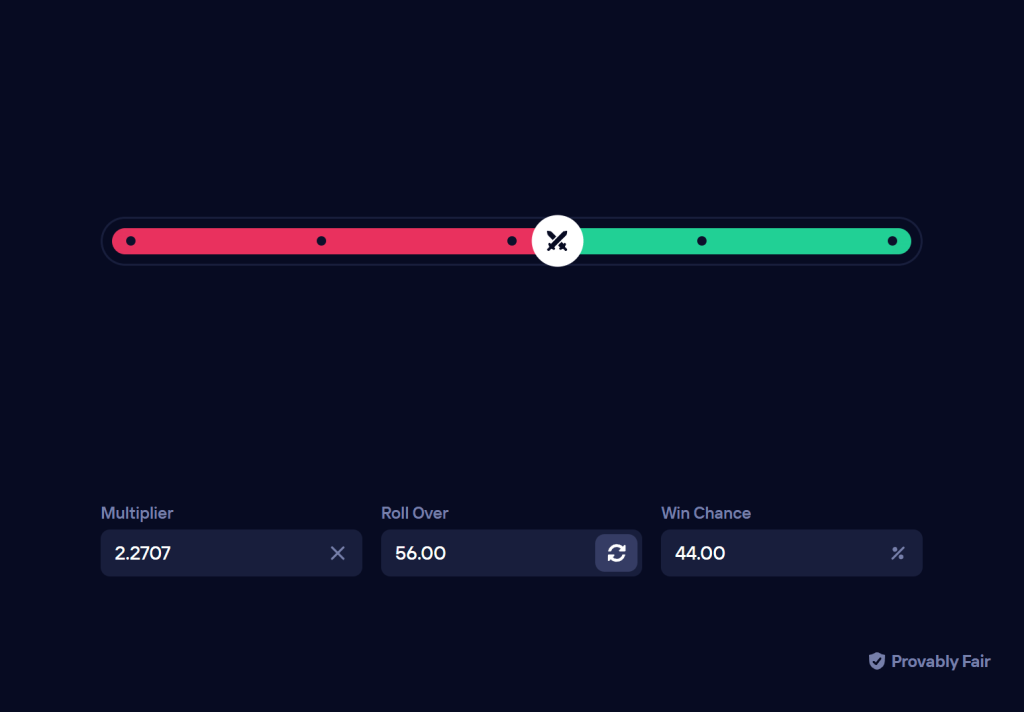
Instead of standard 1.00% to 4.00% casino house margins, compare with mathematically verified 100% RTP Originals (0.00% House Edge) on Duel Casino:

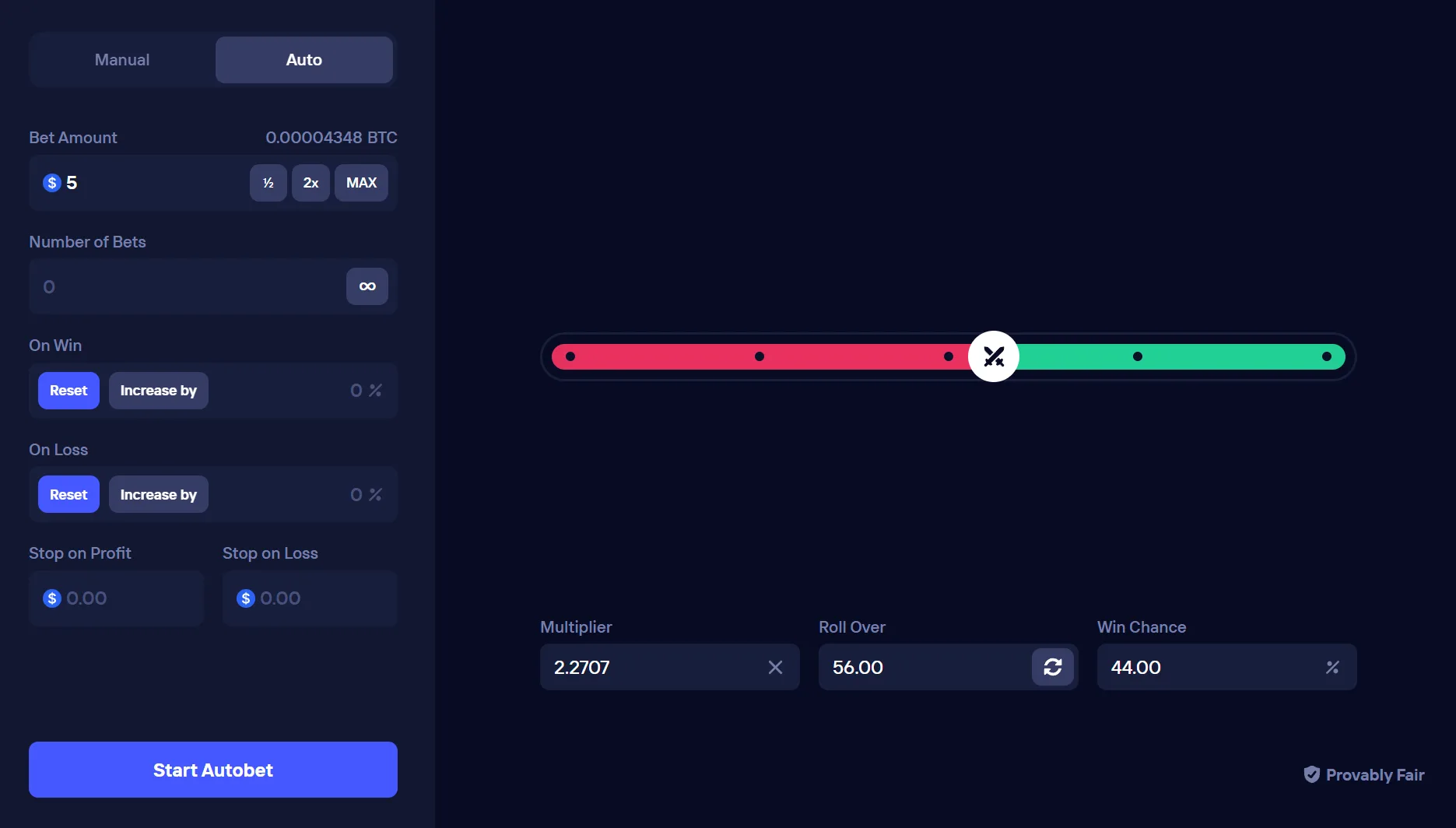
This is not a claim you need to take on trust. For a simple coin flip with a 49% win rate and a 51% loss rate, set a win target of +1 and a loss limit of -100. A small script can simulate 10,000 sessions and record how often the session ends above zero. You will see a profitable-session rate near 50% or higher, but the average money returned across all sessions will be negative, because the occasional -100 losses pull the expected value down.
For a rigorous treatment, the gambler’s ruin formula gives the probability of hitting +L before -M for a unit bet. In the zero-edge case, the probability is M divided by L+M. With a negative edge, the probability is lower for every pair of L and M. The key point is that this formula is independent of any discipline or self-control applied at the table.
If you prefer to verify within a specific casino, check the provably fair seeds and hashes for each bet outcome. The server seed, client seed, and nonce are sufficient to reproduce the outcome. Reproducing 1,000 or 10,000 rounds with a fixed betting rule will show the same expected return as the stated RTP, regardless of when you choose to stop. The provably fair verification guides walk through the procedure.
Why the rule feels effective
Stop-win rules feel useful because they convert a long, grinding session into a series of shorter sessions with a high frequency of modest wins. The human brain records that you left when you were ahead as evidence that the rule works. It does not record the rare days when the loss limit is hit, especially if the loss limit is large relative to the win target. This is a selection bias you can check in your own session logs.
Additionally, stopping after a win has a provably measurable effect on time spent gambling. If the purpose of a rule is to limit the number of rounds, it reduces turnover. Lower turnover means lower total expected loss, since expected loss scales with turnover. But that is true for any rule that shortens playtime, including a loss limit, a time limit, or a monthly deposit cap. It is not a special property of stopping after a win.
When quitting while ahead is rational
There are scenarios where a stop-win rule is valid risk management. Most of them involve utility, not mathematics. If a player’s bankroll is small relative to the profit target, and losing the profit would hurt more than not having it, cashing out locks in the utility. In that sense, a stop-win is an insurance decision. It is rational if the gambler values the certainty of a small positive return over the potential of a larger return that may be more heavily taxed, delayed, or could be lost to margin requirements.
Another scenario is a bonus with a wagering requirement. A cash-out after a win might be the only route to a guaranteed positive settlement, but only if the remaining wagering requirement can be waived or if the win already satisfies it. For any casino offering no-wager bonuses, a stop-win rule simply stops the play without affecting the bonus conversion. For standard bonus terms, stopping early might violate them. That is a contract question, not a probability question. Since bonus and cashback rules change often, monitor casino rule updates.
Variance and bankroll management
In a flat-betting framework, a stop-win rule truncates the right tail of the session distribution. This can lower the variance. Lower variance is useful when the player’s bankroll is finite and the next loss could exceed acceptable risk. A bankroll management framework that standardises session risk will include both a loss limit and a win target. The loss limit is what matters most; the win target is mainly a way to convert paper gains into real ones.
The table below summarises the difference between a fixed-round rule and a stop-win/stop-loss rule. μ is the expected value of one round, σ² the variance of one round, T the random stopping time, and M and L are the loss and profit limits.
| Quantity | Fixed n rounds | Stop-win at +L and stop-loss at -M |
|---|---|---|
| Expected profit | n·μ | E[T]·μ |
| Profit-session rate | P(sum > 0) | P(hit +L before -M) |
| Variance | n·σ² | Truncated, depends on L, M and drift |
Notice that the expected profit is negative in both columns when μ is negative. The stop-win column just replaces the left and right tails with barriers. The same logic applies to coin flips, dice, roulette, or any other independent-round game.
What to check in a 2026 casino
Stop-win is often marketed by casinos as a feature in auto-bet settings. You can set the session to stop after profit. When evaluating whether that feature has any effect on your outcomes, check the following:
- Whether the RTP stated in the paytable matches the seed-verified outcomes after a large sample.
- Whether the auto-bet stop condition is applied exactly to the wallet balance or to a profit counter that can desynchronise from the server state.
- Whether the casino publishes a complete verifiable seed hash and nonce for each round.
- Whether the session stop rule resets the RTP or applies differently between real-money play and bonus play.
For current implementations, detailed casino reviews compare which operators publish this data and which do not. If an operator claims that stop-win strategies receive a special RTP, test it: run the same game with and without the rule in demo mode, then check the server seeds. The burden of proof is on the operator.
In terms of financial discipline, setting a stop-win can be part of a bankroll management plan. It forces a decision at a predetermined point and stops the common failure mode of giving back winnings. But the plan should be built on the understanding that the rule does not improve the underlying game. Treat it as a session-length control, not as a way to beat the house edge.
FAQ
Does a stop-win rule change the house edge?
No. House edge is defined by the difference between the payout and the true probability of the event. It is decided by the game’s paytable, not by when you choose to stop. You can verify this by reproducing hashes for a set of rounds and comparing the average return to the stated RTP.
Can a stop-win rule increase my chance of finishing a session up?
Yes, if your loss limit is large relative to your win target. That configuration creates a high probability of a small profit and a low probability of a large loss. It does not make the session expectation positive, and the average result will still be negative. The ratio of win probability to loss size is captured by the gambler’s ruin formula.
Is there any way to know if a casino’s stop-win feature is implemented fairly?
Check the provable fairness and session log data. Reproduce a sequence of outcomes from the seed, nonce, and game parameters. Confirm that stopping early or late does not alter which outcomes are generated, and verify the balance after the stop against your own manual calculation. If the casino does not release enough data for that check, view the feature as unverifiable.