Stake vs. Rollbit vs. BC.Game: Which Verification Tool Is Easiest to Audit in 2026?

the author
ProvablySmart Research Desk
date post
Aug 28, 2026

Share


For users who prioritize verifiability, the ease with which a casino’s provably fair system can be audited is a critical factor. Stake, Rollbit, and BC.Game each offer different approaches to seed generation, hashing, and result verification. This article examines each platform’s verification tool as of 2026, focusing on what a skeptical user can check independently, without relying on the casino’s own UI. We compare the steps required, the transparency of seed history, and the availability of tools for offline verification.
Stake: Server Seed Rotation and Client Seed Control
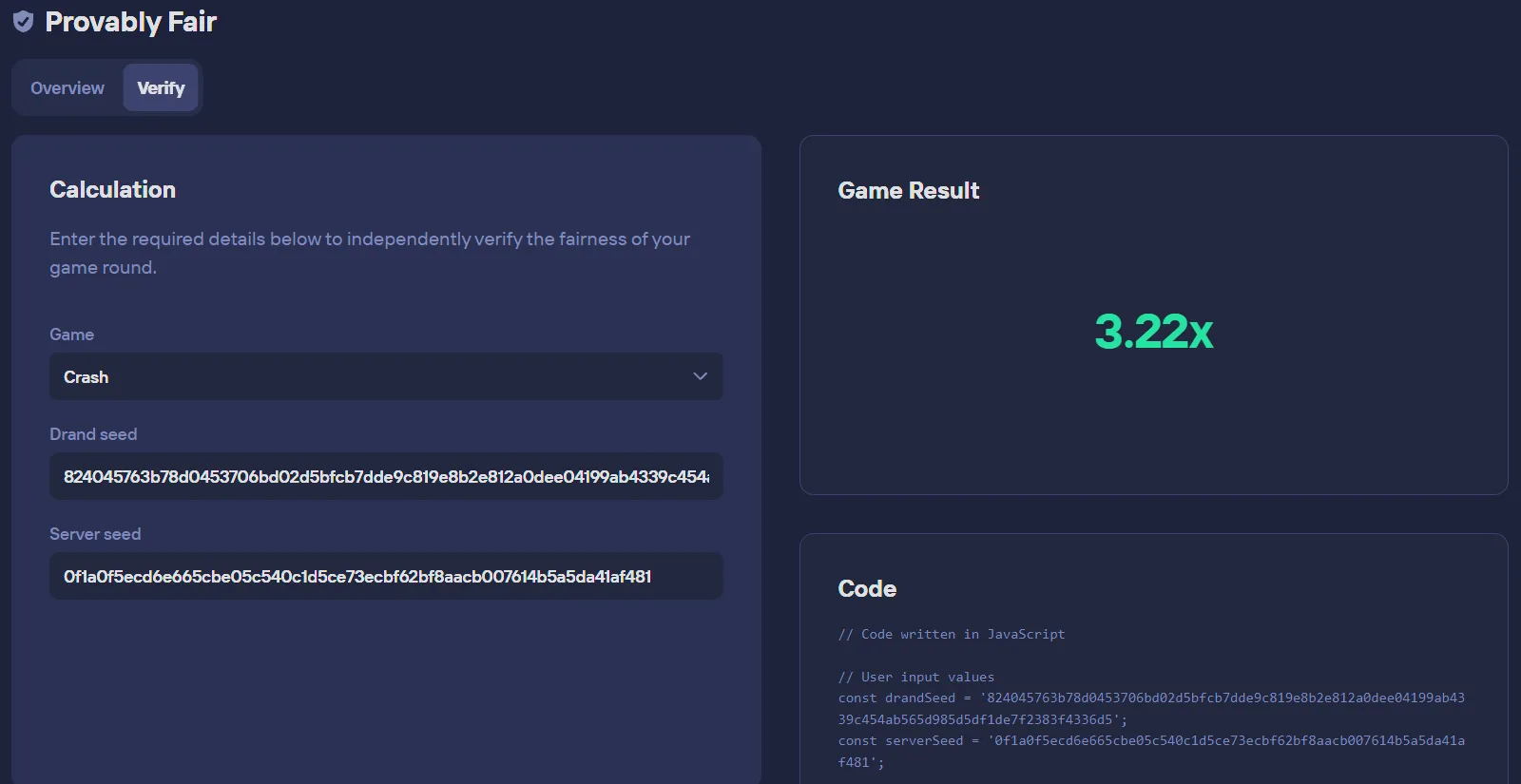
Stake’s provably fair system uses a hashed server seed, a client seed, and a nonce. The server seed is initially presented as a SHA-256 hash. After a round, the server seed is revealed, allowing the user to verify that the hash matched the pre-committed seed. The client seed can be changed by the user at any time, and a nonce increments per bet.
Verification steps
- On the game page, click the “Provably Fair” icon or link.
- Copy the current hashed server seed (SHA-256 hex string).
- After the bet round ends, the server seed is revealed. The user can hash it with SHA-256 and compare to the stored hash.
- To verify a specific bet result, Stake provides a “Verify” button that shows the seed, client seed, nonce, and the resulting number. The user can run the same algorithm (e.g., SHA-256 with seeds, then modulo) to confirm the output.
Ease of audit: Stake’s process is straightforward but requires the user to manually copy hashes and run an external SHA-256 tool (e.g., sha256sum or a browser extension). The platform also offers a provably fair verifier tool that automates the check. However, the tool itself is hosted by Stake, which means a skeptical user might still want to run the verification offline. The required data is available in the browser’s developer tools or via the “Verify” popup.
One advantage: Stake retains a history of past server seeds and their hashes, which can be accessed via the API. This allows users to verify that the seed wasn’t changed mid-round. As of 2026, the maximum seed history is 1000 seeds, but the API endpoint is public. Users can download the list and check for consistency.
Potential friction: The server seed hash is only shown before the round. If a user forgets to copy it, they cannot verify that the revealed seed corresponds to the one used. Some users may find the need to manually copy hashes cumbersome.
Rollbit: Client Seed Hashing and In-Client Verification
How Does This Compare to 0% House Edge Protocols?
Audited 100% RTP
Instead of standard 1.00% to 4.00% casino house margins, compare with mathematically verified 100% RTP Originals (0.00% House Edge) on Duel Casino:

Rollbit’s approach is slightly different. Instead of a hashed server seed, Rollbit uses a client seed that is hashed and displayed before betting. The actual server seed is generated on the server and combined with the client seed and nonce to produce the result. The server seed is not revealed until the end of the round, but it is hashed beforehand.
Verification steps
- In the game settings, the user can copy the “Hashed Client Seed” (SHA-256 of the client seed).
- After the bet, the server seed is revealed (as a hex string).
- Rollbit provides a “Verify” section that shows the seeds, nonce, and the computed result. The user can check that the hashed client seed matches the client seed they entered.
- Rollbit also offers a verifier tool that can be used offline if the user downloads the source code (available on GitHub, though not officially endorsed).
Ease of audit: Rollbit’s system is arguably simpler because the user does not need to track a server seed hash; they only need to verify the client seed hash. However, the server seed is not pre-committed in a public ledger; it is hashed and stored on Rollbit’s servers. A skeptical user cannot independently verify that the server seed was not changed after the fact without trusting Rollbit’s internal database. This is a notable difference from Stake’s approach, where the server seed hash is visible before the round.
Rollbit does provide a fairness ledger that logs all game results with their seeds, but the ledger is hosted by Rollbit. Users can query the ledger via API to verify past results, but the ledger itself is not a blockchain-anchored commitment. The onus is on the user to periodically check and compare hashes, which many do not do.
Another point: Rollbit’s client seed can be changed, but the hashed version is displayed. If a user forgets to copy the hash before changing the seed, they lose the ability to verify previous rounds. Rollbit’s UI does not automatically store a history of client seed hashes, unlike Stake’s server seed history.
BC.Game: Multi-Client Seed and Verifiable Server Seed
BC.Game uses a similar scheme to Stake but with a twist: the client seed is often generated by the platform, but the user can provide their own. The server seed is hashed and displayed before the round. After the round, the server seed is revealed. BC.Game also supports multiple client seeds per user, which can be confusing.
Verification steps
- Go to the “Provably Fair” section of the game.
- Copy the hashed server seed (SHA-256).
- After the round, the server seed is shown. Hash it and compare.
- For the game result, BC.Game provides a formula that concatenates the server seed, client seed, and nonce, then applies SHA-256 and converts to a number.
- BC.Game also offers a built-in guide on how to verify manually, and a web-based verifier that can be used offline if the page is saved.
Ease of audit: BC.Game’s process is nearly identical to Stake’s. The main difference is that BC.Game’s UI sometimes auto-generates a client seed, and the user must manually copy it before the round if they want to verify. The platform does not retain a history of past client seeds, only the current one. This can be a friction point: if a user changes the client seed, they lose access to verifying previous rounds unless they saved the client seed.
BC.Game does publish a fairness ledger with a list of server seeds and their hashes, accessible via API. The ledger is updated in real-time. However, the ledger is not anchored to a blockchain; it’s a database on BC.Game’s servers. A determined auditor could compare the hashes from the ledger with the hashes shown in the game UI, but that requires continuous monitoring.
One notable feature: BC.Game allows the user to set a custom client seed, which is recommended for maximum transparency. The verification algorithm is documented in their glossary and is a standard SHA-256-based method.
Comparison: Ease of Independent Audit
We evaluate each platform based on three criteria: (1) pre-commitment visibility, (2) offline verification feasibility, (3) seed history retention. The table below summarizes the findings.
| Platform | Server seed pre-hash visible? | Client seed history? | Offline verification possible? | API for seed history? |
|---|---|---|---|---|
| Stake | Yes, before round | No (user must save) | Yes, with SHA-256 tool | Yes, last 1000 seeds |
| Rollbit | No (server seed hash hidden) | No (only current client seed hash) | Yes, but requires client seed hash capture | Yes, fairness ledger by ID |
| BC.Game | Yes, before round | No (user must save) | Yes, with SHA-256 tool | Yes, real-time ledger |
From a purely technical audit perspective, Stake and BC.Game offer a stronger pre-commitment because the server seed hash is shown before the bet. Rollbit’s pre-commitment is weaker: the server seed is hashed, but the hash is not displayed to the user until after the bet, making it impossible for an independent observer to verify that the server seed was not changed after the fact, unless they trust Rollbit’s database.
However, all three platforms allow offline verification using standard cryptographic tools. The main friction is the need to manually copy the client seed and nonce. Stake and BC.Game require the user to save the client seed before changing it; Rollbit requires the user to save the hashed client seed. None of the platforms automatically store a full history of client seeds tied to each bet, which is a common limitation across the industry.
For a user who wants to perform a one-time audit of a single round, Stake and BC.Game are equally easy. For ongoing auditing, Stake’s public server seed history API is slightly more accessible than BC.Game’s, though both are functional. Rollbit’s lack of server seed pre-commitment is a significant drawback for a skeptical auditor.
FAQ
Can I verify a bet from 2024 using these tools?
If you saved the client seed and nonce, and the platform still retains the server seed, yes. Stake and BC.Game keep server seed history (Stake up to 1000 seeds, BC.Game indefinite via ledger). Rollbit also retains server seeds in their ledger. However, if you did not save the client seed, verification is impossible because the client seed is not stored in the ledger.
Do these platforms allow setting a custom client seed?
Yes, all three allow the user to set a custom client seed. Stake and BC.Game encourage it; Rollbit allows it but recommends using the auto-generated one. Using a custom client seed increases transparency because you control one half of the entropy.
Which platform is easiest for a non-technical user to verify?
Stake and BC.Game both have built-in verifier tools that automate the process. Rollbit’s verifier is also automated, but the absence of a pre-committed server seed hash means the user must trust the platform’s server to not have changed the seed. For a non-technical user, Stake’s interface is slightly more intuitive because it clearly shows the hashed server seed alongside the revealed seed.