How Many Spins Until RTP Converges? The Real Convergence Numbers

the author
ProvablySmart Research Desk
date post
Aug 28, 2026

Share


Return to Player (RTP) convergence is a statistical concept often oversimplified in casino marketing. Players are told that over time, actual payouts will approach the theoretical RTP, but rarely are the numbers quantified. As of 2026, with provably fair games dominating crypto casinos, understanding convergence is essential for verifying fairness claims. This article calculates the number of spins required for RTP to converge within specific tolerances, accounting for variance and confidence levels.
Law of Large Numbers and Convergence
The law of large numbers states that as the number of trials increases, the sample average converges to the expected value. For a casino game with true RTP p (e.g., 0.96 for 96%), after N spins, the observed RTP is a random variable with mean p and standard deviation:
σ = sqrt( p(1−p) / N )
This assumes each spin is an independent Bernoulli trial with win probability p. In reality, slot outcomes are not simple Bernoulli—they have multiple paylines, multipliers, and bonus features—but this model provides a foundational lower bound. The central limit theorem tells us that for large N, the observed RTP is approximately normally distributed. Thus we can compute the number of spins needed for a given probability that the observed RTP lies within a margin ε of the true p.
Number of Spins for 1% and 0.5% Tolerance
How Does This Compare to 0% House Edge Protocols?
Audited 100% RTP
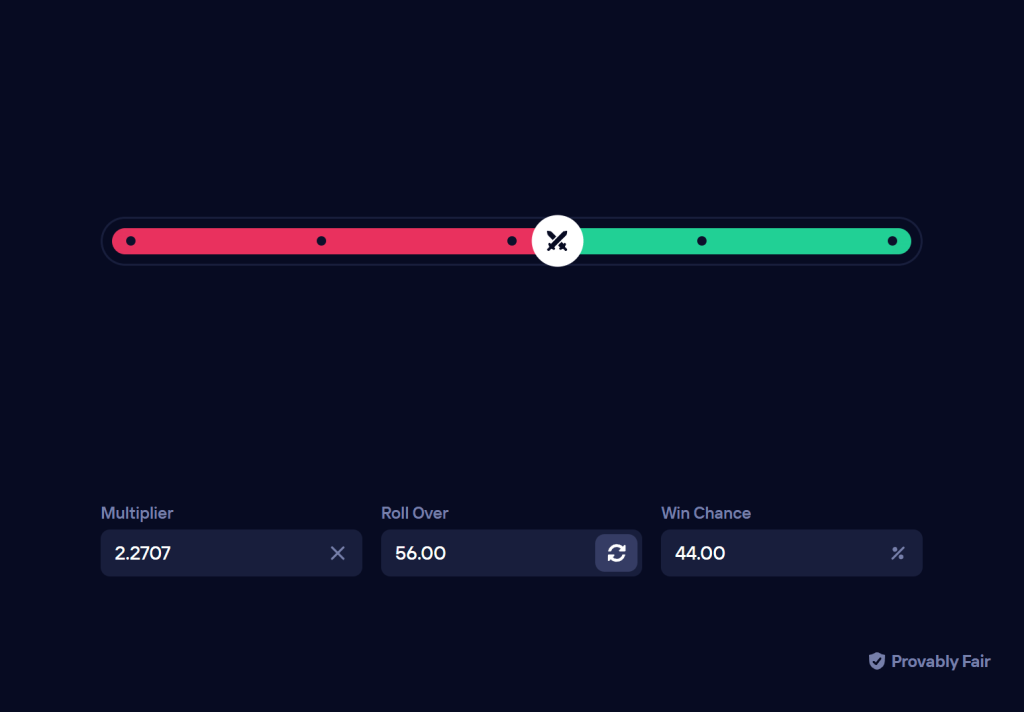
Instead of standard 1.00% to 4.00% casino house margins, compare with mathematically verified 100% RTP Originals (0.00% House Edge) on Duel Casino:

To achieve a 95% confidence that the observed RTP is within a tolerance ε of p, we require:
Z0.975 × sqrt( p(1−p) / N ) ≤ ε, where Z0.975 = 1.96.
Solving for N:
N ≥ (1.962 × p(1−p)) / ε2.
Below are the required spins for different RTP values and tolerances, assuming a simple binomial model (no extra variance).
| Theoretical RTP (p) | Variance factor p(1−p) | Spins for ±1% tolerance | Spins for ±0.5% tolerance |
|---|---|---|---|
| 0.90 | 0.0900 | 3,460 | 13,840 |
| 0.95 | 0.0475 | 1,830 | 7,320 |
| 0.96 | 0.0384 | 1,480 | 5,920 |
| 0.97 | 0.0291 | 1,120 | 4,480 |
| 0.98 | 0.0196 | 755 | 3,020 |
| 0.99 | 0.0099 | 381 | 1,520 |
These numbers assume each spin is a Bernoulli trial with win probability p. For games with RTP claims like 96%, you would need roughly 1,500 spins to be 95% confident your observed payout is within 1% of 96%—assuming no added variance. Note that 1% tolerance means observed RTP between 95% and 97% for a 96% game. For a tighter tolerance of 0.5%, spins increase fourfold (quadratic relationship).
Impact of High Variance on Convergence
Real slots have much higher variance than a simple Bernoulli process. Free spins, multipliers, and progressive jackpots increase the standard deviation of each spin. The effective standard deviation for a slot can be expressed as a multiple k times the Bernoulli standard deviation, where k often ranges from 3 to 10 or more. For example, a medium-variance slot might have k = 5. Then the standard deviation of the average after N spins becomes:
σslot = k × sqrt( p(1−p) / N ).
Consequently, the required number of spins scales by k2. For a slot with k = 5 and p = 0.96, spins for 1% tolerance become:
N = 52 × 1,480 = 37,000 spins.
For a high-variance slot with k = 10, that jumps to 148,000 spins. This explains why players can experience long losing streaks or big wins that deviate significantly from the theoretical RTP even after tens of thousands of spins. The convergence is real but occurs over a much larger window than most assume.
How to Estimate a Slot’s Variance Factor
You can approach this by examining the game’s provably fair verification mechanisms. Many crypto casinos publish the mathematical model or at least the hit frequency and variance category (low, medium, high). If the operator provides the standard deviation per spin (often in the game rules or RTP documentation), you can compute k = σslot / sqrt(p(1−p)). Otherwise, comparative tests using the provably fair seeds can give an empirical estimate—though that requires many spins itself.
Practical Implications for Players and Auditors
Understanding these numbers changes how you interpret RTP claims. If you play 1,000 spins on a 96% RTP slot and observe only 88% payout, that is not necessarily evidence of manipulation—it falls within normal variance. For a low-variance game (k≈2), the 95% confidence interval after 1,000 spins is roughly ±1.2%. For a high-variance game (k≈10), it’s ±6%. So observed RTP could be 90% or 102% without statistical significance.
For those verifying fairness through recent provably fair implementations, the important takeaway is that convergence verification requires a sample size large enough to overcome variance. A single session of a few hundred spins is worthless for RTP validation. Instead, track results across multiple sessions and aggregate them, or use statistical tests that account for variance (e.g., chi-squared tests on win categories).
Bankroll management also benefits from this knowledge. If you know a game’s variance factor and your desired tolerance, you can estimate session length and betting size accordingly. See our bankroll management guide for strategies that incorporate convergence time.
FAQ
How many spins until I can trust that the RTP is accurate?
Trust depends on your tolerance for error. For a typical 96% RTP slot with medium variance (k=5), you need about 37,000 spins to be 95% confident that observed RTP is within 1% of claimed RTP. For 0.5% tolerance, that figure quadruples. Lower-variance games (e.g., dice) converge much faster—around 1,500 spins for 1% tolerance.
What does RTP convergence mean in a crypto casino context?
In crypto casinos using provably fair technology, the theoretical RTP is fixed by the game’s algorithm and seeds. Convergence means that over many spins, the average payout of the provably fair results will approach that fixed value. You can verify individual spins’ randomness by checking seeds and hashes, but convergence is a statistical property that manifests only after a large enough sample. The numbers above provide the required sample sizes.
Can a provably fair game be rigged to prevent RTP convergence?
If the game is truly provably fair (seeds committed before play, hashed, and verifiable), the RTP converges to the theoretical value by design—assuming the game logic is correct. However, an operator could theoretically manipulate the seed generation or the payout algorithm if the source code is not open. This risk is mitigated by independent audits and community verification. Always check that the operator’s provably fair implementation is sound by reviewing their documentation and using independent casino reviews that test fairness.