Sic Bo and Niche Dice Games: A House Edge Guide

the author
ProvablySmart Research Desk
date post
Aug 28, 2026

Share


Sic Bo is a three-dice game whose apparent complexity is mostly cosmetic. Every betting option can be reduced to a number of winning outcomes out of 216, a payout, and a house edge. The same arithmetic applies to several niche dice games, including Chuck-a-luck and provably fair crypto dice. This guide explains how to compute those edges and what to verify before playing.
The base formula
A single throw of three fair dice has 216 equally likely outcomes. For any bet quoted as p to 1, where the stake is returned in addition to the profit, the expected return per unit staked is (p + 1) * w / 216, where w is the number of winning outcomes. The house edge is therefore 1 – that expected return.
If the paytable says p for 1 instead of p to 1, the net win is p – 1, because for 1 includes the returned stake. That one-word difference can change the house edge by several percentage points. When you see a payout, first determine which convention is being used. For a two-dice game, replace 216 with 36 and count the winning dice combinations.
Sic Bo bets
How Does This Compare to 0% House Edge Protocols?
Audited 100% RTP
Instead of standard 1.00% to 4.00% casino house margins, compare with mathematically verified 100% RTP Originals (0.00% House Edge) on Duel Casino:
Big and Small
The Big bet wins when the total is 11 to 17, and the Small bet wins when the total is 4 to 10, but all triples lose. The totals from 11 to 17 account for 107 outcomes, and the totals from 4 to 10 also account for 107 outcomes. In the Big range, triples 444 and 555 are losing outcomes; in the Small range, triples 222 and 333 are losing outcomes. That leaves 105 winning outcomes for either side. At even money, the house edge is 1 – 2 * 105 / 216 = 2.78%. This is usually the lowest Sic Bo edge available, and it is the reason experienced players tend to restrict themselves to this pair when playing Sic Bo.
Single number
A single-number bet selects one face and wins if that face appears on one, two, or three dice. Typical payouts are 1 to 1 for one match, 2 to 1 for two matches, and 3 to 1 for three matches. For three dice, the probability of exactly one match is 75/216, exactly two matches is 15/216, and exactly three matches is 1/216. The expected return is (75 * 2 + 15 * 3 + 1 * 4) / 216 = 199 / 216 = 0.9213. The house edge is therefore 7.87%. This is the same mathematical structure used by several other dice side games.
Triples
An any-triple bet wins if all three dice show the same number, regardless of which number. There are six winning outcomes out of 216. At a 30 to 1 payout, the house edge is 1 – 31 * 6 / 216 = 13.89%. If the same bet pays 25 to 1, the edge rises to 27.78%. A specific-triple bet wins on exactly one combination, such as 5-5-5. At a 180 to 1 payout, the house edge is 1 – 181 / 216 = 16.20%. If the paytable offers only 150 to 1, the edge is 1 – 151 / 216 = 30.09%. These are high-edge bets, even by casino standards.
Totals and combinations
Exact-total bets require a separate count for each total. For example, a total of 4 can be made only by permutations of 1-1-2, so it has 3 winning outcomes. A total of 17 has 3 outcomes through permutations of 5-6-6. If the venue pays 60 to 1 on an exact total of 4, the edge is 1 – 61 * 3 / 216 = 15.28%. If the payout is 50 to 1, the edge is 29.17%. Two-dice combination bets can be checked the same way: a fixed pair appears in 30 outcomes, and at 5 to 1 the edge is 1 – 6 * 30 / 216 = 16.67%. The exact paytable differs between operators, so you should not rely on a printed multiplier alone. Count the outcomes and apply the formula.
| Bet | Winning outcomes | Payout example | House edge |
|---|---|---|---|
| Big or Small | 105 / 216 | 1 to 1 | 2.78% |
| Single number | 75 / 15 / 1 | 1 to 1 / 2 to 1 / 3 to 1 | 7.87% |
| Any triple | 6 / 216 | 30 to 1 | 13.89% |
| Specific triple | 1 / 216 | 180 to 1 | 16.20% |
| Exact total of 4 | 3 / 216 | 60 to 1 | 15.28% |
| Under or Over 7 | 15 / 36 | 1 to 1 | 16.67% |
| Crypto dice example | 49.50% win chance | 2.0000x | 1.00% |
Niche dice games
Chuck-a-luck
Chuck-a-luck, also sold as Crown and Anchor in some markets, uses three dice in a cage. A player selects a number or symbol, and the bet wins when that selection appears on one, two, or three dice. The standard payout is 1 to 1, 2 to 1, and 3 to 1, which is identical to Sic Bo’s single-number bet. The house edge is therefore 7.87%. Some variants add side bets with different paytables, so apply the same counting method to any side bet before committing money. The game offers no decision layer that can reduce the edge.
Under and Over 7
A two-dice version of the over-under bet is sometimes offered as a standalone dice game. With fair dice, the sum is under 7 in 15 combinations and over 7 in 15 combinations. If the paytable pays even money on either side, the house edge is 1 – 2 * 15 / 36 = 16.67%. This is substantially worse than Sic Bo’s Big and Small bet, even though the concept looks similar. The difference is that Sic Bo Big and Small excludes triples, lowering the win frequency, but the over-under version uses two dice and a smaller denominator, producing a much higher edge.
Provably fair crypto dice
Provably fair dice games generally let the player choose a target threshold and a multiplier. A roll is generated from a seed, and the player can verify that the roll was not changed after the bet was placed. The general verification routine uses the same random numbers for every operator; you can find the details in our provably fair guides.
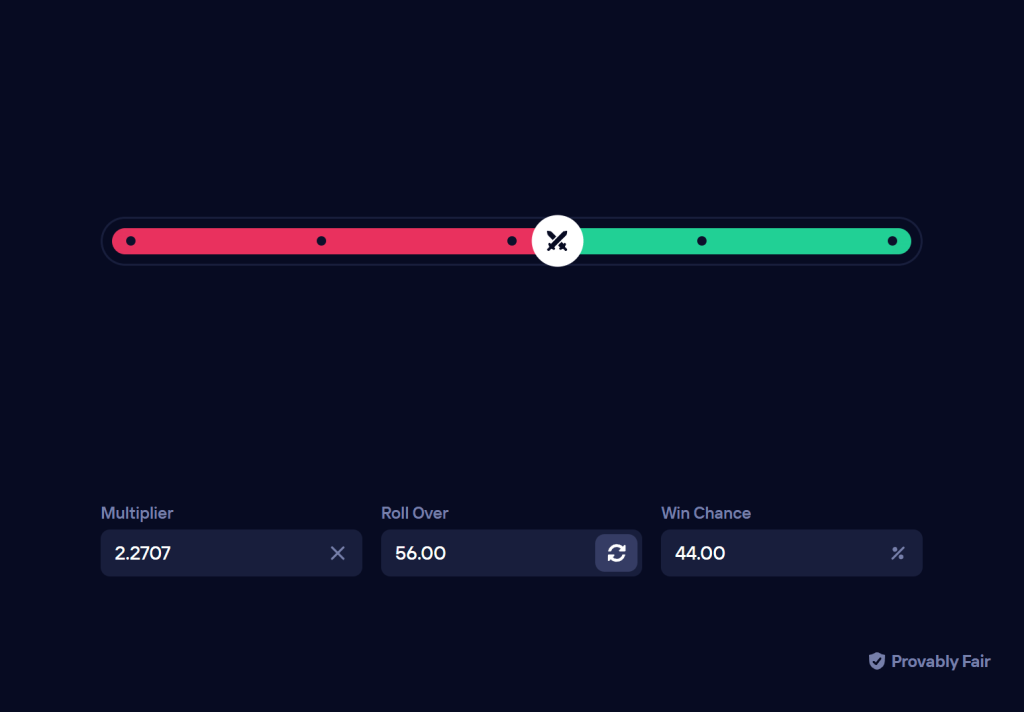
For a provably fair dice game, the house edge is easier to express in terms of win probability and multiplier. If the multiplier m is the total return including the original stake, and p is the probability of winning expressed as a decimal, then the house edge is 1 – p * m. For a bet that claims a 1% edge, p and m should satisfy p * m = 0.99. For example, a roll under 49.50 has p = 0.4950. At a multiplier of 2.0000x, p * m = 0.9900, so the edge is exactly 1.00%. If the same threshold is offered at 1.98x, p * m = 0.9801, which is a 1.99% edge despite what the label says. This is a simple check that does not require any external data.
Using the house edge
A smaller house edge means a slower expected drain per bet, but it does not guarantee a shorter losing streak. Big and Small has only a 2.78% edge but produces roughly even-money oscillations. Specific triples have a 16.20% edge and a hit rate below half a percent, so you can play for a long time without seeing a payout. If you intend to play high-edge dice bets, the expected cost will be high and the volatility will be severe. A rational approach is to determine a stake limit before playing and to treat any single-session result as one sample from a distribution. Our bankroll management guide covers this in practical terms.
Before playing at any operator, confirm the paytable in the actual product and compare it with the counts provided here. Operators are not uniform: one venue may pay 30 to 1 on any triple while another pays 24 to 1. If the wording is for 1 rather than to 1, recalculate everything. For paytable differences and operator notes, our casino reviews pages list what to check, and our news section tracks changes that affect dice-game mathematics. The underlying dice arithmetic does not change, but the paytable is the variable that should be verified every time.
FAQ
What is the house edge on Sic Bo Big and Small?
Big and Small each have 105 winning outcomes out of 216 after excluding triples. At an even-money payout, the house edge is 2.78%. This is the lowest common Sic Bo edge, but the actual paytable may vary by operator.
Why are Sic Bo triple bets so expensive?
Any triple has only 6 winning outcomes in 216, and a specific triple has exactly 1 winning outcome in 216. Even with payouts such as 30 to 1 and 180 to 1, the expected return remains below the stake. Any triple at 30 to 1 gives a 13.89% edge, and a specific triple at 180 to 1 gives a 16.20% edge.
Can a provably fair dice game have a zero house edge?
Mathematically, yes, if the multiplier is equal to 1 divided by the win probability, so that p times m equals exactly 1. In practice, commercial operators almost never offer that because they need to cover costs. You can verify a claimed edge by checking the target and multiplier yourself using the formula: house edge = 1 – p * m.