Verifying Old Rounds After a Casino Closes: What Survives

the author
ProvablySmart Research Desk
date post
Aug 28, 2026

Share


When a casino shuts down, its provably fair history often disappears with it. The difference between a verified round and an unverifiable one reduces to a handful of files: pre-revealed server seed hashes, revealed seeds, client seeds, nonces, and bet receipts. This article explains which records survive a closure, which never leave the operator’s servers, and what you can still check in 2026 if you prepared in advance.
What a Provably Fair Record Requires
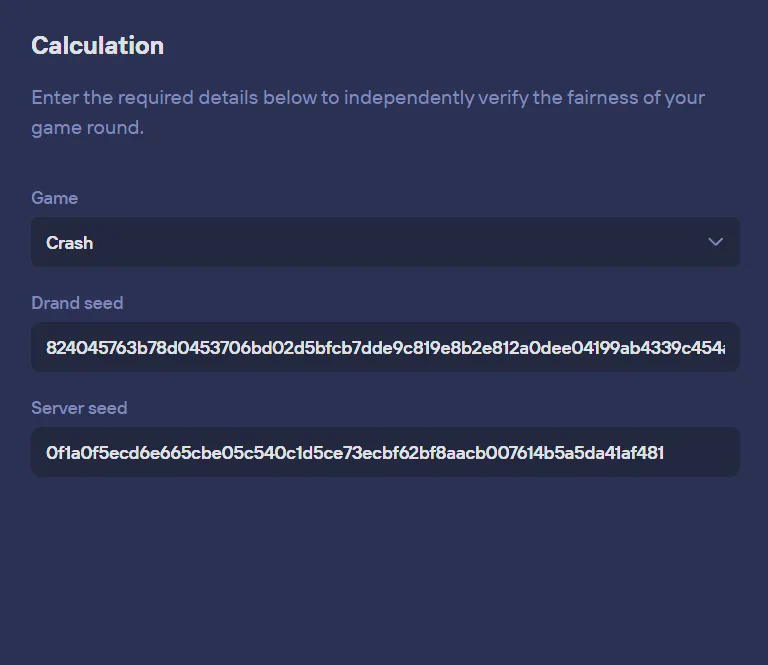
Every provably fair game has four minimum inputs:
- Server seed hash — a commitment to the operator’s secret seed, shown before betting.
- Server seed — the actual seed revealed after betting.
- Client seed — a string chosen or edited by the player.
- Nonce — a counter that makes each round unique.
If you have all four, with the correct hash, you can recompute the game outcome from the public algorithm and compare it to the recorded result. If any one is missing, the verification either fails or becomes weak. A revealed server seed without its prior hash is useless: the operator could have selected it retroactively. A hash without a revealed seed only tells you that something was committed. The exact math is specific to each game type; see our provably fair verification guides for worked examples.
What Survives After Closure
How Does This Compare to 0% House Edge Protocols?
Audited 100% RTP
Instead of standard 1.00% to 4.00% casino house margins, compare with mathematically verified 100% RTP Originals (0.00% House Edge) on Duel Casino:
Casino closure is not one event. It can be a voluntary shutdown, a license revocation, an insolvency proceeding, or a sudden block of access. Each scenario changes what data remains accessible.
1. Data You Downloaded Yourself
The most durable records are those on your device or in your email: CSV exports of bets, transaction logs, screenshots of seed rotations, and JSON responses from the casino’s API. If you made a habit of downloading round history after each session, you already have the core evidence. This is also true for account passwords: once the site closes, login may be impossible, but a CSV file does not require a login.
2. Public Seed Commitments
Most crypto casinos publish their current server seed hash on a public page. If that page was indexed or archived while the site was live, the hash itself may be recoverable from web archives. In 2026, this is the only way to prove a seed existed before the rounds were played. If the hash was only visible inside an authenticated dashboard, it survives only if you recorded it. No archive can help you there.
3. On-Chain Recordings
A smaller set of casinos writes bet hashes or transaction IDs to the blockchain, sometimes as part of an on-chain verification system. After closure, those blockchain entries persist. However, persistence alone is not verification. The on-chain record must contain the same nonce, client seed commitment, and bet result that the casino’s site displayed. If the site was the only way to map your account to those hashes, the mapping dies with the site. A transfer of funds on-chain proves money moved, not that the crash point was 1.94x.
4. Operator or Regulator Records
If the casino held a license, the regulator may require the operator to keep transaction records for a set period. Similarly, insolvency administrators may preserve databases. You should check the relevant regulator’s notice and the closure announcement. However, there is no universal rule that a customer can access those records. Frame operator-specific claims as what to check: every closure document will state who controls the data and how to submit a request, if at all.
What Is Lost Immediately
The operator’s master key, internal server seed generation logs, and the mapping from your account ID to your active client seed are stored only on the casino’s systems. If the operator does not release these records, no amount of analysis on your side can recover them. Even a saved server seed hash loses value if you do not also have the client seed and nonce for each round. The seed alone produces an outcome only when combined with client seed and nonce.
| Data type | Typical location | Survives closure if… | Verifiable later? |
|---|---|---|---|
| Pre-reveal server seed hash | Casino website or dashboard | you saved it or an archive captured it | Yes, if the revealed seed is available |
| Revealed server seeds | Round history or casino DB | you exported round history | Yes |
| Client seed | Your account settings | you recorded it | Yes |
| Nonce / bet result | Round history or casino DB | you exported bets | Yes |
| Operator’s private key / seed source | Operator’s server | operator publishes it | Rarely |
Why the Pre-Reveal Hash Is Non-Negotiable
Post-closure verification is essentially an audit of the commitment scheme. The only cryptographic reason to trust a server seed is that its hash was committed before the outcome was known. If you do not have a pre-existing hash, then a generous casino could give you any seed after the fact and claim it was the original. In a court or a forum dispute, that claim is no stronger than the operator’s word.
For this reason, the single most valuable habit before any bet is to write down the current server seed hash shown on the casino’s fairness page. If the page rotates seeds every session, record the hash at the start of each session. The practice costs seconds and turns a closed casino from an unverifiable black box into an auditable record. We cover session-start recording in more detail in bankroll management and record-keeping.
Closure Statistics and RTP
After a casino closes, players often look at their total deposits and withdrawals and ask whether the observed return matches the advertised RTP. This is normal but statistically unhelpful. A specific game’s RTP is a long-run expectation over millions of outcomes. Your own account may hold tens or hundreds of rounds. The difference between expected and observed results can be wide even in a completely fair game. Closure only truncates the sample; it does not make the sample representative. See closure announcements and industry status for information about operators that stop running.
Practical Checklist for the Next Casino You Play
If you are currently playing at a casino and care about post-closure verification, do the following now:
- Save the current server seed hash before your first bet of each session.
- After each session, export your round history and store it locally in at least two places.
- Store your client seed and the exact wallet address used for deposits.
- Check whether the casino’s published verification instructions match its actual game output. If the casino makes it difficult to access fairness pages, treat it as a warning.
Before you rely on a casino’s long-term solvency, also read reviews that discuss license status and data retention. The casino reviews on this site list what to verify about an operator and what kind of public records it provides. No review can guarantee a future closure, but a history of publishing complete seed data is a better signal than a white paper.
FAQ
Can I verify a bet after the casino is gone if I never saved any seeds?
No, not cryptographically. Without a pre-reveal server seed hash and the corresponding client seed and nonce, you cannot prove that the round was generated by a predetermined algorithm. Player-side export files are the minimum requirement for independent verification.
Does the casino’s published RTP matter after closure?
As a default trust signal, no. Closure removes the sample frame, and a short series of outcomes does not test an RTP claim. However, if you saved complete round data, you can recompute the outcome—which tests one round, not the long-run average.
Are on-chain bets automatically verifiable after closure?
Only if the blockchain record includes the same bet ID, nonce, and seed commitment that the casino displayed. Most on-chain transactions only record a payment hash, which proves movement of funds but not the game result. Treat on-chain records as supplementary, not a substitute for downloading your own round history.