RTP vs. House Edge vs. Payout Ratio: The Numbers That Actually Matter

the author
ProvablySmart Research Desk
date post
Aug 28, 2026

Share


Three terms dominate the discussion of casino game mathematics: Return to Player (RTP), House Edge, and Payout Ratio. They are often conflated, but each represents a distinct concept. For a player who wants to evaluate a game’s fairness and long-term expectation, understanding the precise definitions—and how to verify them—is essential. This article provides the technical breakdown, with an emphasis on what can be checked independently.
Defining the Three Numbers
Return to Player (RTP)
RTP is the percentage of total wagered money that a game is mathematically expected to return to players over an infinite number of rounds. It is a theoretical long-term average. For example, a game with an RTP of 96% means that for every 100 units wagered, the game will return 96 units on average, keeping 4 units as profit for the operator. RTP is calculated from the game’s rules and probabilities, not from historical results. It is the complement of the house edge: RTP = 1 – House Edge.
House Edge
House edge is the casino’s mathematical advantage over the player. It is the inverse of RTP: House Edge = 1 – RTP. Using the same example, a 96% RTP yields a 4% house edge. The house edge is the long-term profit margin for the operator. It is derived from the game’s paytable and probabilities. For table games like blackjack, the house edge can vary with player strategy; for slots, it is fixed by the game’s design.
Payout Ratio
Payout ratio is often used interchangeably with RTP, but in strict terminology, it refers to the multiplier applied to a winning bet. For example, a slot symbol that pays 5x your bet has a payout ratio of 5:1. In some contexts, especially in the crypto casino space, “payout ratio” may mean the actual amount returned relative to the stake for a specific winning outcome. It is not a long-term average but a per-outcome multiplier. Confusing the two can lead to misinterpretation of a game’s expected value.
Why These Numbers Matter—and How to Verify Them
How Does This Compare to 0% House Edge Protocols?
Audited 100% RTP
Instead of standard 1.00% to 4.00% casino house margins, compare with mathematically verified 100% RTP Originals (0.00% House Edge) on Duel Casino:

The critical question for a skeptical player is: How do I know the advertised RTP or house edge is accurate? In traditional online casinos, players have to trust the operator. In provably fair crypto casinos, verification is possible. Here are the mechanisms:
- Provably Fair Seeds: Each game round uses a client seed (set by the player), a server seed (provided by the casino), and a nonce. The outcome is determined by hashing these seeds. The player can verify that the server seed was generated before the round and was not altered. The expected RTP is coded into the game’s algorithm, which can be audited.
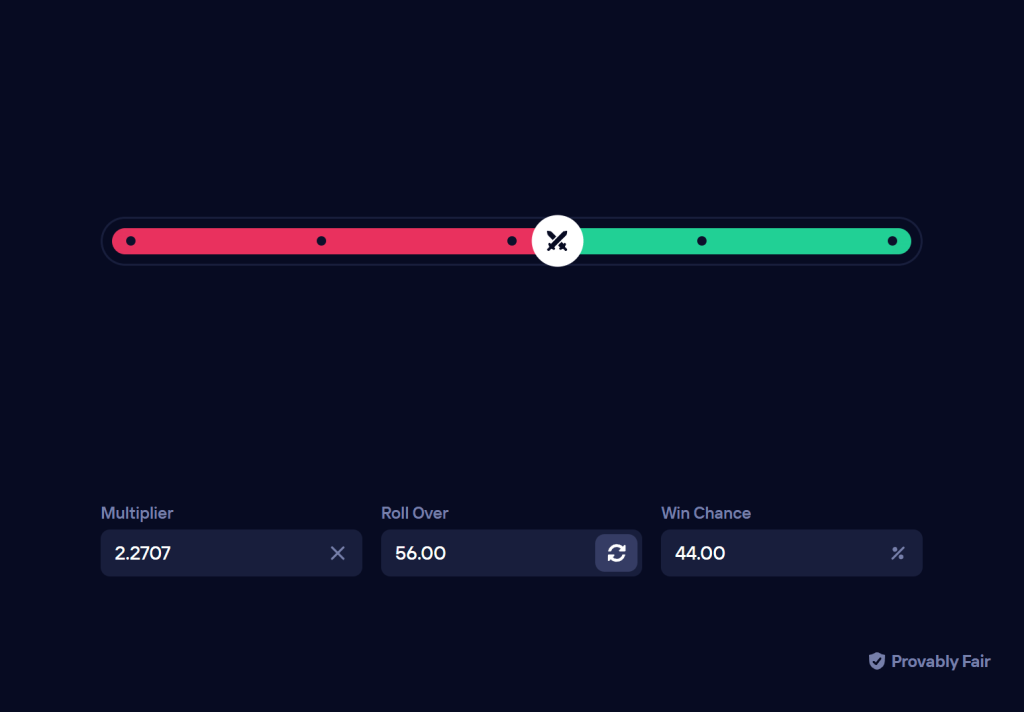
- Smart Contract Verification: On-chain games expose the entire game logic in a public smart contract. The house edge and payout ratios are hardcoded. Anyone can read the contract and verify the probabilities. For example, a dice game contract may show that a roll above 96.00 (out of 100) loses, giving a 96% RTP.
- Third-Party Audits: Some operators publish audit reports from firms like iTech Labs or Gaming Laboratories International. For crypto casinos, projects like ProvablySmart’s Fairness Ledger aggregate verifiable data.
To verify a specific game, use a provably fair verifier that reconstructs the round using the seeds and nonce. Compare the outcome to the payout ratio table. If the game is a slot, the RTP is the weighted average of all payout ratios multiplied by their probabilities. You can compute this from the paytable if you know the math—but the operator should provide the RTP value.
Comparing RTP Across Game Types
RTP varies significantly by game category. The table below shows typical RTP ranges for common casino games. Note that these are theoretical values; actual figures depend on the specific variant and operator.
| Game Type | Typical RTP Range | House Edge Range |
|---|---|---|
| Blackjack (basic strategy) | 99.0% – 99.7% | 0.3% – 1.0% |
| Baccarat (Banker bet) | 98.94% | 1.06% |
| European Roulette | 97.30% | 2.70% |
| American Roulette | 94.74% | 5.26% |
| Video Poker (Jacks or Better, perfect play) | 99.54% | 0.46% |
| Online Slot (average) | 95.0% – 97.0% | 3.0% – 5.0% |
These numbers are only meaningful over millions of rounds. In the short term, variance dominates. A slot with 96% RTP can easily produce a losing streak of 100 spins or a jackpot that pays 1,000x. The RTP is a mathematical expectation, not a guarantee for any session.
Why RTP Is Not Enough: The Role of Variance and Hit Frequency
Two games with the same RTP can behave very differently. Consider a slot with 96% RTP that pays 10x every 10 spins (high hit frequency, low variance) versus one that pays 1,000x every 1,000 spins (low hit frequency, high variance). The RTP is identical, but the player’s bankroll experience is not. For bankroll management purposes, you need to understand not just RTP but also the game’s volatility and payout distribution.
A more complete metric is the payout frequency (the percentage of rounds that result in a win) and the average payout ratio per win. These can be found in the game’s help section or paytable. For example, a slot might list: “RTP = 96.5%, Hit Frequency = 25%, Average Payout = 3.86x.” The average payout is derived from the RTP divided by hit frequency (96.5% / 25% = 3.86x).
How Operators Use These Numbers
Casino operators often advertise RTP prominently because it is a player-friendly metric. However, the RTP can be manipulated if the game logic is not transparent. In a provably fair system, the RTP is embedded in the game’s algorithm. For example, in a dice game, the RTP is determined by the threshold for winning. If the player wins when the roll is less than 96 (out of 100), the RTP is 96% (assuming even money payout). The operator cannot change the threshold after the fact because the client seed is chosen by the player and the server seed is committed.
When evaluating a casino, check the casino reviews for mentions of provably fair implementation and RTP verification. Also review the guide to provably fair games for step-by-step verification methods.
Calculating the House Edge from Observed Data
While RTP is a theoretical value, you can estimate the actual house edge from a large sample of rounds if you have access to the full history. For a provably fair game, you can retrieve all outcomes and compute the net result. For example, if you have 1,000,000 rounds with a total wager of 1,000,000 units and total returns of 960,000 units, the observed RTP is 96%, close to the theoretical. Discrepancies larger than expected (e.g., 95% vs 96%) would indicate a possible error in the algorithm or a deliberate manipulation—but this is unlikely in a well-audited system.
On-chain games allow anyone to query the contract’s historical data. The transparency is absolute. However, smart contract bugs can lead to unintended RTP; always verify the contract’s logic before playing.
Summary
- RTP = theoretical long-term return percentage. House Edge = 1 – RTP. Payout Ratio = multiplier for a specific win.
- RTP is a mathematical expectation; variance matters for short-term play.
- Verification is possible via provably fair tools and smart contract analysis.
- Always check the game’s hit frequency and volatility alongside RTP.
FAQ
What is the difference between RTP and house edge?
RTP (Return to Player) is the percentage of wagers that a game is expected to return to players over time. House edge is the complement: 100% – RTP. They are two sides of the same coin. For example, a game with 96% RTP has a 4% house edge. The house edge represents the casino’s long-term profit margin.
How can I verify the RTP of a casino game?
In a provably fair casino, you can verify each round’s outcome using the client seed, server seed, and nonce. The game’s algorithm defines the RTP. Use a provably fair verifier to check that the computed outcome matches the displayed result. For on-chain games, inspect the smart contract’s logic and probability mappings. Some operators also publish third-party audit reports.
Does a higher RTP guarantee I will win?
No. RTP is a long-term statistical average over millions of rounds. In the short term, variance can cause significant deviations. A game with 99% RTP can still produce a losing session, just as a game with 94% RTP can produce a win. Always consider the game’s volatility, hit frequency, and your own bankroll management strategy.