Rakeback vs Reload Bonuses: Long-Term EV Compared

the author
ProvablySmart Research Desk
date post
Aug 28, 2026
Share


For players who treat crypto casino play as a long-term activity, the choice between rakeback and reload bonuses can significantly affect overall expected value (EV). Both are promotional tools that give back a portion of the house edge, but their structures differ fundamentally. This article compares the two using verifiable math, focusing on EV under realistic assumptions, and explains how to check the numbers yourself.
What is Rakeback?
Rakeback is a rebate on the total amount wagered (turnover) or on the house edge generated by a player. Typically offered as a percentage of turnover — for example, 0.3% on slots — it is paid out periodically (e.g., daily or weekly) regardless of win/loss. The key property: rakeback is a fixed reduction in the house edge. If a slot has a house edge of 4% (96% RTP), a 0.3% rakeback reduces the effective house edge to 3.7%.
To calculate the EV of a single bet with rakeback:
EV = (Bet Amount × House Edge) + (Bet Amount × Rakeback Rate)
For a $100 bet on a 4% house edge slot with 0.3% rakeback: EV = -$4 + $0.30 = -$3.70. Over many bets, the actual loss will approach this value. The rakeback is not contingent on meeting any wagering requirement; it is simply credited based on turnover.
What are Reload Bonuses?
How Does This Compare to 0% House Edge Protocols?
Audited 100% RTP
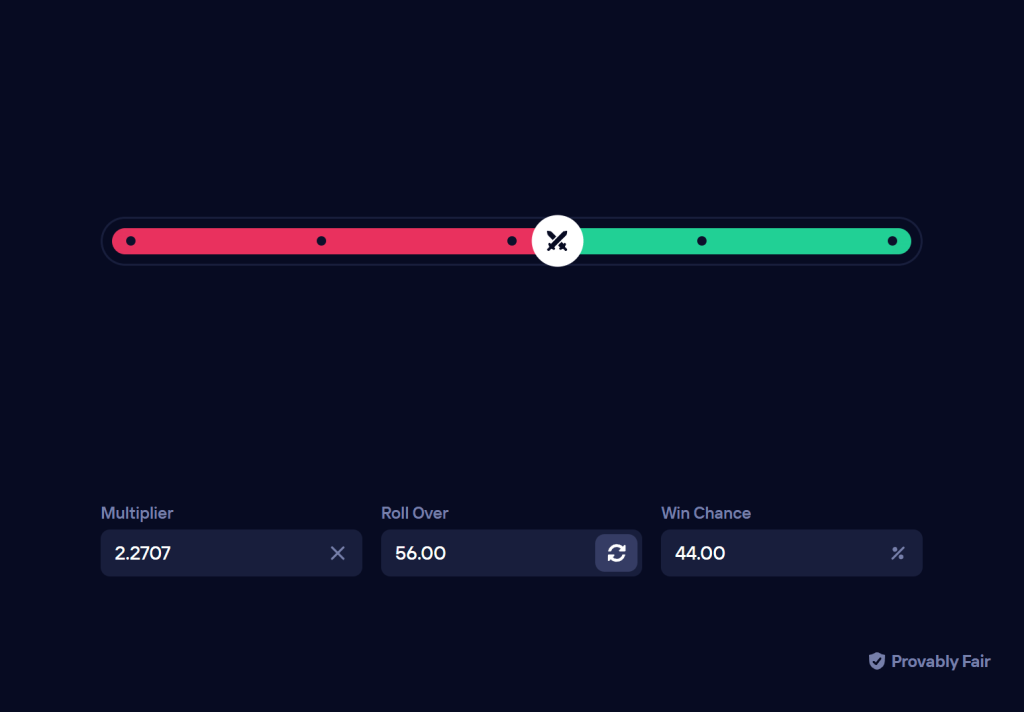
Instead of standard 1.00% to 4.00% casino house margins, compare with mathematically verified 100% RTP Originals (0.00% House Edge) on Duel Casino:
Reload bonuses are match deposit offers — e.g., “50% up to $500”. They require a deposit, give a bonus amount, and impose a wagering requirement (WR) that must be met before the bonus can be withdrawn. The EV of a reload bonus is:
EV = Bonus Amount – (WR × House Edge of games played)
However, the house edge used in the calculation must account for game weighting. For example, a bonus may have a WR of 30x the bonus, and slots contribute 100% while blackjack contributes 10%. The effective house edge is a weighted average.
Example: Deposit $100, get $50 bonus, WR = 30x bonus = $1,500. If you play slots with 96% RTP (4% house edge), expected loss = $1,500 × 0.04 = $60. Bonus EV = $50 – $60 = -$10. Negative EV. If you play blackjack with 0.5% house edge (and it contributes 10% to WR), the effective WR for blackjack becomes $1,500 / 0.10 = $15,000. Expected loss = $15,000 × 0.005 = $75, EV = $50 – $75 = -$25. But if blackjack contributes 100% (rare), EV = $50 – ($1,500 × 0.005) = $50 – $7.50 = +$42.50. The actual EV depends on the operator’s game weighting and your ability to play optimally.
Long-Term EV Comparison
To compare the two, we must consider the same total wagered amount. Assume a player plans to wager $10,000 over a month. We model two scenarios:
| Scenario | Rakeback (0.3% of turnover) | Reload Bonus (50% up to $200, 30x WR, slots only) |
|---|---|---|
| Deposit | None required | $400 (to get max bonus $200) |
| Bonus | N/A | $200 |
| Wagering Required | None | 30 × $200 = $6,000 |
| Total Wagered | $10,000 | $10,000 (includes $6,000 from bonus play) |
| Expected Loss (4% house edge) | -$400 | -$400 |
| Rakeback Received | 0.3% × $10,000 = $30 | None |
| Bonus EV | N/A | +$200 – (0.04 × $6,000) = $200 – $240 = -$40 |
| Net EV | -$370 | -$440 |
| Effective House Edge | 3.70% | 4.40% |
In this example, rakeback yields a better net EV. The reload bonus is negative EV because the wagering requirement exceeds the bonus value relative to the house edge. However, if the player can use a low-house-edge game (e.g., baccarat with 1.06% house edge) and that game contributes 100% to WR, the reload bonus becomes positive:
| Scenario | Rakeback (0.3% turnover) | Reload (low house edge, 100% contribution) |
|---|---|---|
| House Edge | 4% | 1.06% |
| Wagered | $10,000 | $10,000 (including $6,000 WR) |
| Expected Loss | -$400 | -$106 |
| Rakeback | +$30 | None |
| Bonus EV | N/A | +$200 – (0.0106 × $6,000) = $200 – $63.60 = +$136.40 |
| Net EV | -$370 | +$30.40 |
Here, the reload bonus is clearly superior. But the player must meet the WR exactly and avoid any game restrictions (e.g., max bet limits, game weight changes).
Key Factors in Long-Term EV
- Consistency: Rakeback is nearly guaranteed as long as you play. Reload bonuses require you to meet conditions within a time limit; if you fail, you forfeit the bonus.
- Volatility: Rakeback reduces variance slightly because it is a fixed cash flow. Reload bonuses introduce a large lump-sum bonus that can be lost if you bust before clearing WR.
- Game Selection: Reload bonuses are heavily dependent on finding games with low house edge and high WR contribution. Rakeback usually applies to all games, but rates may differ by game.
- Time Value: Rakeback is paid out regularly; reload bonuses require an upfront deposit and lock up funds.
Verifiability
To verify the EV of a rakeback offer, check the terms: the percentage of turnover or revenue share, and whether it applies to all games. You can track your own wagering through the casino’s transaction history (often viewable on the balance page). For reload bonuses, read the full terms – wagering requirement, game weighting, max bet, and expiry. Calculate the EV using the house edge of the game you intend to play. You can verify the game’s RTP by checking the provably fair hash or the game provider’s published return. For on-chain deposits, you can record the transaction to confirm the deposit amount and bonus credit.
Many casinos display their rakeback rates in the account settings or loyalty dashboard. For reload bonuses, the deposit form often shows the bonus amount and WR. Cross-check with the casino reviews on this site, which list typical bonus terms and rakeback rates for each operator.
Practical Recommendations
- If you primarily play high-house-edge games (slots, keno), rakeback is almost always better than a reload bonus with a high WR.
- If you play low-house-edge games (blackjack, baccarat, craps) and can find a reload bonus that allows 100% contribution, the reload can be positive EV.
- Never accept a reload bonus with a negative EV unless you are also receiving rakeback that offsets the loss. Always calculate the combined EV.
- Use bankroll management to ensure you have enough funds to clear the WR without going broke.
For the latest changes in bonus policies, see the news section.
FAQ
Can I combine rakeback and a reload bonus?
Yes, many casinos allow both. In that case, the EV of the reload bonus is added to the rakeback EV. However, check the terms: some bonuses may not earn rakeback while the bonus is active, or there may be restrictions on game eligibility during the wagering period.
How do I calculate the EV of a reload bonus if I play multiple games?
Compute a weighted average house edge based on the proportion of wagers on each game, adjusted for the wagering contribution multiplier. For example, if you wager 50% on slots (4% edge, 100% contribution) and 50% on blackjack (0.5% edge, 10% contribution), the effective house edge for the WR is 0.5 * 0.04 + 0.5 * 0.005 * (100%/10%) = 0.02 + 0.025 = 0.045 (4.5%). Then use that in the EV formula.
What is a typical rakeback rate for crypto casinos?
Rates vary widely, from 0.1% to 0.5% of turnover on slots, or 10% to 30% of the house edge. Always check the specific terms. You can verify the rate by comparing your wagering history and the amount of rakeback credited over a period.