Rain Features in Casino Chat: Small Value, Real Math

the author
ProvablySmart Research Desk
date post
Aug 28, 2026

Share


Rain features in casino chat rooms are small token distributions that appear when a moderator, casino account, or automated bot sends credits to active participants. The amounts look trivial, but they are not outside the reach of probabilistic analysis. This article treats rain as a financial instrument: what is its expected value, which factors make it worse than face value, and how can you verify the distribution is honest?
What rain is and how it gets distributed

Rain typically appears as a chat message with a command, a time limit, and a set of recipients. The casino may define “active chat participants” as anyone who sent a message in the last N minutes, or as anyone who clicks a button. Each recipient receives either a fixed amount or a randomly drawn amount from a range. The source of funds, the min/max values, and the selection algorithm should be published by the operator. If they are not, the correct response is to assume the process is opaque.
Rain is often subject to wagering requirements before the credits are withdrawable. In that sense it resembles a no-deposit bonus with a small nominal value. To calculate whether the rain has positive expected value, you need three inputs: the gross rain amount, the wagering multiplier, and the house edge of the game you are required to play. None of these are hidden in principle; all can be found in the terms attached to the promotion, or in the game returns table.
The math of small-value distributions
How Does This Compare to 0% House Edge Protocols?
Audited 100% RTP
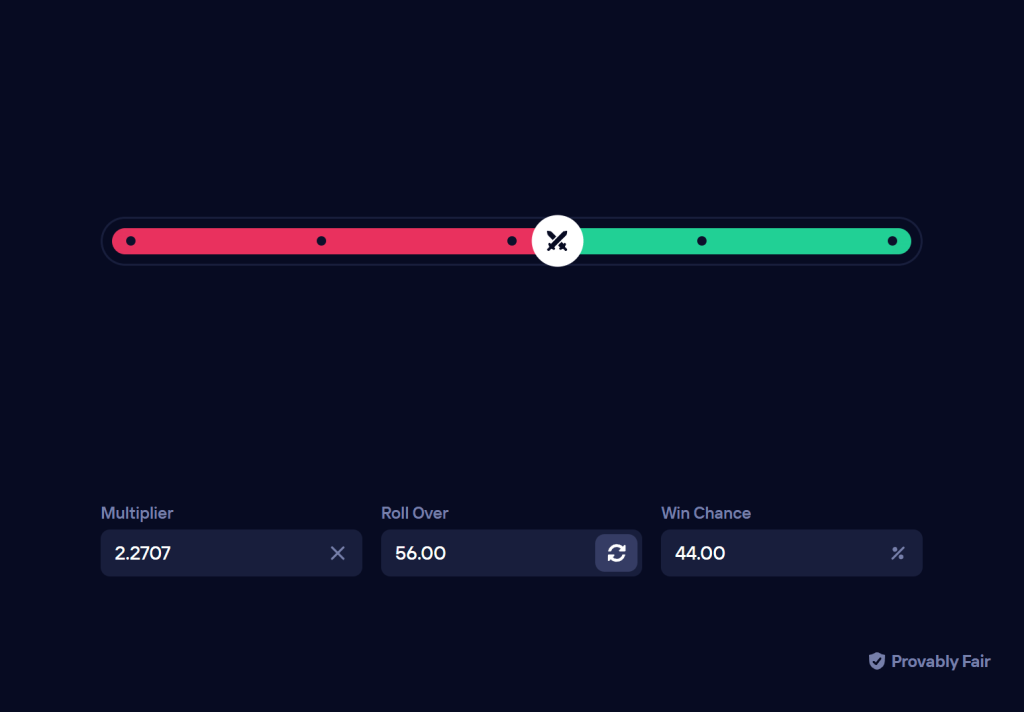
Instead of standard 1.00% to 4.00% casino house margins, compare with mathematically verified 100% RTP Originals (0.00% House Edge) on Duel Casino:
Let a player receive rain amount R in the casino’s base currency. The casino attaches a wagering requirement M; the player must place total bets of R × M before the balance becomes withdrawable. If the game used for wagering has house edge H (expressed as a decimal), the expected cost of clearing the requirement is R × M × H. The expected value of the rain after clearing, before considering the probability of ruin during the wagering, is:
EV = R − (R × M × H) = R(1 − M × H)
For example, take a rain drop of 20 USDT with a 40x wagering requirement. If the only eligible game is a RTP 96% slot, H = 0.04. Expected cost = 20 × 40 × 0.04 = 32 USDT. The EV is 20 − 32 = −12 USDT. The player is not receiving 20 USDT; they are buying a negative-expectation obligation worth −12 USDT in expectation.
| Rain amount | Wagering multiplier | House edge | Expected cost | EV |
|---|---|---|---|---|
| 10 USDT | 20x | 2% | 4 USDT | +6 USDT |
| 10 USDT | 40x | 2% | 8 USDT | +2 USDT |
| 10 USDT | 40x | 5% | 20 USDT | −10 USDT |
| 20 USDT | 40x | 4% | 32 USDT | −12 USDT |
The formula is only the start. A positive EV does not mean a profitable session. Variance matters. With a 10 USDT rain and a 20x requirement on a 98% RTP game, the expected cost is 4 USDT, so the theoretical EV is +6 USDT. But the player must complete 200 USDT of wagers with a high-volatility game; the probability of ending that run with a non-zero withdrawable balance is far below 100%. The player may exhaust the balance before clearing. This is another way the casino’s house edge works: the provably fair game guides often show the variance, not just the RTP, and that variance should inform whether a rain is worth activating at all.
The distribution randomness of the rain itself
The amount received from a rain is often random. If the operator advertises a range, the selection of the amount should be deterministic from a seed and a server seed. A player cannot directly observe the probabilities from a single rain, but across a sample of hundreds of rain transactions, the distribution of amounts can be compared to the advertised range. This is why some casinos record each rain’s seed or transaction ID. What to check: whether the rain generation shows a hash before the distribution, whether you are allowed to verify the server seed after the event, and whether the operator publishes the full list of recipients and amounts.
If a rain uses a biased selection algorithm, the effect on any single small amount is irrelevant in absolute terms. But it is not irrelevant as a signal. A distribution system that is not verifiable is a black box, and a black box is a red flag when the casino is already asking you to accept a wagering requirement.
On-chain and ledger verification
Rain funded from a casino wallet can be checked on-chain if the casino publishes the wallet address and the transaction IDs of the rain. Each recipient’s payout should match a transaction output. For a chat user, this may seem like excessive diligence for a 10 USDT credit, but the same ledger discipline applies to larger casino promotions. Checking that the casino actually moved the funds, rather than adjusting a number in a private database, is part of third-party casino reviews methodology.
For casino-owned rain systems that are not on-chain, the verifiable artifact is the seed log. The casino should publish a hash of the server seed before the rain round, then reveal the seed after. The recipient list and the amount for each recipient are generated from that seed. If the operator does not provide a reveal mechanism, there is no way for a user to distinguish “random rain” from “rain amounts selected by an admin after seeing who is in the chat.”
Rain as a bankroll management input
Rain is small, but it is still part of your bankroll accounting. The correct treatment is to record any rain credited to your balance as a liability if it carries wagering requirements. It is not income until the requirement is cleared or the amount is withdrawn. This distinction matters for players who keep a session log or use a dedicated bankroll. Counting rain at face value while it is still trapped by wagering leads to an inflated view of available funds, and that feeds overbetting.
The rational way to treat rain is to calculate the EV with the formula above, decide whether the time cost of clicking and clearing is worth it, and then either play the requirement at the lowest-house-edge eligible game or ignore the rain entirely. Since rain amounts are small, the time cost often dominates the math. If it takes four minutes of wagering to turn a +2 USDT EV rain into cash, that is below most players’ opportunity cost. The value is real, but so is the cost of extraction.
For players who do not want to spend attention on promotions, the simplest rule is to avoid rain with a requirement multiplier above a threshold where the expected cost exceeds the face amount. That threshold is M = 1/H. For a 2% house edge game, any multiplier above 50 is negative EV. For a 5% game, any multiplier above 20 is negative. This is not complex or hidden math; it is the same calculation used for any bonus, and it belongs in every bankroll management routine.
What you can verify in practice
- Check the rain announcement for the wagering requirement and eligible games. Use the EV formula before you click.
- Check whether the casino publishes a pre-rain hash and a post-rain server seed reveal for the amount selection.
- Check on-chain wallet records when the casino claims to send rain as a transaction.
- Check independent review sites and player reports for patterns of rain recipients being selected in a way that is inconsistent with the published logic.
Rain is not a reason to deposit, and it is not a reason to ignore the house edge. It is a small, measurable event. The math works exactly as it does for any other bonus. The only difference is the amount, and a smaller amount does not change the operators’ obligations to be transparent about the process. In 2026, with the proliferation of crypto chat platforms, rain has become a retention tool in the same category as faucets and free spins. The correct reaction for a skeptical player is to calculate first, then decide whether the extraction cost is worth it.
For a current look at which casinos publish verifiable rain terms, see our news coverage of promotional changes and the terms in each review.
FAQ
How do I calculate the expected value of a rain drop?
Use the formula EV = R(1 − M × H), where R is the rain amount, M is the wagering multiplier, and H is the house edge of the game you must play. If the result is negative, the rain is worth less than nothing in expectation. If positive, it is still not a guaranteed profit due to variance.
Is a rain payment verifiable like a provably fair game?
Only if the operator publishes a hash before the distribution, a server seed reveal after, and a list of recipients. With those three components, you can confirm that the amount you received was determined by the same seed used for the round. Without a reveal mechanism, the distribution is not verifiable.
Should I complete a high wagering requirement for a small rain amount?
Probably not. The time cost of wagering, plus the risk of losing the balance before clearing, often exceeds the face value. Apply the threshold M = 1/H first. If the multiplier is above that, the expected cost is larger than the rain itself.