Provably Fair vs Regulated RNG: Two Different Trust Models

the author
ProvablySmart Research Desk
date post
Aug 28, 2026

Share


Online casinos typically rely on one of two trust models to assure players that game outcomes are random: provably fair (cryptographic verification) or regulated RNG (third-party certification). While both aim to prevent manipulation, they operate on fundamentally different assumptions about what the player can and cannot verify. This article compares the two models from a technical perspective, focusing on verifiability, audit trails, and the trust requirements each imposes.
How Provably Fair Works
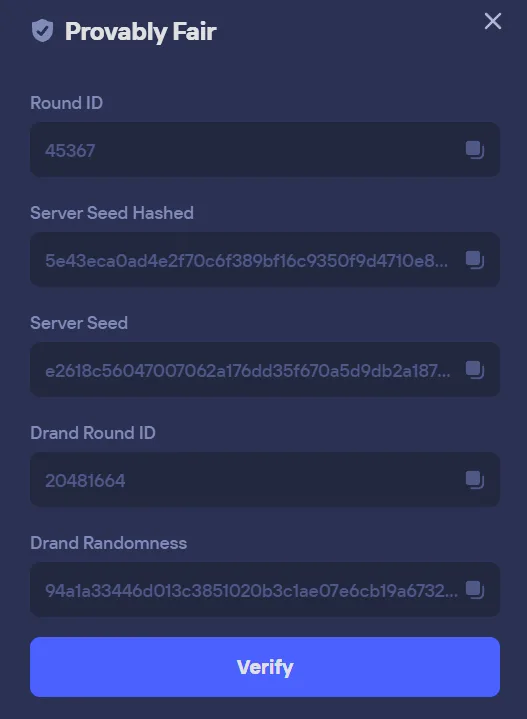
Provably fair is a cryptographic protocol that allows the player to independently verify each game round’s outcome after the fact. The typical implementation involves three components:
- Server seed – a random string generated by the casino, kept secret during the round but hashed (SHA-256) and published before the round begins.
- Client seed – a random string provided by the player, often changeable between rounds.
- Nonce – an incrementing counter that ensures each round uses a unique combination.
Before the round, the casino publishes the hash of the server seed. After the round, the casino reveals the original server seed, and the player can combine it with their client seed and nonce to compute the expected outcome. If the computed outcome matches the actual result, the round is provably fair.
This protocol is deterministic: given the same seeds and nonce, the outcome is always the same. The only way the casino could cheat is by predicting the client seed in advance and choosing a server seed that yields a desired outcome. However, because the server seed hash is committed before the player submits their client seed, any such manipulation would require inverting a cryptographic hash, which is computationally infeasible.
From a verifiability standpoint, provably fair offers complete transparency. The player can check every round themselves using open-source code or simple command-line tools. No trust in a third party is required, only trust in the underlying cryptographic primitives (SHA-256, HMAC, etc.).
How Regulated RNG Works
How Does This Compare to 0% House Edge Protocols?
Audited 100% RTP
Instead of standard 1.00% to 4.00% casino house margins, compare with mathematically verified 100% RTP Originals (0.00% House Edge) on Duel Casino:

Regulated RNG casinos use software random number generators that have been tested and certified by an independent laboratory (e.g., eCOGRA, GLI, BMM Testlabs). The certification process typically involves:
- Statistical analysis of the RNG’s output (e.g., chi-square, runs tests, serial correlation) to confirm uniformity and independence.
- Source code review to ensure the algorithm is correctly implemented and cannot be tampered with.
- Periodic re-testing to verify that the RNG remains unchanged after certification.
In this model, the player cannot directly verify individual outcomes. The trust is placed in three entities: the casino (to not alter the RNG after certification), the testing lab (to perform thorough audits), and the regulatory body (to enforce compliance). The player may see a certificate seal on the casino’s website, but they cannot independently confirm that the RNG used in a given round matches the certified version.
The RNG itself is typically a pseudorandom number generator (PRNG) seeded by a hardware entropy source or a secure random seed. The casino’s server generates the outcome, and the player receives only the result. There is no cryptographic commitment before the round.
Comparing Trust Assumptions
| Dimension | Provably Fair | Regulated RNG |
|---|---|---|
| Verification method | Player computes outcome from seeds | Relies on lab audit reports |
| Verification frequency | Every round (player-driven) | Periodic certification (yearly or less) |
| What is being trusted | Cryptographic hash functions | Testing lab + regulator + casino |
| Can player detect cheating? | Yes, immediately after round | Only if caught by regulator (rare) |
| Transparency of algorithms | Open source (usually) | Proprietary (often closed source) |
| Regulatory oversight | None (or minimal) | Licensed jurisdiction required |
The key difference is that provably fair eliminates the need for a trusted third party, while regulated RNG replaces direct player verification with institutional oversight. Each model has its own failure modes: provably fair can be compromised if the casino sees the client seed before committing the server seed hash (e.g., through a replay attack or if the client seed is not truly random), while regulated RNG fails if the certification process is perfunctory or the casino alters the RNG after the audit.
Verifiability: What the Player Can Check
Provably Fair
To verify a provably fair round, the player needs:
- The server seed (revealed after the round).
- The client seed (as chosen by the player).
- The nonce (typically shown in the game history).
- The hash algorithm used (usually SHA-256).
- The outcome derivation function (e.g., how the seed combination yields a number between 0 and 99 for a 100-sided dice).
Most provably fair casinos provide a verification page or a third-party tool. The player can also verify locally using a script. Because the entire process is deterministic, any discrepancy between the expected and actual outcome proves the casino cheated. As of 2026, this model is almost exclusively used by crypto casinos, which often publish their seed-change policies and allow players to change client seeds.
Regulated RNG
For a regulated RNG, the player can check:
- The casino’s license number and issuing authority (e.g., Malta Gaming Authority, UK Gambling Commission).
- The certificate of the testing lab (usually a PDF on the casino’s site).
- Whether the lab’s seal is clickable and leads to the lab’s verification page.
- Historical RTP reports published by the casino (some jurisdictions require monthly payout percentages).
However, none of these allow the player to verify a specific round’s outcome. The player must trust that the RNG used in real time is the same one that was certified. In practice, certification occurs at a point in time; the casino could theoretically swap the RNG module after the audit. Some jurisdictions conduct surprise inspections, but the frequency is low.
Which Model Suits Which Player?
The choice between provably fair and regulated RNG often depends on the player’s risk profile and technical ability. Players who value cryptographic certainty and are willing to perform manual verification may prefer provably fair. Those who prioritize regulatory protection and dispute resolution channels (e.g., through a licensing authority) may lean toward regulated RNG. Many comprehensive casino reviews now explicitly note which trust model a site uses, as it is a key differentiator.
It is also possible to combine both models. Some casinos offer provably fair games while also holding a license from a recognized regulator. In such cases, the player gets the best of both worlds: cryptographic verification at the round level and institutional recourse if something goes wrong. However, these hybrids are rare because regulated jurisdictions often require proprietary RNGs that cannot be made provably fair (due to closed-source requirements).
For players who want to manage their risk across different trust models, the bankroll management approach remains the same: allocate only what you can afford to lose, and treat verification as a due diligence step, not a guarantee of winning.
Ultimately, the verifiability of provably fair is a stronger guarantee for the technically inclined, but it places the burden of verification on the player. Regulated RNG shifts that burden to a third party, which may be appropriate for players who prefer not to or cannot verify every round themselves. Understanding the difference is essential for making an informed choice, and readers can find more detailed guides on how to verify provably fair games.
FAQ
Can I trust a regulated RNG casino if I cannot verify individual rounds?
Trust in a regulated RNG casino is based on the effectiveness of the regulatory framework. In jurisdictions with strong oversight (e.g., UK, Malta), the casino faces heavy penalties for non-compliance. However, the player cannot independently verify any single round. The risk is that the certification may be outdated or the casino may have tampered with the RNG after the audit. The level of trust required is higher than with provably fair, but the regulatory safety net provides a layer of recourse that provably fair does not.
Do all provably fair casinos actually allow player seed changes?
No. While the protocol typically includes a client seed, some casinos do not allow the player to change the seed until after a certain number of rounds. Others may force a fixed client seed for certain games. The player should check the casino’s seed change policy. A truly provably fair system should allow the player to change their seed at any time (and ideally before each round). If the casino prevents seed changes, the verifiability is weakened because the player cannot ensure the seed was chosen independently.
Is provably fair mathematically more secure than regulated RNG?
From a cryptographic standpoint, provably fair is more transparent because the verification is based on publicly known algorithms (SHA-256, HMAC-SHA512). Regulated RNGs typically use approved PRNGs (e.g., AES-CTR, Mersenne Twister) that are also mathematically sound, but the player cannot see the implementation. The security of both models ultimately depends on correct implementation. Provably fair does not prevent the casino from using a biased outcome derivation function (e.g., one that secretly favors the house), but any such bias would be detectable if the player reviews the code. In practice, the biggest risk is user error (e.g., using a non-random client seed) rather than a flaw in the protocol itself.