Polygon Casinos: Ultra-Low-Fee Gambling and Its Trade-Offs

the author
ProvablySmart Research Desk
date post
Aug 28, 2026
Share


When a casino advertises Polygon payments, it usually means deposits and withdrawals settle on a network where gas fees are measured in fractions of a cent. For players who place small or frequent bets, that fee difference is meaningful. But the low fee is a transport-layer property. It does not, by itself, tell you whether the game RTP is honest, whether the outcome is provably random, or whether the casino’s internal ledger respects on-chain transfers. The useful way to evaluate a Polygon casino is to separate the blockchain transaction from the game contract, and then verify each independently.
What Polygon Changes and What It Does Not

BTC

ETH

SOL

XRP

USDT

LTC
Polygon PoS is an Ethereum sidechain. The asset you send is usually POL or a bridged stablecoin such as USDC. A simple token transfer on Polygon PoS in 2026 commonly costs less than a US cent, while the same value sent on Ethereum L1 can cost a dollar or more during normal demand and many dollars during congestion. The exact figures are visible in the fee field of any public explorer. The fee difference is real, but it describes only how much it costs to move a token. It does not alter the mathematics of the game.
| Network | Fee magnitude for a token transfer | What to verify |
|---|---|---|
| Ethereum L1 | Often $1-$10, higher in congestion | Etherscan fee field |
| Polygon PoS | Usually below $0.01 | Polygonscan fee field |
| Polygon zkEVM | Usually below $0.05 | zkEVM explorer fee field |
Before depositing, identify the exact network and token contract. A transaction hash on Polygonscan is a strong trace. The receipt shows the token contract, sender, recipient, and fee. If the casino credits an amount that differs from the transaction value, ask for a written reconciliation. If a bridge is involved, record the bridge contract address; the bridge transaction and the Polygon transaction will be different events.
On-Chain Game Contracts vs Off-Chain Database
How Does This Compare to 0% House Edge Protocols?
Audited 100% RTP
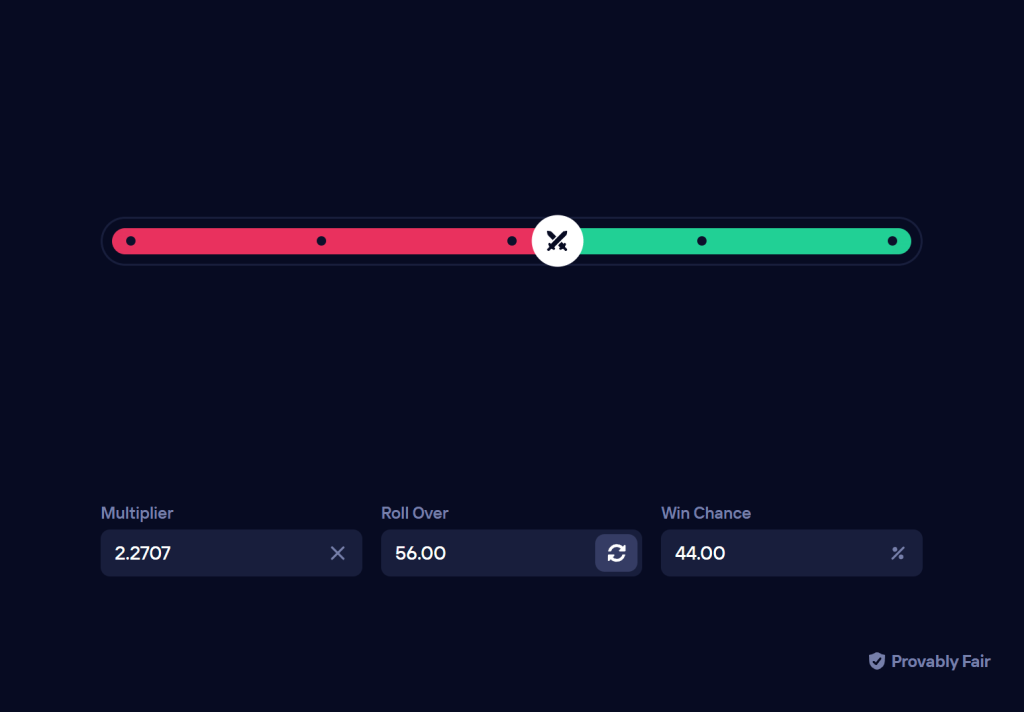
Instead of standard 1.00% to 4.00% casino house margins, compare with mathematically verified 100% RTP Originals (0.00% House Edge) on Duel Casino:
A large number of operations called Polygon casinos use Polygon only as a payment rail. The game itself runs on an ordinary server, and the ledger that changes after each bet is a SQL database. In that design, the blockchain records deposits and withdrawals but not bets. The transaction proves that money arrived; it does not prove that the casino’s internal balance was updated, nor that the stated RTP was obeyed.
| Property | On-chain game contract | Off-chain casino database |
|---|---|---|
| Bet result visible to the public | Yes, if contract source is verified | No |
| Provable fairness still possible | Yes | Yes, but not from the chain |
| RTP verification | From paytable and contract code | From paytable only |
| Operator can alter a historical bet record | Not without a reorg | Yes, because the database is under its control |
If the casino deploys a game contract, check whether the source code is verified on Polygonscan. An unverified contract is a black box; event logs may tell you something, but they do not replace source code. If no contract is deployed, treat the game as proprietary and base your assessment on the published algorithm and paytable.
Provably Fair on Polygon: What Exactly to Verify
The standard Polygon-friendly provably fair scheme uses a server seed, a client seed, a nonce, and a hash commitment. The server seed is hashed and published before the player chooses a client seed. After the bet, the operator reveals the server seed. The player can then recompute the outcome locally. The exact algorithm should be documented in provably fair verification guides. You should verify the following in this order:
- The algorithm is deterministic and unique to the game. If there are multiple versions, use the one referenced by the game ID or seed rotation.
- The server seed hash is timestamped before your client seed. A Polygon transaction can serve as a timestamp for that hash, but the key property is the order in time.
- The outcome calculated by the algorithm maps to the same final number shown by the casino. Check more than one result, including a losing result.
- The RTP in the paytable matches the payout multipliers. For a unit bet, if an outcome with probability p pays a total return of r, the contribution to expected return is p multiplied by r. Sum those contributions over all outcomes; the house edge is one minus that sum. If the claimed RTP is 98%, the expected return calculation should match to within rounding.
None of this is made true by Polygon. The network gives you a cheap and persistent place to anchor a hash or finalise a result, but the mathematics of the game is designed by the operator.
The Trade-Offs of Low-Fee Gambling
1. Low friction can increase total amount wagered
A transaction fee is not usually what creates the house edge, so removing it does not create an edge. If low fees cause a player to place ten times as many bets, the expected loss also multiplies by ten, because expected loss equals total amount wagered multiplied by house edge. This is the central negative trade-off of low-fee gambling: the operator lowers the cost of continued play as much as the player’s cost of gambling.
2. Bridge finality and settlement risk
Moving funds from Ethereum to Polygon requires a bridge. The bridge has its own contract, fee, claim period, and failure modes. Withdrawing from Polygon back to Ethereum can be slow and more expensive than the Polygon side transaction. If a casino offers a withdrawal and says it was sent, ask for the exact transaction hash. If the withdrawal is carried out through a bridge, the bridge receipt is the evidence, not the casino’s internal message. The low fee applies to the Polygon leg, not to the Ethereum leg.
3. On-chain settlement does not make an operator solvent
You can verify that a casino wallet is able to pay out from public account balances, but solvency also depends on liabilities and outstanding player balances. A single address can hold large token balances and still fail to honour withdrawals if the internal ledger reports larger liabilities. Proof-of-solvency would require a signed commitment of liabilities, not just a hot wallet balance. When an operator does not provide that, an independent casino review is a useful supplement, but it cannot replace direct verification.
4. Bankroll management still decides survival
Low fees do not change variance. Stake sizing should be based on the losing-run distribution of the specific game, not on the cost of the next transaction. A sensible approach is to keep gambling funds in a separate wallet, define a session loss limit before opening the game, and use a staking rule that survives the worst observed run. The bankroll management guide covers those calculations. The guide is more relevant on a low-fee network than on an expensive one, because the chain will not stop you from continuing to play.
FAQ
Is a casino on Polygon provably fair by default?
No. The low network fee only proves that a transfer happened. Provable fairness requires a deterministic algorithm, a committed server seed, a user-chosen client seed, and a disclosed paytable. If those elements are verifiable, you can reproduce results. A transaction hash alone proves nothing about outcome logic.
What actually is the fee for a Polygon casino transaction?
For a native POL or bridged stablecoin transfer on Polygon PoS, the transaction fee is commonly below one US cent in 2026. Check the fee field in the transaction receipt. If a bridge is involved, the total cost includes the Ethereum L1 fee and bridge fee, so it may be much larger. Any separate deduction by the casino is an operator fee and should be stated independently.
Can a Polygon casino reverse a withdrawal?
A normal Polygon token transfer cannot be reversed after finalization under normal consensus operation. But a withdrawal instruction inside the casino’s internal database can be cancelled before the operator broadcasts a transaction. The safe test is to look up the casino’s wallet address on a public explorer and wait for the transaction to confirm. Until the transaction appears, the withdrawal is only a promise.