Plinko Risk Levels Compared: Low vs High Variance Math

the author
ProvablySmart Research Desk
date post
Aug 28, 2026

Share


Plinko is a staple of provably fair crypto casinos. The game’s central variable is the risk level, which determines the distribution of multipliers. While the return-to-player (RTP) is typically fixed for a given number of rows, the variance—and thus the probability of large wins or rapid losses—changes dramatically. This article provides a mathematical comparison of low and high risk Plinko, focusing on what the player can verify independently.
Risk Level Mechanics in Provably Fair Plinko
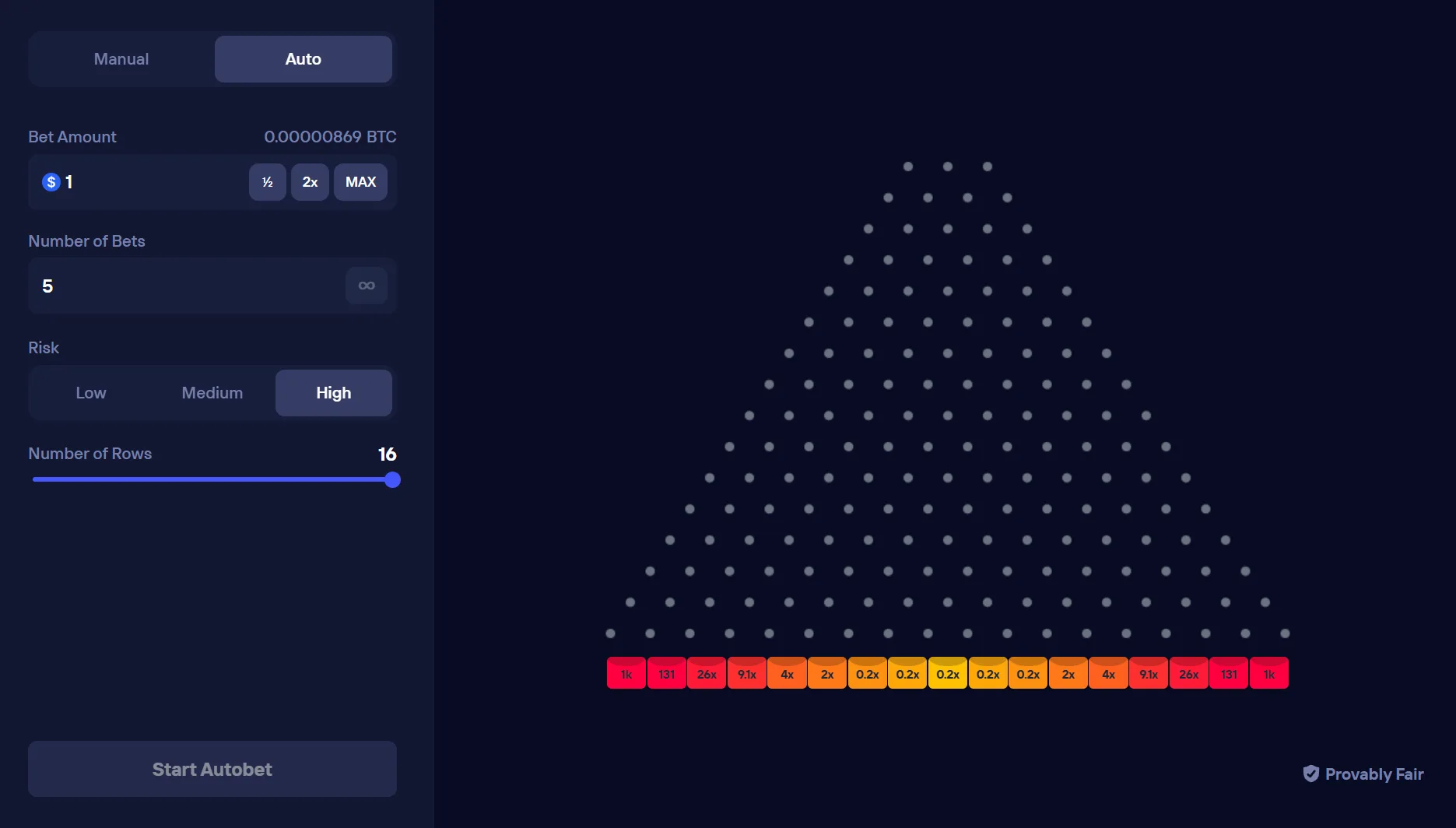
In a standard implementation, Plinko uses a triangular grid of pins (rows). The ball bounces left or right at each pin, following a deterministic path generated from a seed. The final bucket determines the multiplier. The risk level is a preset configuration that assigns different multipliers to each bucket. Operators typically offer 3–5 risk levels, from “low” to “high.”
The table below shows a plausible set of multipliers for a 16-row game. Note that these are illustrative; each casino publishes its own payout table. The reader should verify the exact values on the casino’s provably fair documentation.
| Risk Level | Multiplier Range | Number of Buckets |
|---|---|---|
| Low | 0.1x – 10x | 17 |
| Medium | 0.1x – 50x | 17 |
| High | 0x – 1000x | 17 |
Low risk multipliers are tightly clustered around 1x, with a maximum of 10x. High risk includes a zero bucket (ball lands in a bucket that pays 0x) and a very high multiplier (1000x) at the edges. The exact distribution is determined by the binomial path probabilities. For 16 rows, the probability of landing in the center bucket is C(16,8) / 2^16 ≈ 19.6%, while the edge bucket probability is 1/2^16 ≈ 0.0015%.
Mathematical Variance Comparison
How Does This Compare to 0% House Edge Protocols?
Audited 100% RTP
Instead of standard 1.00% to 4.00% casino house margins, compare with mathematically verified 100% RTP Originals (0.00% House Edge) on Duel Casino:

Expected Value and RTP
Let’s assume both risk levels have an RTP of 97% (i.e., expected value = 0.97 per unit bet). The multipliers are scaled so that the weighted average equals 0.97. For low risk, the multipliers are within a narrow band; for high risk, the zero bucket and the large multiplier compensate each other to keep the mean constant.
For a 16-row low risk table, suppose the multipliers are:
- Center bucket: 1.0x
- Adjacent buckets: 0.5x, 2.0x
- Outer buckets: 0.2x, 5.0x
- Edge buckets: 0.1x, 10x
The weighted sum (with binomial probabilities) yields 0.97. For high risk, a typical table might have:
- Center bucket: 0.1x
- Adjacent: 0.2x, 0.5x
- …
- Edge buckets: 0x, 1000x
Again, the expected value remains 0.97.
Variance and Standard Deviation
Variance is the average squared deviation from the mean. For a discrete random variable X with outcomes x_i and probabilities p_i, Var(X) = Σ p_i (x_i – μ)², where μ = 0.97. The standard deviation is the square root of variance.
Using the illustrative tables, we can compute approximate values:
- Low risk: Variance ≈ 2.1, Standard deviation ≈ 1.45
- High risk: Variance ≈ 4500, Standard deviation ≈ 67.1
The high risk variance is over 2000 times larger. This means that while the average return per bet is the same, individual outcomes oscillate wildly. For a bet of 1 unit, a low risk player rarely sees a multiplier below 0.1x or above 10x. A high risk player can lose 100% of bets (zero bucket) or win 1000x, but the probability of the 1000x is only 0.0015% (1 in 65,536).
These numbers are calculated from the binomial distribution and the assigned multipliers. The reader can replicate the calculation using the casino’s published payout table and the known probability of each path. The seeds used are irrelevant for variance; the distribution is fixed by the pin count and risk level.
Implications for Bankroll Management
Variance directly affects the risk of ruin. If a player bets a fixed fraction of their bankroll per round, the probability of losing the entire bankroll over a given number of rounds depends on the variance. For low risk, the bankroll declines slowly with small fluctuations. For high risk, a single loss can be near-total (if the ball lands in a zero bucket) or a single win can multiply the bankroll substantially.
Consider a player with a bankroll of 1000 units who bets 1 unit per round. After 1000 rounds, the expected outcome is a loss of 30 units (3% house edge). Under low risk, the actual result is likely between -150 and +90 units (roughly 95% confidence interval). Under high risk, the confidence interval spans from -1000 to +several thousand units, because the 1000x win can occur, but so can many zero-drops.
For a player aiming to maximize the probability of a given profit target, low risk is more predictable. For a player willing to accept a high probability of total loss in exchange for a tiny chance of a massive win, high risk is more suitable. The mathematical expectation does not change, but the utility of outcomes differs. See our bankroll management guide for strategies tailored to variance.
Verifiability – How to Check the Math
In a provably fair system, the ball’s path is determined by a seed that the player can verify. The casino publishes a server seed hash, the client seed is chosen by the player, and each round uses a nonce. The SHA256 hash of these three inputs is used to generate a sequence of left/right decisions. The player can compute the hash themselves and confirm that the path matches the final bucket.
However, the variance analysis above does not depend on the seed. The payout table is a static configuration. The player should verify that the casino’s stated payout table matches the actual multipliers paid. This can be done by examining the game’s source code or by asking the casino for the exact table. Most provably fair casinos document the payout table in their provably fair guides.
Because the RTP is fixed, the risk level merely redistributes the probabilities. There is no hidden edge; the house edge is the same across risk levels. The only difference is the shape of the distribution. The player can confirm this by computing the expected value for each risk level using the published multipliers and the binomial probabilities.
FAQ
Does risk level affect the RTP of Plinko?
No. For a given number of rows, the RTP (return-to-player) is typically identical across all risk levels. The multipliers are scaled so that the weighted average remains constant. The risk level only changes the variance, not the house edge. Always verify the published payout table to confirm that the sum of probability-weighted multipliers equals the claimed RTP.
Which risk level has the highest chance of a profit?
Low risk has the highest probability of returning more than 1x per bet, because the distribution is concentrated near the center where multipliers are just above 1x. However, the magnitude of profit is small. High risk has a very low probability of profit (most bets lose), but the rare large win can be substantial. The expected value is the same, so the chance of being ahead after many bets approaches 50% for low risk but remains near 0% for high risk due to the zero bucket and high variance.
How can I verify the payout table for a Plinko game?
Check the casino’s provably fair documentation or the game’s HTML source code. Most reputable casinos publish the full list of multipliers for each risk level. You can also simulate the game offline using the binomial distribution to compute the expected value. If the RTP matches the casino’s claim, the payout table is consistent. For seed-related verification, refer to the casino’s provably fair implementation guide.