Phishing and Casino Clones: A 60-Second Domain Check

the author
ProvablySmart Research Desk
date post
Aug 28, 2026
Share


Phishing against crypto casino players does not require breaking cryptography. It requires a one-line URL error by a user who is looking at a convincing clone. The cloned site copies the interface—logos, game layout, live chat, terms pages—but it cannot legally use the same registrable domain as the operator. The domain is the only object that connects the browser to the actual server and to the operator’s published seed hashes. In 2026, the browser still provides no built-in semantic warning for a domain that visually resembles another. The check below is not a security audit; it is a 60-second sanity check to run before typing a password or connecting a wallet.
The attack surface: a domain, not a page
Casino clones are not technical attacks against TLS or provably fair algorithms. They are impersonation attacks against the player’s attention. A clone operator registers a domain that looks similar to the official one and puts a copied or scraped version of the official website on it. The player logs in or deposits and the attacker collects the credentials. The same clone can display seed hashes copied from the official site. That is why checking the seed hash alone is not enough; you must first confirm that the domain is the real domain.
Visual lookalikes become harder to spot when the domain contains non-ASCII characters. A Latin ‘a’ and a Cyrillic ‘a’ are rendered similarly in many fonts. A domain such as yourcasino.com can be changed to yourcаsino.com using a Cyrillic character. The address bar may show the Unicode form, while the certificate viewer will show the punycode form starting with xn--. This is one more reason to compare the exact hostname against a verified source, not just a mental memory of the brand.
The 60-second domain check
How Does This Compare to 0% House Edge Protocols?
Audited 100% RTP
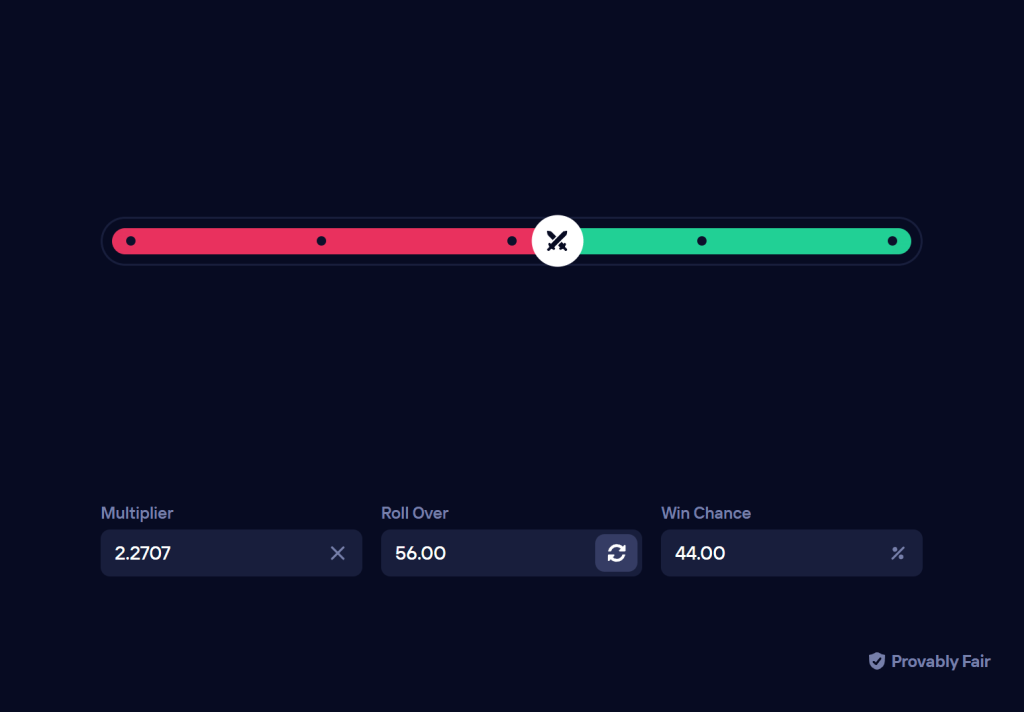
Instead of standard 1.00% to 4.00% casino house margins, compare with mathematically verified 100% RTP Originals (0.00% House Edge) on Duel Casino:
Step 1 — Compare the registrable domain with a verified source
Open the operator’s official URL from a page you have bookmarked, or from our casino reviews. Do not use a search engine result labeled as sponsored. For a normal .com site, the registrable domain is the last two labels: yourcasino.com. A page at login.yourcasino.com uses the same registrable domain, so it is not automatically a clone. The warning signs are yourcasino-login.com, yourcasino.xyz, yourcasino.com.ph, or any other string before the verified second-level domain.
Step 2 — Read the certificate name
Click the encryption symbol in the address bar, open the certificate viewer, and inspect the Subject Alternative Name. It lists the hostname for which the certificate is valid. If the value is a punycode string such as xn--yourc-somecode.com, compare it with the letters you see in the address bar. The certificate name is the authoritative machine-readable hostname and is harder for an attacker to disguise than the rendered page text.
Step 3 — Look up the registration date via RDAP / WHOIS
Run a lookup for the exact registrable domain. RDAP responses include the creation date, registrar, and name servers. Many clone domains are registered only a few days or weeks before the phishing push. A creation date that is recent is a red flag, but not a verdict. Some licensed casinos are launched in 2026 with new domains. Use the date as one input, not as proof by itself.
Step 4 — Search certificate transparency logs
Every publicly trusted TLS certificate must be logged in a certificate transparency log. You can search these logs by hostname using public tools. Check when the first certificate was issued for the suspicious domain and whether the certificate is part of a batch of similar-looking casino names. If the domain was created and certified within the same week, the infrastructure is new and deserves extra verification before you enter anything.
Step 5 — Repeat the check with your password manager
Password managers and hardware wallets are designed around exact origin matching. If you store the official login URL in a password manager, it autofills only on the exact registrable domain, and it will refuse to autofill on a visually identical clone. If you do not use one, store the official URL in a secure note and copy it manually. This adds another layer between the attacker’s domain and your credentials.
What the check does not prove
The 60-second domain check only reduces the risk that you are speaking to an impersonator. It cannot prove the operator is trustworthy, solvent, or fair. A legitimate-looking domain can still have manipulated game outcomes, unclear terms, or hidden withdrawal restrictions. The table below summarises the value and limits of each check.
| Check | What it shows | What it cannot show |
|---|---|---|
| Domain match | The page is on the same registrable domain as the verified source | Server-side logic or operator solvency |
| TLS certificate | Encrypted connection to the exact hostname | Operator identity or fairness of games |
| WHOIS age | Whether the domain is newly registered | Whether the operator is legitimate |
| Punycode inspection | Confuses IDN homograph attacks | All visual lookalikes are ASCII and remain visible |
After the domain check: verify the provably fair layer
When the domain matches, continue with the verification process described in the operator’s provably fair documentation. The protocol differs by casino, but the same principle applies: the hash of the current server seed should be public before you place bets, and the revealed seed should hash to that value after each changed seed. Cloning a static page is easy; changing the official published hash on the official domain is not. For step-by-step methods, see our provably fair guides.
You should also be aware of the overall landscape of known phishing domains. Our news section reports on large-scale clone campaigns and domain-based attacks. It is the fastest way to see whether a URL has already been reported by other players.
Finally, the domain check is not a substitute for position sizing. A clean domain reduces the risk of losing credentials to a clone, but not the risk of losing money through volatility or bad luck. Pair this technical hygiene with an explicit betting budget, as outlined in our bankroll management guide.
FAQ
Can a cloned casino site show a valid HTTPS padlock?
Yes. TLS certificates prove that the server controls the private key for an exact hostname. A clone registers its own domain and obtains a certificate for it; the browser then shows the normal lock icon. The padlock only confirms encryption, not identity. Open the certificate viewer and compare the Subject Alternative Name against the verified registrable domain.
What should I do if I already typed credentials into a clone?
Assume the password is compromised. Change the casino password and every other account using the same or similar password. Enable two-factor authentication where available and contact the official support channel from the verified domain, not from the clone page. If the casino has a built-in withdrawal address whitelist, check it immediately. Time is the main variable in this situation.
Is a recently registered domain proof of a phishing site?
No. A legitimate casino can launch in 2026 with a new domain. Registration age is only a red flag when combined with an unexpected URL, an unsolicited message, or a mismatch against an independent review source. Use WHOIS as one indicator in the broader check, not as a standalone verdict.