Originals Games Ranked by House Edge: Dice to Plinko

the author
ProvablySmart Research Desk
date post
Aug 28, 2026
Share


House edge is the structural reason a casino wins in the long run. For provably fair originals, it is also the easiest number to verify: if you know the win probability and the payout multiplier, the edge is simple arithmetic. The ranking below starts with Dice at the strict 1% baseline and ends with Plinko, where effective edge can drift upward after multipliers are rounded. Operator-specific settings vary, so treat the ordering as logic, not as a statement about every casino.
Computing the edge yourself
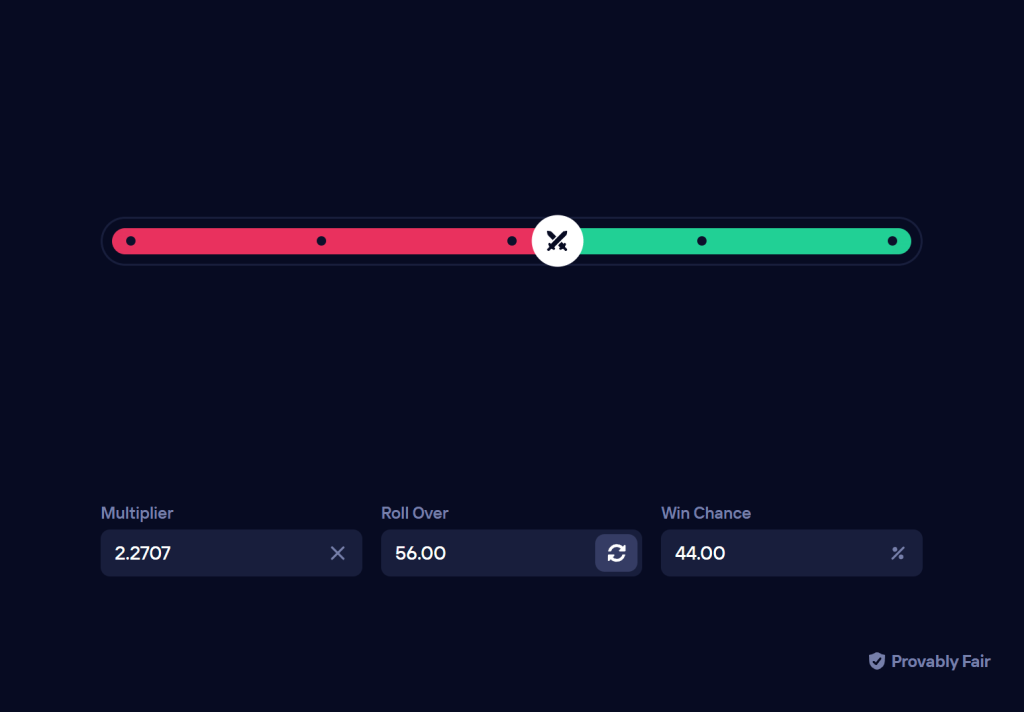
For a single bet, expected payout = probability x multiplier x stake, so house edge = 1 – (expected payout / stake). The equivalent form is 1 – (p x m).
Check this against your client: if p=0.495 and m=2.0, expected payout is 0.99 units per unit staked, which is a 1% edge. For multi-step games such as Mines, sum the probability-weighted payouts across all terminal states before applying the formula.
Baseline ranking
How Does This Compare to 0% House Edge Protocols?
Audited 100% RTP
Instead of standard 1.00% to 4.00% casino house margins, compare with mathematically verified 100% RTP Originals (0.00% House Edge) on Duel Casino:
| Game | Baseline edge | What moves it |
|---|---|---|
| Dice | 1.00% | Single multiplier derived directly from p and edge; minimal rounding unless the client truncates m. |
| Limbo | 1.00% | Same inverse probability model; edge stays 1% as target multiplier increases. |
| Mines | 1.00% per round | Multiplier ladder compensates each revealed tile; edge is at round level, not per tile. |
| Keno | 1.00% to 4.00% | Payout tables are often rounded; each chosen-number count may have a different edge. |
| Plinko | 1.00% to 2.00%+ | Row payout bins are rounded for display; effective edge per row depends on actual multipliers. |
Dice and Limbo: the clean 1% pair
Dice is the easiest original to audit. In many clients, the multiplier is set as 0.99 / p, and p is derived from one random number. Verify by running the seed pair through the published algorithm and checking the multiplier. Limbo uses the same 1% math but reads the generated number until it crosses the target multiplier; the house edge remains 1% with the same inverse relationship.
Mines: the edge is per round, not per tile
Mines has a payout ladder based on the number of mines and the number of tiles selected. The advertised edge is per game round, so do not multiply it by the number of tiles placed. Check the ladder for your mine count, compute combinations, multiply each potential payout by its probability, and compare the sum with the stake. Common default values sit near 1%, but the exact number depends on the payout file delivered by the operator.
Keno and Plinko: rounding can move the number
Keno payouts are often rounded to integers. With a 1% base target, small probabilities are the most sensitive to rounding. For each pick count, use the actual multiplier displayed rather than the intended formula. One pick can be close to the baseline while a five-pick table drifts higher or lower.
Plinko has a longer list of payout bins per row. The intended edge may be 1%, but each bin multiplier is limited to fixed decimals. A 1% nominal target becomes a different actual edge per bin. Sum the probability of each pin position multiplied by the actual multiplier. If that sum is below 0.99, that row edge is above 1%. This is the main reason Plinko can be ranked at the higher end of the practical house-edge scale.
What to check before relying on an advertised edge
- Calculate p x m for every outcome. If the product is not constant across the payout table, the advertised edge is only an average.
- Record the server seed hash before betting and the revealed seed after the round. If the result does not map to a payout in the table, the client is not provably fair.
- If the operator posts transactions on-chain, compare the transaction hash with the bet result. This gives the same verification path as the seed check but with a public timestamp.
- For Keno and Plinko, save the payout table for the exact row or risk level before increasing stake. If the table changes between rounds, treat that as a red flag.
The calculation style is the same for every provably fair game: reproduce the result, map it to a payout, then compute expected value. Configuration files and screenshots are available in our casino reviews, and the extended examples live in our provably fair guides.
Bankroll consequences of a 1% versus a 2% edge
A 1% house edge means the expected loss per 100 units wagered is 1 unit. A Plinko row with effective 1.7% edge costs 1.7 units per 100 wagered. This difference is small in one session but deterministic in expectation. If your bankroll model assumes 1% and you spend hours on a high-risk Plinko row, the actual cost is higher. Use a method that accounts for the game-specific edge, not the lobby average; see bankroll management for variance and risk-of-ruin tables.
FAQ
Can I verify the house edge of an original game from the provably fair result?
Yes, in principle. The seed pair determines the random number; the client maps that number to an outcome and a multiplier. Reproduce that mapping, compute expected payout over all outcomes, and compare with the stake. If the computation does not match the advertised edge, the client or the payout table is wrong.
Why is Plinko’s house edge sometimes higher than advertised?
Because the advertised edge is calculated before multiplier rounding. Each row has a set of payout multipliers, and the actual product of outcome probability and multiplier is not exactly 0.99 for every bin. You need to sum over all bins in that row to get the true edge.
Is a lower house edge always the right choice?
For a fixed total wager, a lower edge reduces expected cost. But short-term variance can still produce a losing session at 1%, and a 2% game can still profit on a lucky run. The edge determines expected value, not the range of possible session outcomes.