Mines Verification: Why Tile Count Changes the Entire Calculation

the author
ProvablySmart Research Desk
date post
Aug 28, 2026
Share


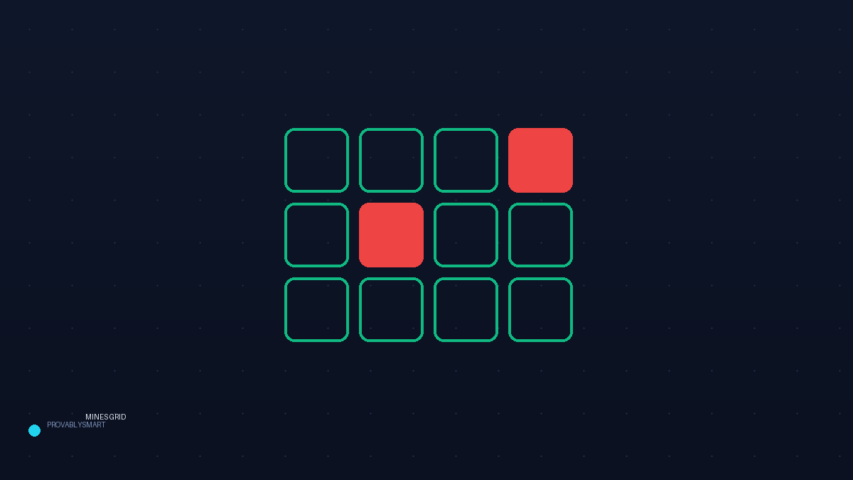
In the casino game Mines, the grid size — the number of tiles on the board — is often treated as a display option. In verification terms, it is not. The tile count, usually written as N, is a first-class input to the provably fair algorithm. Change N from 25 to 49, and the same seed pair, nonce, and mine count will produce a different mine layout and a different payout curve. This article explains why tile count is part of the calculation, and how you can verify it yourself.
Tile count as a verification parameter
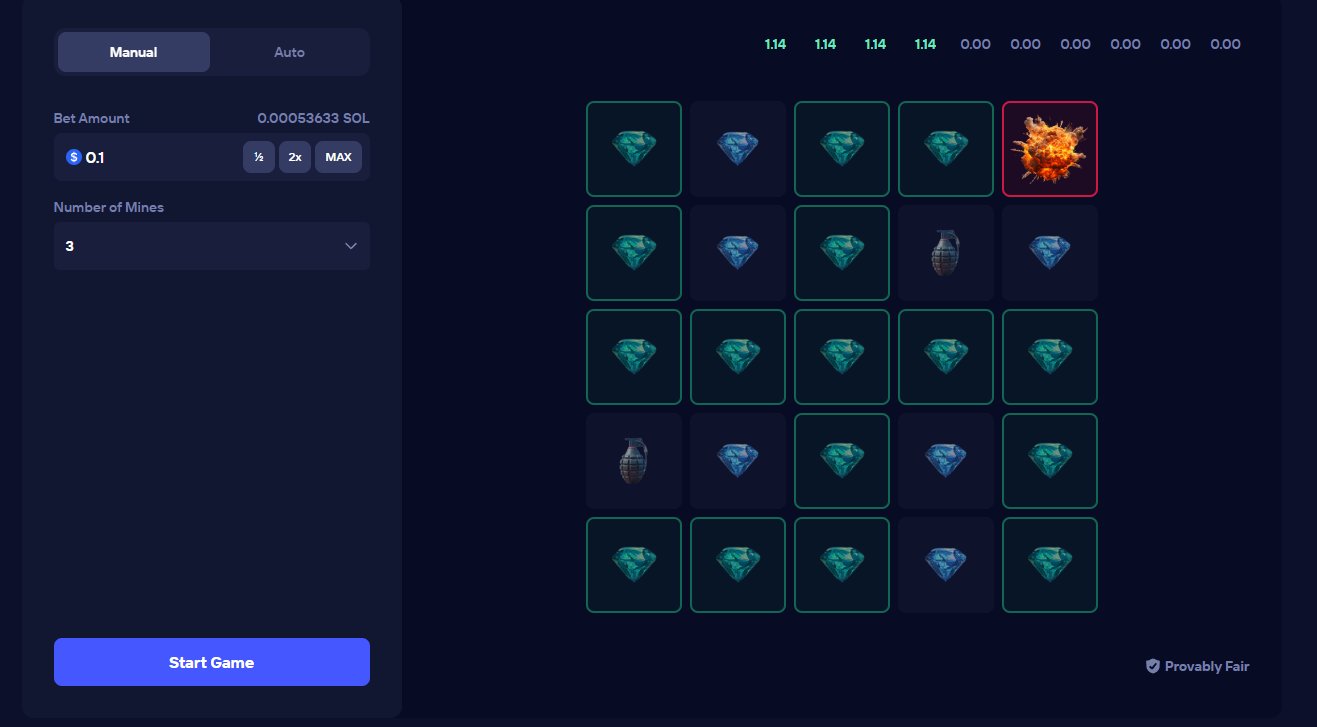
A standard Mines round has four replay inputs: server seed, client seed, nonce, and game id. The casino hashes these inputs to generate an index stream. That stream is then consumed to choose mine positions. The consumption logic depends on two numbers: total tiles N and mines K. N is not derived from the hash; it is a rule parameter supplied by the game engine. If you verify with the wrong N, you will not reproduce the observed mines.
For a grid, N is the product of rows and columns. A 5×5 board has N = 25; a 7×7 board has N = 49. The number of ways to place K mines is the binomial coefficient C(N, K). That number determines how many hash bits are theoretically needed, and it sets the probability of each pick. Both of those depend heavily on N.
How the hash becomes a mine pattern
How Does This Compare to 0% House Edge Protocols?
Audited 100% RTP
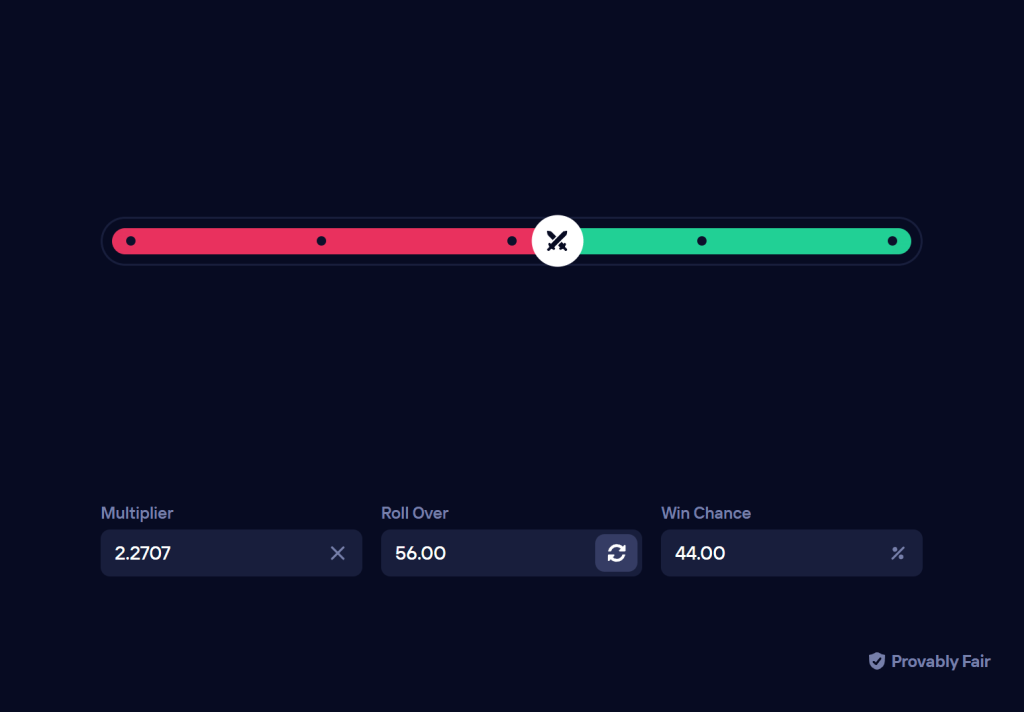
Instead of standard 1.00% to 4.00% casino house margins, compare with mathematically verified 100% RTP Originals (0.00% House Edge) on Duel Casino:
Most modern Mines implementations use an HMAC-SHA256 or SHA-256 construction over a string such as:
server_seed + ':' + client_seed + ':' + nonce + ':' + game_idThe resulting hex string is consumed sequentially. The common technique is to take bytes, map each to an integer, and select an index from the remaining free tile positions. When the byte value is too large, the algorithm uses rejection sampling to avoid modulo bias. The cutoff value is floor(256 / r) * r, where r is the number of remaining tiles. That never changes. However, the required number of bytes and the cutoff both change with r, and r is initialized to N. Therefore, the hash consumption differs for different N.
Concretely, when N = 25, the first draw has 25 candidates, so a single byte is enough for the mapping after rejection. When N = 49, you still need one byte, but the rejection threshold changes. At later picks, when only a handful of tiles remain, the algorithm may skip bytes that fall outside the acceptable range. These skips do not produce a visible output, but they shift the position in the hash stream. Two boards with different N values will never consume the hash stream identically.
Why N changes the result: a concrete example
To make the effect observable, use a small grid. Suppose N = 3, K = 1. The mine is placed at one of three positions: 0, 1, or 2. If the hash byte is 0x00 or 0x01, you get position 0 or 1. If the byte is 0xFF, the algorithm may reject and move to the next byte. Now set N = 4, K = 1. The same hash byte 0xFF maps differently, because the modulo base is 4 and the rejection threshold is different. You can experiment with any hex string: the output positions rarely match across N values.
This is not a bug. It is the intended design. The verifier must receive N as an explicit input, just like the mine count and the seeds. If a casino silently changes the default grid size, any previously archived verification result becomes meaningless unless the grid size was recorded.
Tile count and the mathematical expectation
The tile count also changes the probability of each safe pick. After i safe tiles have been revealed, with K mines remaining hidden, the probability the next pick is safe is:
(N - i - K) / (N - i)For a fixed K, a smaller N reduces the numerator and denominator differently. Consider K = 3. On the first pick:
N = 25: (25 – 0 – 3)/25 = 22/25 = 88.0%N = 49: (49 – 0 – 3)/49 = 46/49 = 93.9%
The same mine count is much safer on a larger board. Therefore, a payout table that is fair for N = 25 is generous or unacceptable for N = 49, depending on the multiplier. In a well-designed game, the payout multipliers are recalculated from the conditional probabilities using the current N and K. When you verify a round, check that the displayed multiplier matches the theoretical multiplier for that board size.
House edge is not determined by N alone. It is the difference between 1 and the RTP, where RTP is the sum over all cash-out paths of probability × payout. Since changing N changes all path probabilities, the casino must recompute payouts. If they do, the house edge can stay constant. If they do not, the edge drifts. The verification script should therefore compute the expected value from the actual payout table, not from a static number.
Common verification failures
When manual verification fails, the error is frequently not the hash function. It is one of these:
- Hard-coding
N = 25when the round was played on a 49-tile board. - Using
Nequal to the number of revealed tiles instead of the full grid size. - Swapping client and server seed order, or omitting the separating colon.
- Using the previous nonce instead of the round-specific nonce.
- Ignoring rejection bytes, which causes the index stream to desynchronize.
All of these are easy to check if the casino publishes the full replay string format. As of 2026, most reputable operators include a “Verify” button that should accept grid size as an input. If the tool does not, you can still reconstruct the mapping by reading the game logic in the site’s provably fair documentation.
Practical verification checklist
- Record the server seed, client seed, nonce, game id, grid size, mine count, and final cash-out multiplier.
- Recompute the hash exactly as documented by the operator.
- Generate mine positions using the documented rejection logic and the recorded
N. - Compare the generated mine positions with the ones revealed at the end of the round.
- Verify that the multiplier is the one implied by the conditional safe-pick probabilities.
We covered this technique in more detail in our provably fair verification guides. For casino-by-casino checks, such as whether a standalone verifier is published, see our casino reviews. If you are an active player, the practical consequence of tile count matters more than most players realize: playing the same mine count on different grid sizes changes volatility, and it should change your stake sizing. The math behind that is in bankroll management.
Conclusion
Tile count is not a decoration. It defines the size of the probability space, drives the hash consumption algorithm, and determines the payout schedule. Every verification tool and every archived round record should include N. When you test a casino’s Mines game, deliberately run a round on a non-default grid size and check whether the verifier accepts that board size as a separate input. A casino that hard-codes a single grid size in its verification page is not giving you full transparency. The correction is simple: treat N as part of the round data and re-run the calculation from that value.
FAQ
Does tile count change the house edge?
No, not by itself. The house edge is set by the payout table relative to the probabilities. When tile count changes, the probabilities change, so payouts must be recalculated. If the operator updates payouts correctly, the house edge can be preserved.
Why do I get different mine positions for the same seed and nonce?
Because the mine-placement algorithm uses tile count in its mapping and rejection logic. Different N values result in different output positions even when the hash input is identical.
Can I verify a Mines round without the casino’s verifier?
Yes, if the operator publishes the seed pair, nonce, game id, hash function, and mapping rules. You can replicate the process in a short script. The tile count must be one of the inputs, otherwise the output will not match.